
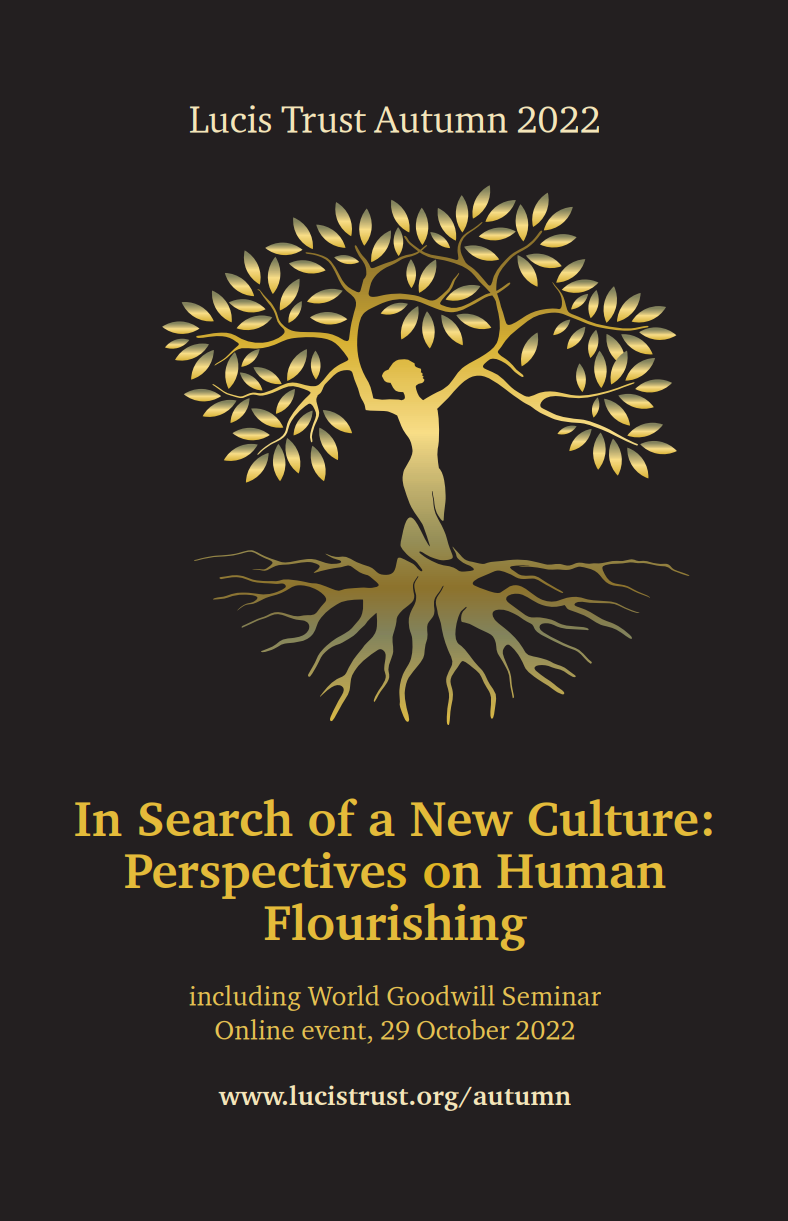
In Search of a New Culture: Perspectives on Human Flourishing
|
Dear co-worker,
‘Culture’ is a word that has its metaphorical roots in the plant kingdom – from the Latin cultura: “the tilling of land, act of preparing the earth for crops, a cultivating agriculture”.1 It was the ancient Roman orator Cicero who first used the term as an agricultural metaphor to describe a cultivation of the soul or “cultura animi”. Cicero’s works rank among the most influential in global culture – the central idea being the cultivation of a ‘philosophical soul’ as the highest possible ideal for human development.
This original meaning of culture surely merits attention in the context of our market-driven era in which the predominant culture is entertainment. The concern is that the vast majority of popular culture, television, movies, advertising and most importantly, news and politics, are filtered through the interests of powerful media conglomerates. Signs of this trend were addressed with considerable prescience back in the 1940’s by critical theorists, Theodor Adorno and Max Horkheimer, who described the standardized, commercial production and marketing of culture in capitalist societies as the ‘culture industry’.
In their book, Dialectic of Enlightenment, Adorno and Horkheimer critiqued the culture industry as a means of psychosocial control dictating taste and opinion, stunting the mass-media consumer’s power of imagination, and insidiously turning the thinking, discerning subject into the unthinking, passive consumer. They highlighted the problems associated with any system that “integrates its consumers from above”, be it totalitarianism or monopoly capitalism, arguing that “in attempting to realise enlightenment values of reason and order, the holistic power of the individual is undermined”.2 Their analysis doesn’t suggest that all products of this system are inherently inferior, but that “they have replaced other forms of entertainment without properly fulfilling the important roles played by the now-defunct sources of culture”.3
Whether or not we agree with this analysis, through an esoteric lens, we will see the forces of standardization at work in many areas as well as culture. And this is all part of humanity’s reaction to one of the great seven rays of life – the Seventh Ray of Ceremony and Order – that is steadily gaining in strength and prominence. This energy “imposes certain rhythms upon humanity”, its prime cosmic function being “to perform the magical work of blending spirit and matter in order to produce the manifested form through which the life will reveal the glory of God”. However, it will take time for humanity to learn how to cooperate in this great purpose wisely and skillfully.
In the Alice Bailey writings, we read:
… of these rhythms, the present great experiments in national standardization and regimentation are … an expression, as they demonstrate through the masses in any nation.… The new era is however upon its way, and nothing can prevent that which the stars decree and which the Hierarchy of guiding Minds consequently foresee. The new executives who will succeed the present dictators and powers will take over the control towards the year 1955, and they will be seventh ray aspirants and disciples in the majority of cases; their capacity towards integration and towards fusion along right lines will then rapidly bring about the needed international understanding …
… though the fulfillment of the prophecy is inevitable, yet the time factor may not work out as indicated. This will be because the distressed human mechanisms of those to whom the work is given will fail to react either correctly or at the right time. These incoming seventh ray aspirants and disciples may make mistakes and may perform their undertakings in such a manner that delay may eventuate.4
Despite initial progress after 1955, an economic form of globalization began in the 1980’s that doesn’t comply with the spiritual demand of “rebuilding the shrine of human living” and “redistributing the world’s resources in conformity to divine purpose”. The possible delay that was cited has occurred and the development of Cicero’s vision of the “philosophical soul” has been sidetracked. For our encouragement though, the Alice Bailey writings go on to say that the margin of difference in the timescale of implementation will only be “between one hundred and three hundred years”, and in the meantime:
Much of the success in the coming momentous years is dependent upon the work done by all who may be affiliated (even slightly) with the New Group of World Servers. If public opinion is educated in the new ideals, the momentum of that growing tide will greatly facilitate the work of these seventh ray executives, and in some cases will constitute for them the line of least resistance …5
The New Group of World Servers is presently expanding in size and influence with a multitude of creative ideas to meet today’s challenges, and there are many signs that a realignment with the Divine Plan is currently taking place in the many initiatives that are exploring how a new type of culture can take root around the world. Nowhere is this more important than in the philosophy of education – for the way we educate influences thought, perception, desire, and action in all areas of human enterprise. Of real significance here is UNESCO’s worldwide initiative – Futures of Education: Learning to Become -->. This new goal for education has been described as “global citizenship for human flourishing”,6 and the spirit of this ideal permeates the landmark report that has now been published: Reimagining our futures together: a new social contract for education -->. The report served as the key reference document for the recent United Nations summit: Transforming Education -->.
This concept of human flourishing is now engaging the minds of many enlightened thinkers, and it blends perfectly with Cicero’s use of the term ‘culture’, for flourishing also has its metaphorical roots in the plant kingdom – from the Latin florere “to bloom, blossom, flower”. The Global Flourishing Study --> is an inspiring example of such thinking – a $43 million initiative that runs across 22 countries examining what it means to flourish, and the factors that give rise to it – including the role that religion plays. Another initiative – The Humanities and Human Flourishing Project --> – is an interdisciplinary collaboration with leading researchers around the world, investigating the connection between the arts and humanities and wellbeing. The Project Director, James Pawelski, explains that questions on ‘the Good Life’ and how we flourish were traditionally asked in the context of philosophy, literature, theatre and art; but nowadays:
“the strategic approach to these questions is led more in the social sciences … the social sciences like to measure things … the arts and humanities tend to be interested in meaning … so by collaborating together, hopefully we’ll be able to find out how to measure more and more meaningful things”.7
The concept of flourishing is credited to Dr. Martin Seligman, who used his inaugural address as the incoming president of the American Psychological Association in 1998 to shift the focus from mental illness and pathology to studying what is good and positive in life. The theme of his presidency marked the beginning of a new domain in psychology known as Positive Psychology – an approach that builds on the work of pioneers in Humanistic Psychology such as Abraham Maslow. However, even in Ancient Greece, Aristotle promoted the concept of eudaimonia8 – “the condition of human flourishing or of living well”. The term is often misinterpreted as happiness, but it has little to do with a pleasant state of mind and emotions. It is more accurately defined as the “activity of the soul in accordance with ‘perfect’ or ‘complete’ virtue” or “activity in accordance with reason, man’s highest function”.9
Central to the concept of human flourishing is the need for humanity to move towards more meaningful types of creativity to ensure that the vast diversity of qualities and potencies of the Divine Plan seeking expression through human consciousness is realised. This brings us back to the qualitative difference between culture as it was originally envisioned by Cicero and entertainment – the difference being determined by the location of the point of tension that it generates in the human psyche. The goal for humanity is the collective raising of consciousness from the emotional to the intuitional nature via a point of tension on the plane of mind. The role of spiritual culture – local and global – is to prepare consciousness for this transformation through a more proactive engagement with the arts, humanities, and the social sciences. Humanity is currently in need of a dynamic new culture – one that actually cultivates – one that, in the words of violist and cultural entrepreneur, Jan Karlin, will transform the Age of Entertainment into the Age of Creativity.10
In the companionship of the One Work,
Lucis Trust
1. Online Etymology Dictionary -->
2. Paddy Scanell, Media and Communication, p. 47
3. John Durham Peters, The Subtlety of Horkheimer and Adorno, p. 70
4. Alice Bailey, Esoteric Psychology, Vol I, pp. 365–7
5. Ibid, p. 368
6. Dr Anantha Duraiappah, Dr Nandini Chatterjee Singh, Education: Global citizenship for human flourishing -->, Open Access Government, (digital publication)
7. James Pawelski, The Art and Science of Human Flourishing, YouTube video -->
8. The concept was predicated by Socrates and recorded in Plato’s works
9. Internet Encyclopaedia of Philosophy
10. Jan Karlin, What’s Next? Creativity in the Age of Entertainment -->
 View UK version |
View US version |
Related Content
⟩ A New Mode of Living Hovers Over Humanity