
The Art of Spiritual Balance
|
Three Spiritual Festivals 2026 The Art of Spiritual Balance Common Sense and Humour on the Razor-edged Path |
Dear co-worker,
According to the reminiscences of a senior figure in the theosophical movement, Helena Blavatksy was once approached by a young volunteer with an unresolved question from a group debate. The question was: “What is the most important thing necessary in the study of theosophy?” Blavatsky’s answer was, “common sense”. The volunteer then asked for the second most important thing to which Blavatsky replied, “a sense of humour”. When pressed further for the third most important thing, Blavatsky retorted, “just MORE common sense!” 1
Apart from highlighting H.P.B’s lively wit, her response holds the key to maintaining spiritual balance on the “narrow razor-edged path” that leads into the kingdom of the soul. But while most people have an innate understanding of what ‘common sense’ is, it becomes increasingly esoteric the more it is considered. The Alice Bailey writings refer to “the ‘common sense’ of the mind” and its function of “analysing and synthesising the information conveyed by the five senses”. But they also explain that the mind can be used as a sense organ in its own right, capable of perceiving things of a higher realm.
Esoteric development requires the mind to work in two directions so that the inner and outer realms of existence can be related to one another and perceived as a unified, balanced whole.
Common sense is invaluable in this process as the ‘analytical synthesizer of all stimuli’ – it denotes psychological balance and this is maintained by what Blavatsky considered to be the second most important thing in spiritual development – “a sense of humour”. As we know, humour often provokes laughter, when it is as if the ego is temporarily shaken free from its identification with form to experience a sense of freedom and the ability to see things from a more detached and expanded perspective. With regard to esoteric training, good humour is a vital balancing force that helps the aspirant to dissipate glamour and avoid the pitfalls of fanaticism.
Taking this a step further, the root meaning of ‘humour’ reveals much about its balancing power. The word evolves from the Latin for ‘body fluid’, and the ancient Greeks held that there are four main bodily fluids or humours associated with specific personality traits. The blending of these four states was thought to be responsible for a person’s general temperament – the root meaning of ‘temper’ being to “mix or work up into proper condition, adjust or restore to proper proportions”. From this perspective, illness was due to an imbalance of the four bodily fluids which required rebalancing in order to restore full health.
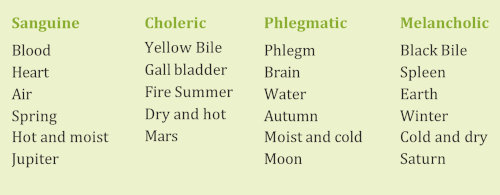
Interestingly, the National Library of Medicine hosts an online exhibition examining how the language of these four humors pervades the literary works of Shakespeare: And there’s the humor of it. 2 In Elizabethan times, ‘humorism’ as taught by the physicians of Ancient Greece was still the prevailing medical theory. According to the exhibition, the humours were thought to be “connected to celestial bodies, seasons, body parts, and stages of life”. Carried by the bloodstream, they bred “the core passions of anger, grief, hope, and fear – the emotions conveyed so powerfully in Shakespeare’s comedies and tragedies”. The National Library of Medicine finds a connection between Shakespeare’s age and our own in the common understanding that “the emotions are based in biochemistry and that drugs can be used to alleviate mental suffering”.
While this perspective limits medicine to the realm of effects, a more causal approach to balancing the four human temperaments is practiced in Waldorf education in accordance with Rudolf Steiner’s teachings. “Temperament”, said Steiner, “stands between the things that connect a human being to an ancestral line, and those the human being brings with him out of earlier incarnations”. 3 Waldorf education pays close attention to harmonizing the four temperaments into what might be regarded as a good and wholesome ‘sense of humour’ – the quality that H.P.B. considered to be the second most important thing necessary for esoteric training. And when this is combined with the first and third most important things – common sense – the disciple achieves that most important of goals on the path – spiritual balance – a dynamism that is wonderfully portrayed for us in the motion of the gyroscope.
We might equate the ‘adaptive stability’ of the gyroscope with the ‘immovable will’ of those spritualised human beings who have achieved an inner calm at the centre of their being. Such people recognize their own centre in relation to the centre of others and so demonstrate a dynamic social awareness. They know how to share psychological space with others – holding all relationships in a state of joyful, spiritual tension. And where we see the gyroscope demonstrating the maintenance of its orientation regardless of how the frame around it is moved – we see in advanced human beings an unswerving alignment with their spiritual source, no matter how much the buffeting forces of the surrounding environment may attempt to divert them.
With regard to the pure physics of gyroscopic motion, a great authority on the subject was Eric Lathwaite, who became known as the ‘Father of Maglev’ for developing the technology of magnetic levitation on which the high-speed, wheel-less trains of Japan, Korea and China run. He was, nevertheless, branded a heretic for maintaining that the gyroscope displays a “levitational capacity” that defies the laws of classical physics. 4 In more recent times, the physicist, Wal Thornhill suggested that the spin of the gyroscope offsets its atomic nuclei to the extent that “it becomes more strongly influenced by ‘cosmic attractions’ than by Earth’s gravity, perhaps even repelled by the Earth”. 5 This explanation is mentioned because it seamlessly bridges between exoteric and esoteric science; it also provides a key to understanding the subjective correspondences to levitation.
From the perspective of esoteric psychology, the ‘substance of the mind’ has to be brought into a state of rhythm or harmonious vibration. It is “the attainment of the point of perfect balance and of equilibrium. This point of perfect balance then produces... [among other things]... the liberation of the essence which the form confines”. 6 Through the reconciliation or balancing of the psychological forces and counterforces that operate on the lower planes of manifestation, consciousness is released along the ‘narrow razor-edged path’ (the noble middle path of the Buddha) that leads between the pairs of opposites into the kingdom of the soul.
Paradoxically, pilgrims on the path travel by standing still. Through meditation, study and service, the spin of all the atomic lives that comprise their bodies of manifestation is accelerated to the point that their hold on consciousness is offset. Then, in Alice Bailey’s words: “When the point of rhythm or balance is reached…then the occupier of the form is loosed from prison; he can withdraw to his originating source, and is liberated from the sheath which has hitherto acted as a prison; and he can escape from an environment which he has utilised for the gaining of experience and as a battle ground between the pairs of opposites.” 7
In this difficult transition period, humanity is faced with the collective challenge of balancing the pairs of opposites and safely moving into the Aquarian age. It is therefore heartening to know, that in this transition period through which the world is now passing, the influence of Libra – the sign of balance and equilibrium – is “steadily coming into pronounced control and into a position of power in the planetary horoscope”. 8 As the forces of political polarization divide and ravage societies across the globe, let us take hope from this fact and trust that humanity will, in time, acquire the common sense and good humour needed to find its centre of spiritual balance, raise its vision into the light, and affirm the great keynote of this sign: “I choose the way which leads between the two great lines of force.”
In the companionship of the One Work,
Headquarters Group Lucis Trust
- Sylvia Cranston, H.P.B: The Extraordinary Life and Influence of Helena Blavatsky, p.337.
- And there’s the humor of it, National Library of Medicine, www.nlm.nih.gov/exhibition/shakespeare-and-the-four-humors/index.html
- The Four Temperaments. GA 57: Rudolf Steiner Archive.
- www.youtube.com/watch?v=NnonSwMn4Ig&t=53s
- Wal Thornhill, The Long Path to Understanding Gravity, www.youtube.com/watch?v=YkWiBxWieQU
- A.A. Bailey, A Treatise on Cosmic Fire, p.158.
- A.A. Bailey, A Treatise on Cosmic Fire, p.159.
- A.A. Bailey, Esoteric Astrology, p.238.
 View UK version |
View US version |
Related Content
⟩ An opportunity to prepare for the Full Moon of Wesak and the Christ’s Festival
⟩ Information about the Three Spiritual Festivals
⟩ Three Spiritual Festivals 2026
⟩ World Invocation Day Information 2026