
Goodwill and the Codes of Living Well
Jen Loui
Most people have a personal definition of what Goodwill is. At its simplest, the vast majority might characterize it as extending kindness and respect to others. This is a very good definition, and it’s worth noting that Goodwill seems to be a vibrant and natural element of the human psyche. Because it is a fixed concept which has grown with humanity as the race has evolved, Goodwill will likely be described with as many nuances as there are cultures. We’ll find many and varied definitions of this word in the core beliefs of spiritual systems worldwide. In Christianity there is a famous and often repeated phrase “…peace on earth, goodwill toward men.” One interpretation of this phrase (and there are many) is as an encouragement to humankind to strive after peace using the method of Goodwill. In Islam the idea of Goodwill - called “Ihsan” - calls for a very high bar to be used in the expression of faith – an expression which includes showing kindness, mercy, and compassion to all. In Judaism, the concept of Tikkun Olam calls for actions of kindness intended to perfect or repair the world.
It seems that all major religions have within their precepts some variation of the concept of goodwill and if we look deeply, we will find a unifying thread running through each one. This thread is the call for each individual to extend themselves outward. First, we desire for all beings to live and move through life in a state of peace and grace – and then, we take the right actions which bring this desire to life. No matter the source, the act of Goodwill is the same everywhere. It is, as we say, love in motion. We can’t just think goodwill or pray goodwill. We must live goodwill through action.
People who actively live this truth have been with us a long time, watching and nurturing the concept. They have been aware of the shifting currents and patterns of a humankind which desires, on the one hand, to amass all the world has to offer - and on the other, to hold in trust for 7 generations that same abundance.
In the middle of this past April, just as Spring was beginning at the UN Headquarters in New York, the United Nations held its Forum on Indigenous Issues. Representatives of Native peoples from all over the globe made a long journey to speak freely in front of a global audience, and to take part in discussions mainly to do with their ability to remain sovereign and autonomous in the face of massive global change. The focus throughout the week was Enhancing Indigenous Peoples Right to Self-Determination.
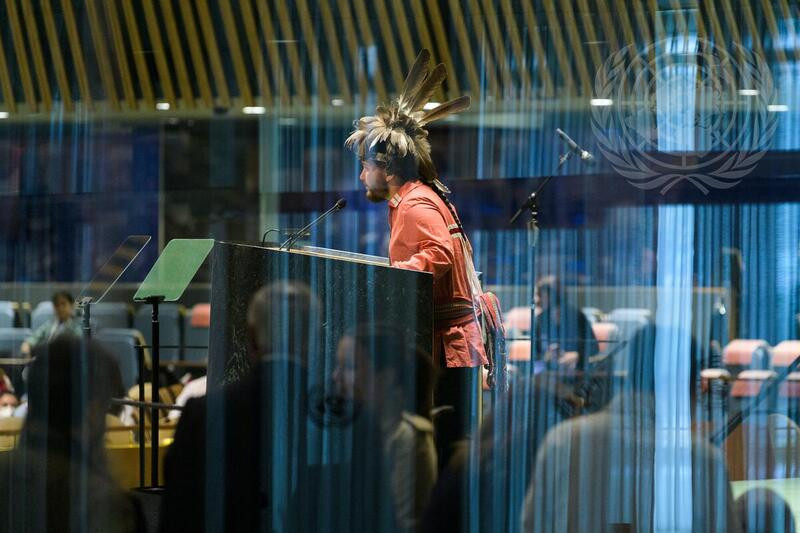
Feathered headdresses, bright-colored shirts, tunics and traditional tattoos replaced the normal business attire worn by UN delegates and visitors. One afternoon there was drumming and chanting outside on the plaza. And at the opening of a General Assembly session commemorating the 10th anniversary of the World Conference on Indigenous People, the gathering was opened not with speeches, but with a ceremonial greeting by Chief Jake Edwards of the Onondaga Nation of North America. He stood at the podium chanting in the Onondaga language for ten minutes. When finished, he translated the greeting for us - referring to the address as “The Words Before All Else.” In his tradition, offering thanksgiving for all that sustains the people’s lives - the earth, the plants, the winds, the weather, the sun, the moon, the waters, the four messengers and finally, the Creator “who has great patience for us” – is the right and proper way to begin a dialogue.
The opening segment concluded with an indigenous human rights defender from New Zealand, Catherine Murupaenga-Ikenn, who paced the front stage near the speaker’s podium offering a traditional greeting and blessing using the trill and hand motions of the New Zealand tribal people. Though not every speaker was as vibrant as these two, the unmistakable undercurrent of gratitude and an intelligent acknowledgment of the need to be aware of a greater good was touched on in ways large and small by most indigenous representatives.
But the most striking contribution to the event came from Bolivia.
Throughout the first week of this Conference the Vice President of Bolivia, David Choquehuanca, had been a frank and inspirational voice on behalf of the rights of indigenous peoples. He is an indigenous person as well as a strong political figure, having come from the Aymara people of the Andes region of South America. His political history is powerful, as is his determination to act on behalf of his people, and at this year’s UN Forum his goal was very clear.
As part of his mission to uphold the rights and traditions – not only of the indigenous peoples of Bolivia but the indigenous peoples of the world – his office has created a virtual platform of the wisdoms of the people and placed them under the name - The Codes of Living Well. The words live well, are aligned with the life-practices the indigenous people have intuitively aligned with for thousands of years.
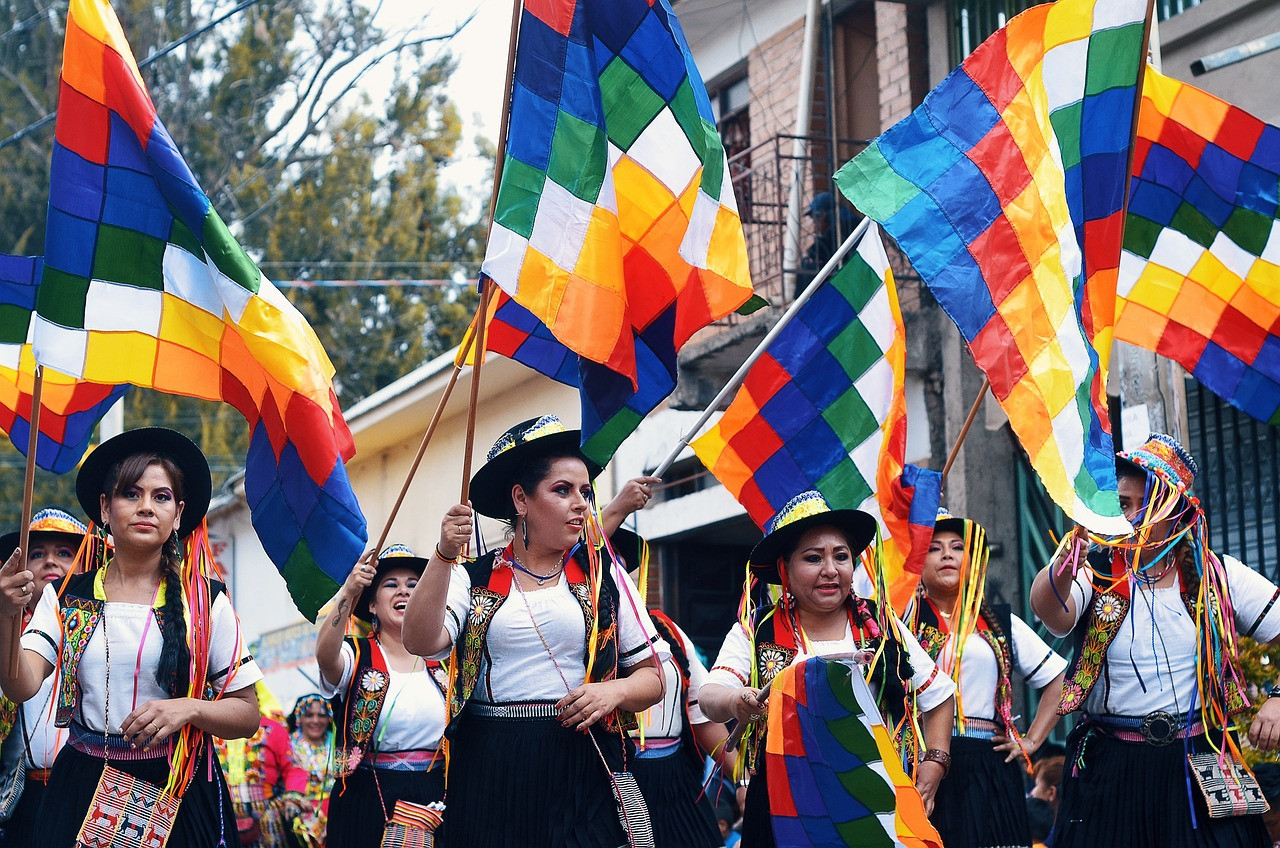
Vice-President Choquehuanca is an eloquent and passionate speaker. He may start off with a written speech in front of him, but often moves away from it to connect more deeply with his audience. He has a keen sense of the way the world works. He understands the kind of politics which exist primarily for personal gain – and he calls it out from his podium. He also begins and ends his talks with a phrase which the “originary” peoples of Bolivia use for greetings, agreements and good-byes. That phrase -Aye Yai Yai (sounds like I – Ya-Ya) is said with both hands up with palms facing forward. Choquehuancahe explained that the intention of the phrase combined with the extending of the hands was to send the energy of goodwill and gratitude outward. He said that to hold onto it, or to “smash” it between the palms of the hands as we do when we applaud, destroys the energy of the intention.
It is this kind of respect for the energy of life which has moved him to create this registry of the Codes of Living Well. As the virtual portal where communities can register these codes says, “The Codes of Living Well of the original peoples … are as old as life itself and are a guarantee that the principles of complementarity, balance and harmony on which life is based will not be violated.”
Over 300 codes have been registered from the 36 different Peoples in Bolivia’s Plurinational State. Those of us who look deeply into the meaning behind the spoken word will notice a solid foundation of goodwill contained within. Some are deceptively simple, and most reflect an innate understanding that to exist in the world well, one must take into consideration the fact of a world which is larger than just the people of one’s tribe or clan. These Codes include micro and macro. They speak to the individual and to the community. They speak to a need for order and for a path which is more right. In a way, they are a description of the poised and steady hold one must keep as our world constantly, and sometimes fiercely, redefines its identity. Below is a sampling of just a few of the 300 Codes.
The Codes of Living Well
The Codes of the Aymara People
Find oneself in balance.
See life in its entirety.
Have one’s own rebellious ideology.
Organize as a system of life.
The Codes of the Joaquiniano People
Recognize that life has immaterial energy.
Know how to dialogue for life.
The Codes of the Chiripieru People
Take care of the cycle of existence.
Guard life from all evil.
Teach what is good.
Codes of the Moseten People
Look beyond with hope.
Listen to Nature.
Walk with the truth.
Codes of the Yaminawa People
Listen to Nature to take care of life.
Work in community.
Learn to live like our ancestors.
The Codes of the Yuracare People
Free life.
Celebrate life.
The Codes of the Chiquitano People
Work in community with joy.
Have one’s own wisdom.
The Codes of the Guarasu’we People
Rejoice in life.
Give thanks for the wisdom of life.
The Code of the Movima People
Be, for others.
The concept of Goodwill is not a new one. It is simply one which works. It may be true to say that its living impulse lies within the nature of all people, everywhere. Original Peoples from every continent have prioritized this truth for thousands of years and embody it to the best of their ability. For them it is a path which is given at birth, and which carries them forward with a certainty of action and direction. Whether it is called the path of Goodwill or the Codes of Living Well, this path, well taken, will continue to guide and inform the act of living - reminding us again and again what we know intuitively - that it is good to Be, for others.
“Our Ancestors used to say, ‘If the path is not one of consciousness, there is no path.”
David Choquehuancahe
Links:
https://codigosvivirbien.bo/en/
Codes of Living Well website where you can read all 338 Codes from 36 Indigenous Tribes.
https://webtv.un.org/en/asset/k1o/k1o778o3xr
UN Recording of the Commemoration of the 10th Anniversary of the World Conference on Indigenous People showing Onondaga Chief Jake Edwards, Maori environmentalist Katrin Murupaenga-Ikenn, and Vice President David Choquehuancahe of Bolivia.
https://www.youtube.com/watch?v=dZITTeCIJto
Vice President David Choquehuancahe of Bolivia talks at the International Peace Bureau in 2023