

Since the dawn of the industrial age, the onward march of science and technology has brought great gifts to humanity but further undermined the instinctive spiritual relationship that human beings once had with the land, fauna, and flora. As the large-scale burning of fossil fuels began in earnest to power incredible new machines, it sparked the beginning of what can only be called a disintegrative worldview, which is now being directly reflected back at us through the Earth’s polluted and dysfunctional ecosystems.
Even so, it is only a perceived life threat to the whole of humanity – a common enemy in the form of global warming – that has caused sufficient alarm for the nations of the world to start rallying around the new mindset of ‘sustainable development.’ And while we might say that this represents humanity waking up from its disintegrative dream state, it still has to adjust its vision to the dawn of a new day and see things in a different light. For the notion of sustainable development remains connected to the mindset that placed humanity in its dire position in the first place – the concrete, scientific mindset of measurement and control that can, so easily, isolate itself from the balancing, feminine energy of the intuitive mind. We might regard the current scientific approach as a transition period that may help to limit the damage, but as yet, it contains no impelling vision – no narrative worthy of forming a new, integrated worldview that unites masculine science with feminine Nature.
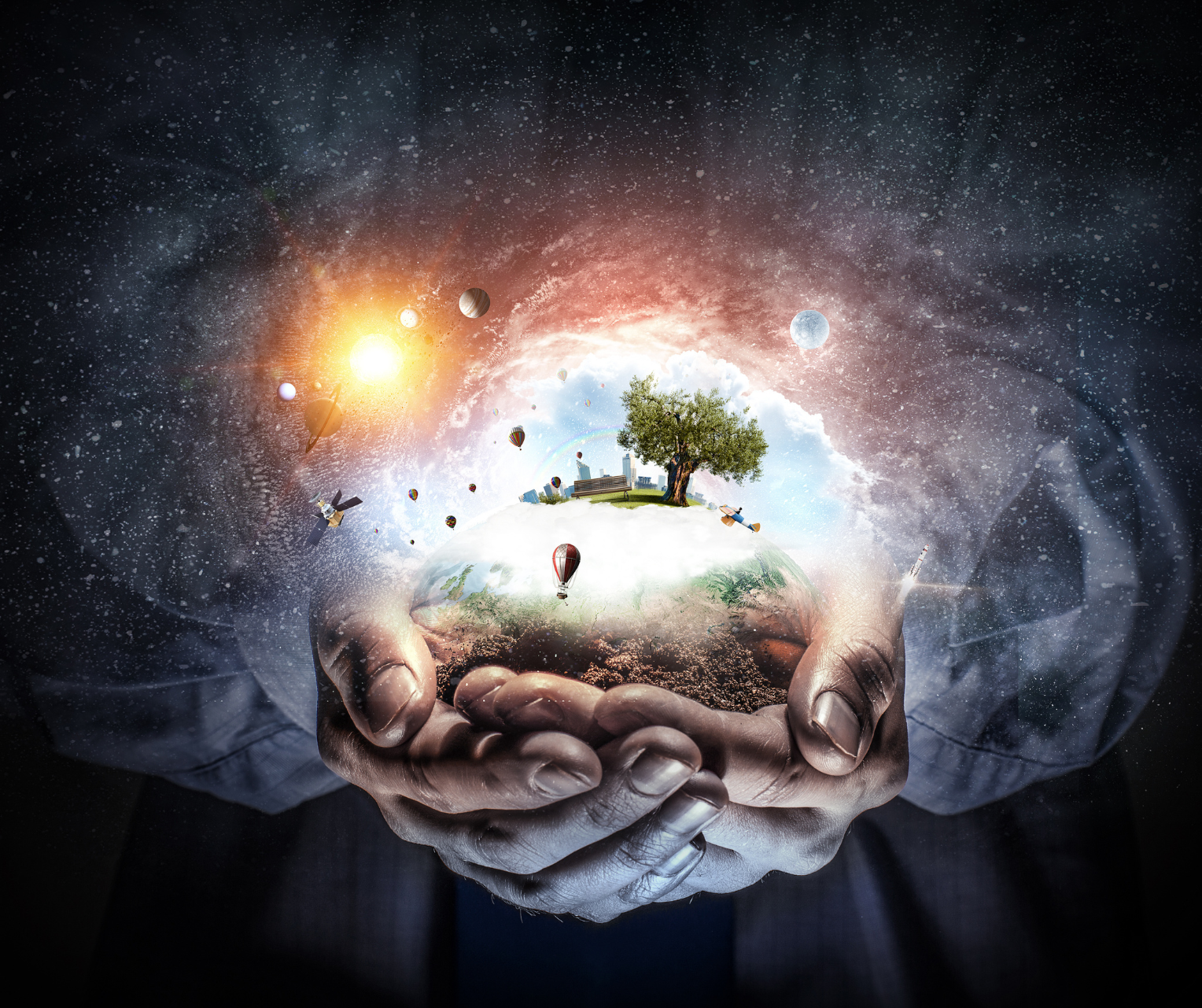 As the poet and political activist Muriel Rukeyser wrote, ‘The Universe is made of stories, not of atoms.’ Humanity thrives on narratives that give it a sense of place and perspective in the scheme of things. The public speaker and author Charles Eisenstein is a good example of the many scientifically minded storytellers who are building bridges from the dominating mindset of controlling global warming through the reduction of carbon emissions towards a new way of thinking about Nature altogether. Acknowledging that global culture is immersed in a destructive ‘story of separation,’ his work presents a ‘story of interbeing’ drawing on ideas from Eastern philosophy and indigenous peoples. He writes of:
‘An emerging understanding among many environmentalists that we have made a scientific, strategic, rhetorical, and political error by reducing the ecological crisis to climate, and the climate crisis to carbon. Earth is best understood as a living being with a complex physiology, whose health depends on the health of her constituent organs. Her organs are the forests, the wetlands, the grasslands, the estuaries, the reefs, the apex predators, the keystone species, the soil, the insects, and indeed every intact ecosystem and every species on earth. If we continue to degrade them, drain them, cut them, poison them, pave them, and kill them, earth will die a death of a million cuts. She will die of organ failure—regardless of the levels of greenhouse gases.’ He goes on to say: ‘Conservation does not mean to ‘use more slowly’ or to ‘save for later.’ What the word really means is to serve with. To serve together. To serve what? To serve life. It is a rhetorical error to frame environmentalism in any other way than to make it about love of nature, love of life.’ [1]
This raises the interesting question of how do we serve Nature in an evolutionary sense – what is Her goal, and how can science and technology fit into the picture in a wholly positive way? This question is intriguing, especially in the light of esoteric teachings, as becomes apparent from the following passage from the Alice Bailey writings:
‘…the next twenty five hundred years will bring about so much change and make possible the working of so many so-called ‘miracles’ that even the outer appearance of the world will be profoundly altered; the vegetation and the animal life will be modified and developed, and much that is latent in the forms of both kingdoms will be brought into expression through the freer flow and the more intelligent manipulation of the energies which create and constitute all forms.’ [2]
Since this was written (1930s), humanity’s creative power has surged, and science and technology’s manipulation of the mineral kingdom has moved on to the forms of the fauna, flora, and even the microbial life of the planet. In fact, the wide concept of biotechnology encompasses a range of procedures for modifying living organisms for human purposes. A practice that has its origins in the domestication of animals and the cultivation of plants has progressed step by step through the ages to the fledgling new science of synthetic biology. This is no less than the design (or redesign) of biology itself – the vision being a world-changing, world-saving green technology. However, the legitimacy of treating living nature as just another material for engineering needs to be of greater concern to humanity. While bioethicists, social scientists, policymakers, and risk experts are deliberating the many new issues that are arising from biotechnology, the overall path of development, the direction it should take, and whose interest it should be taken in are not discussed as frequently and openly as they should be.
This concern is being highlighted by the artist and designer Dr. Alexandra Daisy Ginsberg, known for artworks that explore the relationship between humans, technology, and nature. Her work is an examination of the human impulse to design a ‘better’ world: ‘Design is the transmission of ideas through things,’ she says, ‘but how do we judge if new ideas are good things when the designs themselves become invisible?’ This comment refers to the new path of bioengineering, which, rather than creating tangible products, designs changes in the way that nature behaves over time. From the perspective of esoteric science, the answer as to whether an idea is a good thing or not lies in the last part of the passage quoted from Alice Bailey’s writings and the question: does it help to bring into expression that which is latent in any particular lifeform and seeking expression?
While it is difficult for humanity to even understand the meaning of this question at its current stage of development, the fact that there are many ethical debates taking place in the life sciences these days is an encouraging sign. Ultimately, it is the purpose behind humanity’s actions that decides whether an action is morally good or not. And this is where the importance of Dr. Ginsberg’s work lies – in using her art and design work to ask ‘disruptive questions’ and stimulate debate on what ‘better’ means in the context of creating a ‘better’ world. ‘The imperative of our times,’ she says, ‘is to ask better questions about the path humanity is on. It is to use human creativity to solve better problems, not to be constantly addressing problems arising from wrong relationships with the planetary environment.’
To give a practical example, her latest installation is called Machine Auguries at the Toledo Museum of Art. It addresses the crisis of dwindling bird populations over the decades due to the effects of noise and light pollution. The installation asks the question, ‘What will there be without birds?’ At the start, a lighting array mimics the colors of a sunrise, and as the hues begin to shift, a robin sings, only to receive a machine-generated response. Eventually, only a machine-generated dawn chorus remains, and the spectator is left, under the bright light of the gallery, to experience being ‘in the absence of nature’ and the innermost questions and feelings that arise from this.
This, and many other of Daisy Ginsberg’s installations, address some of the many problems that are arising from the conflicted relationship we have with nature and technology, and the growing overlap between the real and the unreal. Can humanity grasp the opportunity that this presents to reexamine what it wants and values in life? Can the future see the emergence of an integrated world vision that embraces the perspective of ecologists like Charles Eisenstein, who see the Earth as a living superorganism and use science and technology to serve her by stimulating her further unfoldment?
The answer to this, as with all the many problems of humanity, lies in the growth of goodwill. The ‘Will’ is the most powerful force in the universe, and when human will is correctly aligned with the Divine Will, it is an unstoppable force. And as the force of goodwill is applied to all forms in all kingdoms of Nature, so might we see the steady forward march towards the abstract, superphysical levels of reality, and that which sits atop Plato’s hierarchy of being as the ultimate form – The Form of the Good. §
1. Charles Eisenstein, How the Environmental Movement Can Find Its Way Again
2. Alice Bailey, Esoteric Psychology I 83
3. Ref: Synthetic Aeshetics, On Shaping the Future through Design, Designing Nature
4. Ref: Daisy Ginsberg, Machine Auguries
5. Plato’s Form of Good, 1000-Word Philosophy, An Introductory Anthology
