



In Memoriam: Sarah McKechnie
It is with deep appreciation for her life of service, that we announce the death of Sarah McKechnie who served as President of the Lucis Trust and Head of the Arcane School from 1989 until 2012. Sarah passed away Monday morning, 6th July 2026 at her home in Bellingham, WA. She is survived by her husband and long-time partner in the work, former Lucis Trust Vice-President, Dale McKechnie.
Over the years she was President, Sarah travelled to many countries to meet with students and co-workers, uplifting and inspiring the lives of many. She was well known for the depth and simplicity with which she presented the teachings. The intensity of her love and dedication to the work was a source of strength for many, and we have no doubt that her service continues on the inner planes.
She leaves behind an extensive bibliography of work, much of it published during her tenure in The Beacon. A small selection of these articles can be found below. From 2000 to 2008, she and Dale held a weekly radio program, Inner Sight, which addressed universal spiritual principles drawing on the Bailey teachings. It was broadcast every Sunday morning throughout the New York City area. In total more than 400 programs were broadcast over the eight years. A selection of these can also be found below.
Please join us in remembrance of Sarah and her work, and in holding her transition, and the new avenues of service opening before her, in the light.
Wesak: the Blessing of Shamballa
Published in The Beacon (May/June issue, 2004).
The Invocative Appeal of Humanity
Published in The Beacon (May/June issue, 2002).
The Shamballa Energy: Group Use and Understanding
Talk given at the Transpersonal Conference, sponsored by the Group for Creative Meditation , Meditation Mount, Ojai, CA. Also published in The Beacon (September/October issue, 1999).
The Esoteric Training of the Arcane School
Talk given at the University of the Seven Rays Conference. Also published in The Beacon (January/February issue, 1998).
The Great Invocation
Published in The Beacon (January/February issue, 1979).
Inner Sight Broadcasts:
Many of the Inner Sight Radio Broadcasts can be found with accompanying transcripts at the Spiritual Perspectives Blog where Sarah was a regular contributor up until her death. The links below link directly to the respective entry on that website.
The Books of Alice A. Bailey – part 1 | part 2
Ageless Wisdom – part 1 | part 2
The Great Invocation – read/listen
Meditation – read/listen
Harmlessness – read/listen
Reflections on Aspiration and some of its Roles
Reflections on Aspiration and some of its Roles
New Moon Meditation Meeting, New York
June 12, 2026
Emmanuel Sackeyfio
There are three definitions of aspiration in the Webster’s dictionary as follows (1a): “a strong desire to achieve something high or great, (1b):”an object of such desire. (2a): a drawing of something in, out, up, or through or as if by suction such as (a): by the act of breathing and especially of breathing in.
We can apply these definitions to many aspects of the work that we do as one of the worldwide groups within the heart center of the NGWS, for we aspire, towards invoking Hierarchical energies into the human three-fold world of material forces, to transmute, transform and transfigure the world and humanity.
Such is the fundamental role of aspiration in our work that for a major part of our training and learning to serve the Plan, we are characterized as Aspirants.
This characterization of the students of the Ageless Wisdom is a most reasonable, appropriate and responsible description of our efforts and activities. It is a safe characterization which guides and guards against the all-too-common “misconceptions existing on all levels of the personality life – maya on the etheric level; glamour on the emotional plane; and illusion on the mental plane; climaxing in the sum total of all three combined in the personality – the so-called dweller on the threshold.” (GWP, back cover)
For there is a manner of characterizing our activities/efforts which lead to many difficulties, loss of time and much bewilderment. And one such characterization which is problematic and leads to difficulties on the path stems from personalizing our efforts, ignoring the implications of the essential group nature of the work, forgetting the need for increasing carefulness as we proceed with the work, and overlooking the significance of humility, as the sense of “right proportion”, in the One Work.
It may be said that “all phases of desire are essentially forms of aspiration …” (EP, II, p.329), but as aspirants, working among the many other groups in this esoteric worldwide endeavor, one of our goals is to understand and employ aspiration in a more intelligent manner. First identifying aspiration as a specific soul energy permitting a wide range of applications in our training; secondly, as involving an occult, and a scientific process, and above all, as one of the essential modes and means of achieving the objectives of Service and of discipleship in the New Age.
The effort to achieve the yogic disciplines and techniques of detachment, dispassion and the discrimination, meditation, etc., required /needed in treading the Path are all accomplished through a habit of steady aspiration, and so are the achieving of inclusiveness, harmlessness and right speech, three major states of consciousness, facing us all in the One work, to be achieved through an increasing potency of a developing aspiration.
These states of consciousness provide the safe conditions for successfully invoking and evoking the group energies needed in the work of the NGWS— in holding the Vision before the eyes of the people, …, preparing the world for the ROTC, toiling in Pisces and illumined by Taurus….
All Actions (physical activities), feelings, sensing, and the formulating of thought forms when devoid of personal and separative considerations are all motivated by some form of aspiration. Surely may we say that the spiritual disciplines attendant to the esoteric work of working with the Plan and training for DINA, are all instruments of aspiration.
There is the tendency to consider aspiration as being emotional, and the Tibetan has sought strongly to disabuse us from this misconception about aspiration as being an emotional activity and has stated in many places of the teaching that aspiration is not an emotional activity at all. For instance, “Students must lose sight of the foolish and erroneous idea that aspiration is really an emotional attitude. It is not. It is a scientific process governing evolution itself. When given free scope and duly followed, it is a mode par excellence whereby the matter aspect, or the whole personality “is raised up to heaven.” He further stated: “Aspiration is an activity of an occult and scientific nature and is instinctual in substance itself.” (EPI, pp. 326-327)
These are words of tremendous import concerning aspiration, for the “raising of the matter aspect, the whole personality to heaven” is a most comprehensive description of the work to be done on the path of return, the whole Path of Discipleship training. The significance of understanding aspiration and its role on the path cannot be over emphasized.
In fact, our work is a major enterprise in the aspiration of the right kind, the kind that leads unerringly to the fulfillment of the purpose and the achievement of the goal set for the human kingdom.
What is this purpose or goal, we might ask. The Tibetan stated that the purpose [of the human kingdom] is the Transfiguration, He further stated that “this is the esoteric goal set before humanity.” (EP I, p. 328)
This is the third initiation of Transfiguration, the consummation of the Birth and Baptism initiations, (the first and second human initiations), and we are told that it, “is an initiation which lies far ahead of humanity”. This third initiation is significantly related to the above definition of aspiration by the Tibetan as “… the mode par excellence whereby the matter aspect, or the whole personality “is raised up to heaven.”
It is “an initiation which lies far ahead for humanity”, and we are told is vitally connected with the first two initiations, for the energies associated with the crisis of the third Initiation, become increasingly available while struggling to achieve the first two initiations of the Birth and the Baptism.
In these two initiations, aspiration plays a significant role in two ways simultaneously: (1) “Fiery aspiration, [brings about] the domination of the physical man so that every atom of his body is afire with zeal and endeavor.” (LOS, p. 123), and (2), aspiration helps to engender “spiritual [D]devotion to human welfare and to a one-pointed adherence to the Plan of the Hierarchy; all emotional reaction to the Hierarchy of Masters fades out, and the disciple can now work without being hindered by constant astral disturbances.” (RI, p.582)
Devotion, as it is fired and engendered by aspiration and related to the Baptism initiation is not emotional, and involves certain important factors, such as employing the aspiration to develop a “capacity to decentralize oneself, to change one’s attitude from self-centeredness and selfishness to one of outgoing to the loved one. In this case the God within, the soul, the Christ in you the hope of glory.)
Secondly, the aspiration is employed to bring about “obedience to the beloved, [the inner God] this is covered under the phrase of “Devotion to Ishvara”. (LOS, p. 123)
In concluding, let us remember the similarity between aspiration and fire and recall from the Affirmation of the Disciple that, “we are points of sacrificial Fire, focused within the fiery Will of God…”, And thus we stand.
Today the fires of aspiration are sorely needed in the world to burn away all that separates and all that puts humanity in harm’s way and all that employs the wrong use of words/speech to distort, to deceive and to destroy the good, the beautiful and the true.
In this sense it is relevant to note that the Christ will be bringing the “Fire of Love”, the very first aspect of Love, the most powerful energy in this solar system, and thus linking love and life more abundantly in His Work, in this rapidly approaching Aquarian Age.
An increasing fiery aspiration by the members of the world groups will not only accustom the world to the purificatory and healing benevolence of the element of fire, but will hasten the ROTC because, in the words of Agni Yoga, “human strivings (aspirations) are needed for a natural affinity with the World of Fire.” (Fiery World, 1933, pp 8-9)
Thank You.
QUESTIONS FOR CONSIDERATION:
The world seems to be on fire, what is the fire (light) destroying and simultaneously seeking to Reveal?
Let’s share our understanding of the word aspiration. How would you define or explain it?
July-September 2026
Subscription > 1 year > 2 years > 3 years | Single issue > Sample issue >
CONTENTS:
Editorial – The Purifying Fire
[The] purifying fire of God, focused in the planetary centre, Shamballa, has impacted directly on the world three times in this root-race… Esoteric unfoldment has to take account of bearing the pressure of the tremendous influx of energies that characterise these momentous times…
On the Treasures of Darkness – Djwhal Khul
[Occult blindness] is something imposed by the soul upon the hastening aspirant, so that the lessons of conscious experience, of discipleship, and later of initiation may be correctly assimilated and expressed…
Service as Spiritual Law: A Scientific Method of Soul Unfoldment – Steven Zagoudis
…esoteric psychology reveals [Service] as a lawful process arising from soul control… an inevitable expression of alignment with the purpose of the Whole.
The Invocative Life – By a student
…the invocative life is characterized by simplicity, responsibility, and quiet effectiveness. Its value lies in its steady orientation toward the whole and its willingness to serve where needed, without attachment.
On Imagination and Reality – Christopher Noakes
…all outer experiences, as physically sensed, are precipitated expressions of imagination [but] some…key factors… determine whether physical precipitation occurs.
When the Places of Light Grow Dim – Sebastian Sęk
When outer structures disappoint, the disciple’s inner alignment becomes more important, not less. If leadership fails, conscience must mature. If systems avoid repair, the disciple must keep choosing repair. This is the work.
Understanding the World Situation: An esoteric perspective on the present geopolitical conflicts and issues – Steve Nation
…beyond all the attention that is given to the forces of separation, the group of deepening servers… is today stronger and deeper in its alignment than at any previous time. It is this that provides the substance for genuine hope and the evidence of the new synthesis now being born.
The Heart and the Mother of the World – Reiko Watabe
The Mother of the World functions as the principle that sustains the world, prevents its collapse, and upholds the conditions necessary for continued evolution. Its essence lies not in sentimentality but in endurance; not in immediate healing but in silence.
Bali, The Island of the Soul – Kasia Przado
Beyond the presence of tourists and digital nomads lies an underlying order—a subtle rhythm shaping actions, attitudes, and community structures … a living matrix of forces expresses itself through ritual precision and interpersonal grace—qualities suggesting an underlying consciousness at work.
Fred McFeeley, “Mister Rogers”: A Forerunner – Melissa Grogan
One must admire the spark of creativity and depth of devotion to the human spirit that was behind his desire… to go into children’s programming simply to find a way that the format could be used for good, to benefit children in positive ways.
Subscription > 1 year > 2 years > 3 years | Single issue > Sample issue >
High Level Political Forum, July 7-15, 2026
|


THE BRIDGE OF THOUGHTS
In accordance with the spiritual teachings, we come to know all things in this world as reflections of inner happenings that are veiled. Centuries past saw bridges in the outer world made of logs, rope, or heavy concrete structures. Today we have high speed rails that span mountain passes and communications technology that can connect us face-to-face with others in places on the other side of the earth. These outer manifestations parallel the bridging work taking place within consciousness, letting reality precipitate and blurring the boundaries between worlds.
At an earlier time, bridging within consciousness was the province of the very few, while the masses were left in ignorance without access to even the essentials of education. Today, people everywhere have access to educational facilities and through technology, at just the touch of a screen, many can access enormous resources of humanity’s knowledge that has been acquired through the lower mind. Building upon this foundation, provides humanity the opportunity to develop the power of thought capable of penetrating the inner spiritual realms which no machine can penetrate. Of course, all opportunities present challenges and counter previous trends. The allure of technology could easily result in humanity becoming lazy and stuck within the unthinking glamour of nonessentials and so forfeiting the massive energy supply of light and goodwill which the mobilization of human thought can provide.
The mystery traditions throughout time have used the symbolism of the bridge as a vehicle of illumination. The Buddha likened His teaching to a bridge or raft that enabled students to cross from the shore of this outer world to the inner shore, a bridge which must be left aside once the shore is reached. Patanjali taught that, through a withdrawal of the senses, we can create that "sacred bridge" that connects us with the source. In her work with the Esoteric section of the Theosophical Society, Helena Blavatsky brought to light the ancient teaching on “The Golden Stairs.” These “Stairs” consisted of directives from ancient eastern esoteric traditions which were devised to lead the student step-by-step on the path to becoming an effective server. The teaching on the antahkarana or inner instrument of light, which was given out less than 80 years ago, holds out the means whereby the promise held within the recesses of the mind can be realized. Those standing within the heart center of the new group of world servers collectively use this bridge to weave lines of relationship–bridging up, down and all around to circumnavigate the earth. At the heart of this bridging work stands the Triangles network.
We must resign ourselves to the fact that the only way in which we can find the clue to [certain esoteric mysteries], lies in the study of the law of correspondences or analogy. It is the one thread by which we can find our way through the labyrinth, and the one ray of light that shines through the darkness of the surrounding ignorance. H. P. Blavatsky, in "The Secret Doctrine," has told us so, but as yet very little has been done by students to avail themselves of that clue. In the study of this Law we need to remember that the correspondence lies in its essence, and not in the exoteric working out of detail as we think we see it from our present standpoint. The factor of time leads us astray for one thing; we err when we attempt to fix stated times or limits; all in evolution progresses through merging, with a constant process of overlapping and mingling. Only broad generalities and a recognition of fundamental points of analogy are possible to the average student. The moment he attempts to reduce to chart form and to tabulate in detail, he enters realms where he is bound to err, and staggers through a fog that will ultimately overwhelm him.
Initiation, Human and Solar, A. Bailey pp.6-7
CONFLICT RESOLUTION
Two roads diverged in a yellow wood
And sorry I could not travel both
And be one traveler, long I stood ...
Observing the current tremendous turmoil in the world of form, many of us are wondering how all these conflicts could ever be mediated or prevented, as they seem such an unavoidable pattern of life. But we can realise that mediation is not just a work carried out between nations or groups, rather it is also sacred process that arises and unfolds within consciousness. As so many religions and philosophies have stated: each human being, sooner or later, must choose which way to live his or her own life from options that are often in conflict.
As described by the first lines from Robert Frost’s poem, The Road Not Taken,1 often it is not easy to decide. What the personality desires for comfort, security and recognition often clashes with the more spiritually purposeful options, but the friction between these two choices is the birthplace of growth recognised in meditation. This is a form of mediation that can call upon the soul’s perspective – it raises the point of view above the level at which the conflict occurs, and this requires a conscious choice and an application of our free will. This process provides a third position which emerges by inner mediation, becoming the observer who neither judges nor rejects but keeps the mind open to higher soul energies. The soul’s wide-reaching perspectives are qualified by inclusiveness, love and the will to serve the whole rather being restricted to satisfying self-centred desires.
Here, in the service of Triangles, we find an extension of this inner mediation – the activity of linking in thought with two others, forming a triangle of light and goodwill. In the Triangles work, the personality stands aligned with the soul and contributes to this enlightened network encircling the world. The personal self, once a source of conflict, is infused with soul energy and becomes a transmitter. The tensions that once divided are now transformed into currents of directed energy, flowing through the triangle and into the collective field of humanity. In this way, even the least experienced Triangles worker can contribute to the healing of the whole. By persistence, those who stand as points of light within this network contribute to the resolution of the world’s ancient dualities.
One can also understand the whole of humanity as an individual unit with a personality and a soul, standing before these conflicting options. True mediation begins with this recognition. Just like separate individuals in moments of tension, humanity feels the weight of regret at the necessity of decision and knows the courage it requires. This has long been recognized in human reflection. Yet the deeper teaching is not merely to choose, but to choose in the light and love of the soul and in alignment with the will that serves the greater whole with joy. So then, returning to the final lines of Robert Frost’s poem:
Two roads diverged in a wood, and I --
I took the one less traveled by,
And that has made all the difference.
1. The lines quoted are part of a longer poem. https://en.wikipedia.org/wiki/The_Road_Not_Taken
Triangles Webinar: Broadcast on the second Monday of every month
www.lucistrust.org/triangles/webinar
FREEDOM IN FORGIVENESS
We use the word “forgiveness” to refer to an attitude in which we are able to find reconciliation for both the minor and major mistakes and mistreatments that are so much a part of everyday life. This not only allows us to show benevolence and compassion toward those who have mistreated us but also, eventually, enables us to resolve our own misdoings. A benevolent attitude is, of course, as commendable as it is necessary, and life is of a much higher quality when this attitude is embodied wholeheartedly. In such embodiment, there is a recognition of human fallibility, as well as a greater freedom from prejudice and resentment. Clearly, depending on the severity of what has been suffered, the process of forgiveness can only happen when we are ready for it. When humanity reaches higher states of consciousness, the faculty of forgiveness will become “the very breath of life itself—the giving of all to all and for all.” 1
This understanding of forgiveness is deeply ingrained in humanity, and it is well preserved by the spiritual teachings of many religious and cultural traditions. However, we can extend this idea upwards towards the workings of the Divine Mind and towards a higher and even more profound meaning of the word, which is “to give for", for-giveness. This can be giving with purpose while expecting nothing as a reward. Even more importantly, it can refer to an act of sacrifice: it is about giving of one’s self for others, for the sake of the collective life, and about making that a sacred act. This giving is not a loss, but a gain, and it is in alignment with the profound meaning of the word sacrifice as “making sacred” (from the Latin sacrificium, “to make holy”). In this light, the fact that Divinity Itself sought manifestation in matter, letting go of Its unique nature and identity, was the highest act of for-giveness and sacrifice that we can fathom. Because of that act, for-giveness has remained as one of the most important basic impulses of life on earth.
In our Triangles, we seek to become points of reception and distribution of the Light, Love and Power emanating from the divine source. By joining a Triangle, we confirm our willingness to have our individual identity merged with those of our partners, and through this inclusive act, we empower the most basic of sacred geometrical figures through which these higher energies can circulate. In this way, humanity is directly in touch with healing forces. As we sacrifice our sense of individual identity to join our individual Triangle(s) and we then take it further to fuse with the Triangles network, we become a reflection of Divine for-giveness and thus further anchor that impulse on earth, in human minds, and in human hearts.
And it is here, in that deep fusion, that we find the freedom to be our true selves. This greater freedom from the yoke of the limitations of matter further empowers the distribution of spiritual energies. As above, so below. As conscious human beings and Triangles workers, we have the privilege of knowing that we can participate in the continuous flow of forgive-ness.
1. Education in the New Age, A.Bailey p.129
June 2026
Taurus New Moon
Taurus New Moon
New Moon Meditation Meeting, New York
May 15, 2026
Good evening friends, and welcome to this New Moon meeting. Our meditation will be working with the energy flow of the lower interlude of Taurus. At Wesak, two weeks ago, during the higher interlude of the full moon when the sun was in Taurus, our meditation for world service created a group approach to energies radiating from the Buddha and the Christ. Today, through our meditation together as a group, we will work with the flow of the Taurus New Moon, aligning with the energies released at the full moon so that we can then turn our attention to humanity; attempting to use the three eyes of the serving esoteric group to imaginatively ‘see’ where and how the light released during the full moon might be taking root within the shrine of human thought, of human living and of human relationships. As our vision and understanding of the light in human affairs clarifies and simplifies in our own mind, and in the group mind, so will we be playing our part in helping to strengthen the hands, and the hearts and minds of the entire New Group of World Servers. This meditation, and this work at the New Moon, is very practical and purposeful.
There is, clearly, at this time, in the realm of thought and emotions, a strong presence of what we might think of as the shadow side of the human psyche. Destructive aspects of the will to power are having an impact on national and international affairs – reaching right into the personal stories of the lives of millions of people around the world. Stimulation of the will to power tends to amplify glamour and illusion, and, temporarily at least, strengthens the shadow in the human psyche – or at least brings the shadow out into the open. This is all one aspect of our response as a species to incoming Shamballa energies.
Yet there are also, in world affairs, elements of a more valuable destruction – and these too reach into personal lives. Universal and ancient glamours and illusions of “selfishness, materialism, aggression, and national prides” are subverting and diverting Aquarian ideologies of wholeness, cooperation and sharing, and inhibiting efforts to think through the ideas, laws and principles which can guide us as a species into a new era. [EXT 431].
Some destruction might be seen as a necessary part of a crisis which can lead to clarification of thought and purpose. It can lead to a deepening understanding of how cooperation and freedom might sweep away the hubris of separative glamours to produce a genuinely transformative world where a true spirit of sharing and right relationship with the whole can take root in personal and family lives, and at local, national and international levels. The focus, it seems to me, needs to be less on the policy choices made by leaders, than on the quality and depth of the thinking that all people of goodwill are willing to invest as they consider what is right action in any situation.
We are on the cusp of a new era in which an infinite diversity of cultures and lifestyles will be able to thrive within an overall respect for and valuing of the oneness of life itself. The coming of the Christ will lead us into that era. The question is – how many decades and how many crises will be needed as we move into the next step on the path towards that destiny?
Perhaps that is the cry driving the collective invocation for the Light and Love and Power of divinity to come to our aid at this time. And that is the cry that we can help to concentrate and clarify, and simplify in our use of the Great Invocation – today at this new moon, and during the period leading into the Christ’s Festival at the Gemini Full Moon.
World Invocation Day is like a symbol when we can imagine esoteric workers from all traditions standing together with the entire ranks of the New Group of World Servers – the muscular, intelligent, wise servers who today can be numbered in the hundreds of thousands if not millions – all, as one, lifting the cry from the people of good hearts and good intentions into one focused, purposeful, directed call towards the assembled Hierarchy of Saints, Rishis and Elders on the inner side of life. Let light and love and power flow into human minds, and hearts; Let the will of humanity be guided by a new depth of loving purpose.
Without intensity, with faith in the future, and with a quiet poise, centered in the soul, we can imagine these days between now and the coming Festival of the Christ being filled with a deep, solemn appeal to divinity to Guide and lift and inspire. And having done this we can direct all our attention to the light and the love and the goodness that is taking root today in people – taking care to notice its presence whenever we see it, and trusting in the power of the soul to nurture and nourish all the new growth that is taking place in humanity’s understanding of the web of relationships.
A part of our work at this New Moon then, seems to be to silently stand during this period between the Taurus and Gemini full moons; to stand in in the flow of a light and love that reveals.
Standing together in this way, identifying with the group of all who love and serve, a part of our task seems to be to hold onto the thought that the energies flowing through the higher interlude of the three Festivals this year are part of a wider energetic environment. An ecology of energies that includes, not only the esoteric influences pouring in from the zodiac, but also the placement of this Taurus/Gemini period between two significant energetic events. We have the centennial Hierarchical Conclave taking place in the recent past (however we are to understand time from a Hierarchical perspective). And we have the coming seven year Festival Week of the New Group of World Servers in December – including the serendipitous occurrence of a Capricorn full moon during the Week.
These two points in the energetic environment within which we are working can perhaps be seen as two complimentary pulses, bringing light into the creative thinking and being of servers in every field of activity and thought; in every profession and every branch of science; in all the arts – stimulating fresh thinking within the seed groups where a new civilization is in process of being born. And this energetic dynamic might lead us to consider 2026 as part of a rhythm echoing through the human symphony every seven years.
Alice Bailey’s writings suggest that at a centennial Hierarchical Conclave the entire body of Rishis and Masters from all 49 ashrams assemble to decide “what form of crisis, on what level of consciousness, and involving what group of lives, must be implemented and presented to humanity”. The reverberations of that decision can be expected to radiate through the hundred year period in human affairs, yet history tells us that they emerge through peak moments of crisis. The key point about the crisis precipitated by Hierarchy is that humanity is left free in the way in which it responds to the crisis. So, as we stand with humanity today, perhaps we can visualize and look for evidence that the species as a whole is using the crisis presented by Hierarchy to take a decisive step onto the discipleship path – a step that will ultimately reorient the civilization away from separation and materialism in the direction of a freely chosen, infinitely varied, response to a sense of synthesis, inclusiveness and wholeness. The new civilization will be founded on thought and ideas – yet it will also be an expression of an intuitive collective sense – a ‘feel’ for synthesis and wholeness throughout the diversity of cultures that sees the whole as much as it sees the part – and loses the sense that these are opposites, or in some way in competition.
What might it mean for the light pouring into humanity at this Taurus / Gemini moment, together with its accompanying pulse in December, to at least begin to activate the eye of luminosity within the mind and heart of the New Group of World Servers? And while many sensitive thinkers in humanity today see this time as a time of profound spiritual crisis – what might it mean for humanity to respond to this crisis with at least a measure of soul; a measure of awakening to a sense that the outer world of time and space has a relationship with higher worlds and realms of being, and to the integrity, beauty and oneness of life itself?
Questions for Discussion:
- We are advised to stand with the group of all who, currently, are firing the world with the sense of relationship. How do you understand this work, and what role do the Festivals of Wesak and of the Christ/Humanity play in your approach to this work?
- At the conclusion of a Centennial Hierarchical Conclave, we are told that the Masters come to a decision about the form of crisis to present to humanity … which humanity will then work through in the coming decades and through the hundred years until 2125. How does this affect your understanding of this period in our collective history as a species?
The New Group of World Servers: A Model for Humanity of the Aquarian Consciousness
The New Group of World Servers:
A Model for Humanity of the Aquarian Consciousness
New Moon Meditation Meeting, New York
March 18, 2026
Maya Costley
Welcome to the Pisces new moon meditation. For those who are new, we meet to meditate monthly at the new and full moons as a service to humanity, and through aligning and working with extra-planetary energies make them available for planetary healing and redemption. The peak opportunity to work with the energies of Pisces will be at 9:24 pm EDT tonight, for those who may also wish to meditate at the exact time.
Pisces is becoming prominent in humanity’s mind because of a growing awareness that Earth is moving out of the Piscean age and into the Aquarian. Much has been written, but the significance of this is the influence the energies of these constellations offer humanity for its evolution. We also come together in recognition of our part in the New Group of World Servers. Our group consists of servers who are linked together, subjectively, by one main objective; that of alleviating human suffering. We are doing this through many means, but primarily by helping humanity to contact and know the Plan. In the Aquarian Age, this Plan will be realized through the manifestation of the principles of goodwill, group consciousness and right human relations within the human kingdom. We, as a group, are here to demonstrate these principles to show humanity the way forward into a more secure and loving future.
As the New Group of World Servers, we are new within the human kingdom. As a group we have become a saving force, or world savior, and the Ajna center of our planetary life. As we transition into the New Age, we are also here to model for humanity new ways of working together and show humanity that through cooperation, and respect for the rights and opinions of others, many different ideas of a possible future for humanity can be synthesized into a positive and shared vision for all. By doing this we are also helping humanity to restore its birthright of abundant health and plenty for all. Our group is made up of servers from every nation, culture, religion and ethnic background-all united in the goal of improving the human condition.
This year is also the year for the festival of the New Group of World Servers. It is a time of profound recognition and of alignment for our group, externally and subjectively. The festival is celebrated every 7 years in-alignment with a significant and vast constellation that is important to our planetary evolution. It is also through Uranus, in the sign of Capricorn, that this energy is made available to Earth for this work. For this reason, the festival happens in December, and will be happening this year from 21st-28th, 2026. A full moon will also be occurring during the festival week, which makes this festival a particularly powerful and important opportunity for our group and its work.
Let us say together, in recognition of our group and its role in helping humanity move forward into the Aquarian Age, the affirmation of the New Group of World Servers:
May the power of the One Life pour through the group of all true servers.
May the love of the One Soul characterize the lives of all who seek to aid the great ones
May I fulfill my part in the One Work through self-forgetfulness, harmlessness and right speech.
The Aquarian Age is also bringing with it the energy of the 7th Ray. This Ray Lord is a cosmic being of tremendous energy and force, whose consciousness stimulates and has a profound impact for life on Earth. For humanity, this can be understood through this great Lord’s name, or keynote, that of: The Lord of Ceremonial Order and Magic. His effect on humanity is increasing through the order and organization that he brings and we can see manifesting in the world, impacting all aspects of human civilization and culture. With this power to order, organize and manifest, He is bringing forth greater beauty in all its forms and in all kingdoms, which is enabling humanity to create at a level never imagined in its history.
The effect of the 7th Ray can also be seen through the modern practices of business and organizational management, and its ability to galvanize humanity in cooperative efforts towards its betterment. Humanity has learned there is a greater chance of survival for those who can cooperate. Science has documented this phenomena, and it is known in biological studies that the more cooperative a species, the more sophisticated, intelligent and advanced it becomes. Nature rewards those who can cooperate. It also indicates that the skill of cooperation is the future for life on Earth. This is the essence of the new teaching on discipleship. Groups, rather than individuals, are the new model for initiation through group work and service. Modern research on corporate management and team work is also reporting similar findings.
In an attempt to synthesize some of the ideas in these two streams of thought, 5 principles and 5 Challenges to group work are offered to understand how groups can work together more successfully. These ideas were drawn from the Tibetan’s work on the New Group of World Servers, Creative Hierarchies and the Seven Laws of the Soul or Group Life. The management theory was drawn from Patrick Lencioni’s, “The Five Dysfunctions of a Team,” Peter Senge’s, “The Fifth Discipline” and Stephen Covey’s, “The 7 Habits of Highly Effective People.” The Tibetan’s ideas have offered humanity a crucial new perspective on how to navigate modern discipleship and group work. New ideas in organizational management are also demonstrating that the New Group of World Servers are working through all departments of human endeavor with the Plan, focussed on meeting real world needs in a meaningful and measurable way. Let’s review some of the ideas from these 5 principles and 5 challenges to group work.
The Five Principles of Effective Group Work:
Effective group work is only possible when those working together can transcend individualism and serve a larger purpose.
- Alignment with a Greater Purpose or Plan.
Groups must have a shared vision, or higher purpose, that focuses and motivates individuals in the group to transcend personal limitations in service to humanity through a subjective recognition of the Plan by the inner group of disciples or group. Senge and Covey highlight building a common mental model and beginning with the end in mind. Without this, efforts fragment. Creative Hierarchies illustrate how groups channel higher creative energies when aligned to those they are here to serve. - Cultivation of Right Human Relations and Trust.
Foundational to all group coherence is healthy relationship dynamics and a culture of trust. The Tibetan describes this as subjective “welding” through goodwill, telepathic rapport, and harmless right relations among group members. Lencioni’s refers to vulnerability-based trust by admitting weaknesses and Covey’s promotes a win-win agenda for the group. This enables a shift from personality separatism to soul-group fusion and can prevent office politics and enable greater emotional safety. - Development of Group Consciousness and Synergy.
The whole must become greater than the sum of its parts. Strength in numbers is the rule. The New Groups are teaching humanity to move beyond individual consciousness to a group soul identification, which is more organic than rigid in structure. Covey describes this as synergy and Senge calls it “team learning.” Creative hierarchies need unified groups to allow energy to flow through them and produce a unified power field for others to contact. - Service, Resulting in Commitment and Accountability to the Group.
Groups thrive through pledged action and mutual service, rather than a focus on individual goals and personality concerns. This demands a willingness for the individual to sacrifice for the greater good. The New groups are demonstrating service and sacrifice so the Plan can materialize. Lencioni and Collins call it peer accountability, while keeping results in the front of the group’s awareness. - Creative and Hierarchical Integration Through Learning, Growth and Adaptation.
Groups must continue to evolve in greater group consciousness or systems thinking, and greater intuitive responsiveness to the problems and challenges that face them. Senge calls it the five disciplines: personal mastery, mental models, shared vision, team learning, systems thinking.
There are also key challenges for this new kind of group work which can be identified, and in which a few ideas are described briefly in the following list:
5 Challenges to Effective Group Work:
The recurring pitfalls of achieving group consciousness or group soul alignment.
- Absence of Trust
Group members feel they must hide their thoughts, feelings or vulnerabilities for fear of judgment. Lencioni calls it a foundational dysfunction when personality prejudices prevent the group from linking more subjectively. - Fear of Conflict
Artificial harmony or a false unity, pervades the group and inhibits creative discussion or debate, or some are excluded from offering ideas to improve the work. This can result in group glamour and illusion which go un addressed. - Lack of Commitment
Unvoiced disagreement or resentment leads to a lack of effort or a lack of cooperativeness with the group vision. Individuals prioritize personal ambitions over the group Plan, which weakens group energy. - Avoidance of Accountability
Low standards are tolerated, or never discussed. Standards may be enforced for some, but not for others. This can result in spiritual selfishness and a refusal of the group to discipline itself for the greater good of the group work. - Inattention to Results
The group is focused on personality concerns or process over group goals and outcomes. Criticism is given to some, but not to others. Group energy is dissipated in secondary activities, instead of the group Plan of achieving “Unity, Peace, and Plenty.” Collins and Senge say that without measurable results, groups fail to create real value.
The New Group work in the coming age entails a growing need to learn to cooperate and also identify the individual strengths and assets of group members to create a group that is stronger together, than any one individual could be alone. In these groups, overcoming these many challenges will require a culture which includes a commitment to vulnerability and honesty from leaders, regular alignment through such techniques as meditation, and a committed focus on service and real results. When these 5 principles are lived and the 5 challenges are addressed, groups can become vehicles for profound transformation, whether advancing the Plan or achieving organizational goals.
At the heart of this new group work are the Aquarian principles of Goodwill, group consciousness and right human relations that we, as members of the New Group of World Servers, are also seeking to demonstrate through our work within humanity. Through this we can help humanity to achieve a more responsive culture, and a level of cooperation and group creativity that will serve the Plan. This demands that through seeking to be of real service, that we rise to a new level of cooperation and transmute our selfishness into selflessness, our self-preservation into a desire to serve the group, and our self-pity into compassion, sympathy and understanding for the needs of others.
Let us now meditate on how to strengthen the hands of the New Group of World Servers to support our work of modeling for humanity the new ways of working together.
That Resplendent Day
As a means of introducing the general public to the Externalization of the Hierarchy and the Reappearance of the Christ, in 2025 I wrote and published a novel of visionary fiction,
That Resplendent Day.
Embark on Zune’s epic journey along the Infinite Highway of Life, which reveals the imminent emergence of our Greatest Souls, humanity’s ultimate Muses. The most special of these is referred to as the Coming One, long awaited by many millions. The plot proceeds to a grand, unexpected zenith.
In this visionary novel, you’ll experience a world where the aspirations of one woman, and the extraordinary man who inspires her, intersect with the destiny of humanity amidst a world undergoing political, economic, and climate crises.
The story approaches its climax as Zune journeys to Transcendent Valley, where community life is based on cooperation and the common good. Naylu, a leader and woman of wisdom, shares Zune's expectation of emerging Great Ones.
That Resplendent Day culminates in a momentous global event, as many experience a profound interconnectedness with all life, galvanizing a shift towards collective well-being and goodwill.
The book is available via www.bradleyberg.com as well as Amazon, Barnes and Noble, etc… in both print and e-book formats.
“The story is intriguing… the prose is insightful… Berg offers a richly unusual premise and provokes deep thought…”
— Publishers Weekly/BookLife Prize Contest 2024
“Berg’s novel is a testament to resilience and the enduring power of the human spirit, offering readers a contemplative journey toward collective upliftment.”
— Brian Mahoney, Editor, Chronogram Media
From Idealism to Integration: The Journey from Vision to Embodied Reality
Humanity has never suffered from a lack of ideals. The great visions that have shaped our contemporary society—human rights, social justice, unity, dignity, freedom— are partial apprehensions of the eternal truths that the soul knows in its own realm. Most of these ideals have not yet been fully embedded in human life. Two main factors may explain why. One is temporal: the movement from ideal to manifestation unfolds slowly, according to a rhythm that is difficult for human beings to fathom beyond their ordinary perception. The other is more subtle and lies in what might be called a “lack of soul”—the failure to ground the ideal in a higher principle of consciousness that embraces both unity and individuality, without which no ideal can fully incarnate as an expression of the soul.
An idea can be understood as a seed of meaning—abstract, relatively neutral, and endowed with structure—that descends from the realm of archetypes into the plane of mind. Such an idea requires a trained thinker (an individual or a group) who would first act as a channel, receiving it, holding it, and transmitting it; and then as an agent, using awareness and will in order to manifest it. When the idea, descending into the thinker’s awareness, meets aspiration, and the agent charges it with directed will, projecting it forward as something worthy of realization, it becomes an ideal. As this ideal makes its movement toward manifestation, it will meet the resistance of existing conditions, precipitating a crisis—not a sign of failure in itself, but a necessary point of pressure in which the essence of the ideal needs to be tested before manifestation becomes possible.
What we are witnessing in contemporary society is not the failure of idealism; the human faculty to generate, hold, and act upon ideals in response to soul impression is very much alive. What we are witnessing is that many ideals are being tested through crisis. This testing is accompanied by destruction: the outer form of the ideal is broken before its inner essence can emerge. Whether destruction leads to collapse or to a further stage of renewal and integration depends on many factors: a decisive one is whether the ideal carries sufficient soul substance to survive the fire and be transformed.
When an ideal has been built on only one pillar—unity at the expense of the individual, leading toward totalitarianism; or individuality at the expense of the whole, producing fragmentation and conflict—it lacks the inner coherence to withstand the pressure, and it can be consumed by the crisis. However, when an ideal is rooted in the soul's own perception, holding unity and individuality simultaneously, as complementary dimensions of a single truth, the crisis becomes initiatory, since it is the necessary purification of a form that is incomplete until its essential synthesis can emerge and begin its movement toward genuine manifestation.
The evolutionary philosopher Pierre Teilhard de Chardin articulated this principle succinctly in his formulation “union differentiates.” The movement toward unity does not dissolve individuality but intensifies it within a greater whole. The path from “I” to “We” is not the erasure of the self, but its fulfilment. This insight mirrors the soul’s vision: unity and individuality are not opposites but complementary dimensions of a single eternal truth.
While it is easy to see the destruction of form in a crisis, it is important to train ourselves to see that, in its midst, many ideals are taking the principles of unity and individuality toward their essential synthesis. Rather than rejecting the crises the world is experiencing, they engage with it and offer a pathway for transformation and redemption. The orientation these ideals embody may be described as a form of “practical idealism”: the capacity to hold a higher vision while working effectively within the constraints of reality. It does not abandon aspiration, but tempers it with insight, patience, and adaptability—thereby allowing the ideal to become, gradually, a living force within the world.
One of the best examples of the above is Joanna Macy’s The Work That Reconnects (TWTR).
Rooted in Deep Ecology, Systems Thinking, and Eastern spirituality, this work is placed within the broader context of what is known as the “Great Turning”, a term that describes the paradigm shift that is currently taking place in the world, as it transitions between an industrial society focused on unsustainable economic growth to one devoted to life-sustaining practices.
TWTR begins with several core propositions: that the world is intelligent and alive, that all beings (human and non-human) are interconnected, that humans possess the capacity to act on behalf of all life, and that when we engage with our pain for the world and are fully present in our connection to one another as human beings and to the whole Earth, something within us is unblocked, stirring us toward action. The practice then unfolds in four key stages: Gratitude, expressing love and appreciation for the Earth and all its beings; Honoring Our Pain, giving permission to share our suffering for the world and cultivating compassion as an expression of our Oneness; Seeing with New Eyes, looking at the world through the lens of interconnectedness; and Going Forth, moving into action, supported by the synergy of the group.
Here crisis is conceived as a “Great Unravelling”, the organic and unavoidable crisis that humanity experiences in any transition between two great historical ages, and in which the coherence of the current system, its memory and its functionality are gradually lost, “until it falls apart”.[1] What is special about the “Great Unravelling” is that it is a transition to be consciously experienced, for it asks of humanity to lift itself in order to embrace its highest ideals and become the co-creators of the next stage in its evolution.
Critical for humanity’s ability to do the above is a shift in consciousness, a “holonic shift” from “self-reflexive consciousness” to “social systems”,[2] which accepts and honours individuality while framing it in the context of a network of interdependence. As Macy says, “groups working together demonstrate the characteristics of systems”: they become more integrated and, at the same time, reveal themselves more differentiated, which allows them to exhibit increasing cohesiveness and, in the same measure, more flexibility.[3] Taking this shift even further, the work borrows from Deep Ecology the notion of the “ecological self” to give human beings “a wider sense of identity” by considering that “our self-interest includes the natural world”.[4] This perspective affirms not only that the natural world possesses intrinsic value beyond being useful to humankind, but also that the world itself can be understood as our “larger self,” whose intelligence “depends on the integrative play of diversity”.[5]
These two aspects of the “holonic shift” reflect a form of synthetic thinking that bridges the apparent divide between views that uphold the sacredness of the individual and those that emphasize the primacy of the collective—in the process synthesizing ancient wisdom and modern philosophical perspectives too. The work does not present this tension as a conflict between two opposing views. Instead, it guides us toward the shift in consciousness in which we realize that unity is not an external future goal but an underlying reality waiting to be recognized. When that recognition is translated into lived experience through the stages of the work, the misconception that results in the apparent opposition between individuality and unity is erased, revealing the true synthetic nature of life.
In this sense, the stages in the work are not merely consecutive phases in a plan of action. They are stages in an experience of deep transformation. As participants experience their shared vulnerability and as they evoke within the group an expanded perception of their own selves and of the universe, the shift in consciousness takes place, as the outcome of the group process. Then the group, aware of their nature as a deep ecological system, will “go forth” with a common purpose. Crisis is not a problem to solve, but a transitional process to be experienced with as much consciousness as possible, bearing the pain of the difficulty of the process, and directing the process as creatively as possible, in order to prepare to embrace the new.
As part of this shift in consciousness, Goodwill can arise organically, as the natural response of an ecological self that seeks to take care of itself and of all its parts. We might take some of the outcomes of the “going forth” stage and label them differently, as achievements in the fields of social justice, economic redistribution, or racial equality. Despite those different labels, what they will have in common is that they will be a direct manifestation of this Goodwill expressed through Right Relationship, and that both of them will have emerged out of a lived relational experience leading toward group consciousness and a sense of Oneness with the whole of creation.
This new articulation of who we are and where we belong might be our best safeguard in order to navigate the paradigm shift from the Industrial Revolution to the Age of Sustainability. As we accept our human nature, with its limitations and its capacities; as we recognize our interdependence and become willing and able to act on it and from it; as we fully develop our creative agency and become channels and agents for ideas to be manifested as an expression of the synthesis between unity and individuality, we become actors and conscious co-creators of the next stage of our evolution.
Download Newsletter in PDF
Go to Newsletter Home
[1] Joanna Macy and Chris Johnstone. Active Hope. How to Face the Mess we’re in without Going Crazy. New World Library, 2012. p. 20.
[2] Joanna Macy, World as Lover, World as Self. Parallax Press, 2021. 30th Anniversary edition. p. 204
[3] Joanna Macy, Molly Brown. Coming back to Life: The Updated Guide to The Work that Reconnects. New Society Publishers, 2014. p. 75.
[4] Active Hope p. 91
[5] World as Lover p. 16
World Goodwill Newsletter 2026 #2 Humanity’s Evolutionary Journey

The last issue of the Newsletter explored the view of nations as psychological and spiritual entities, each on their own path towards integration and wholeness. The current issue continues this exploration through the lens of an evolutionary process working out through the nations and peoples of the world.
Wisdom teachings throughout the ages suggest an evolution inspired by and driven from the central planetary life in all its sacred wholeness. The “one in whom we live and move and have our being” leads consciousness through cycles of transformation involving initiatory rites of passage. Revelations of wholeness are tested and challenged through these rites, deepening and enlivening the agency of the spiritual entity guiding evolution, producing increasingly inclusive levels of synthesis between spirit and matter in the worlds of human experience.
Articles which follow discuss humanity’s evolution from different perspectives: as a sequence of transforming initiations, a passage from idealism to integration, and an ever deepening religious and spiritual life destined to culminate in the appearance of an Avatar making it possible for us to bring a new transformed Planetary Civilization to birth.
Becoming the World Disciple
Catherine Crews
In the Beginning
“In the beginning God created the heavens and the earth. The earth was a formless void, there was darkness over the deep, and God’s spirit hovered over the water. God said, ‘Let there be light,’ and there was light. God saw the light was good, and God divided the light from the darkness.[1] God then created sky and land and sea, plants of all kinds, the lights of day and night, and creatures to inhabit the air, sea, and land. God found all these good. Then, in his own image, God created humans. He blessed this last creation, telling humanity to “...fill the earth and conquer it,” to be masters of the seas and the earth, the plants and the animals. When all this was done “God saw all that he had made, and indeed it was very good.” [2]
In these first verses of the Hebrew scriptures we find the foundation that has guided western thought for many centuries: the Creator is separate from creation and the creation is divided into parts. While God sees all these parts as good, or very good, we humans have assigned preferences; we have built opposition into our inner and outer lives. Yet this is but one way to understand the beautiful first story of God’s love for what he had brought into form, for the ways of thinking among the people who first knew the stories of creation were much different from our modern ways of understanding. In the beginning all history was oral history; creation stories were told within current and changing contexts. God’s name was Elohim, the One and the Many; creation was an ongoing living reality, always happening now. [3] Space was not separate from movement. All things created in the Genesis story were known as moving along together, moving along with the wholeness of the living universe.[4] What mattered in these stories was not the form or appearance of anything, but how it was expressing its unique divine purpose.[5]
This understanding of creation is life-affirming and love filled: light and dark, sky, sea, land and the lives that inhabit them, and humankind, the image of God, are necessary to each other. Creation is known not as a collection of separate parts, but as wholly relational. Transcendent divinity is also immanent and creation never finished. Genesis, an ever-renewing beginning, is happening now. Humanity has been given responsibility to be an active participant in this ongoing work, serving as divine intermediary, working out divine Purpose in time and space.
Returning to the story as given in Genesis, we find God has provided for his human creations a garden of such perfection that we call it Paradise.[6] Here the first humans live in utter peace, communing daily with God. It seems there was only one requirement: do not eat the fruit of the tree in the center of the garden, the tree of knowledge of good and evil. But this requirement they did not heed. Their eyes were opened to a splitting of the world where once had been unity, opened to suspicion and doubt where once had been trust. They could no longer remain in Paradise. The following chapters tell of relationships gone very wrong, yet also of God’s continued concern for humankind. Much of our Biblical history is the story of redemption and restoration, of God’s repeated presence and action in our lives when we have gone astray.
The Coming One
If we look at the divine-human relationship through a broader lens, we find this story of redemption and restoration reaches far beyond that of the Abrahamic faiths. Religious traditions of the east tell too of intervention of divine life in human lives; it can be truly said that never have the hearts and minds of humanity gone out towards God but that divinity itself has come nearer. These divine approaches, as they are called, come in physical form as Savior, or World Teacher or, in the east, as Avatar. Each has brought a unique aspect of divinity to mankind; together they have conveyed a continuity of revelation leading mankind to developing expressions of divinity in the worlds we inhabit.
Many interpret the events of our times as indicators that such a divine mediator will soon appear, perhaps the greatest of all the divine approaches to this time. Across the western world Jews look for the Messiah who will gather all Jews to Israel and bring universal peace; Christians for the reappearance of the Christ, embodying the divine Principle of Love; and Muslims the Imam Mahdi, who will establish peace and justice on earth. In eastern traditions Buddhists await Maitreya, known as the Loving One; and Hindus the Kalki Avatar who will come at the end of the age of darkness to destroy evil and restore righteousness.
Humanity’s responsibility
To understand creation as did the inhabitants of Southwest Asia in Biblical times is to understand creation as an ever renewing beginning, happening now. Humanity has been given the responsibility to be a co-creator in this ongoing work, serving as divine intermediary, working out divine Purpose in time and space. As master of the seas and the earth, the plants and the animals, our free will is inviolate. When we engage our free will in accordance with divine purpose, in active expression and deeds for the good of the whole, we become disciples, serving in our personal lives and in cooperation with our larger group.
Humanity’s development is such that we are now as a whole becoming the world disciple; in this we bridge the spiritual, the soul, and the physical levels of manifestation. These related become a coordinated instrument for goodwill in active expression and tangible deed.
Wisdom teachings speak of energies pouring into humanity: the seventh ray of Ceremonial Order and Magic bringing spirit and matter into a new symbiotic relationship; and those of Aquarius, the sign of group consciousness and universality. We are becoming agents of these incoming energies as they pour into the physical plane. We participate in creating new instruments of goodwill, creating of ourselves instruments that respond to and support the necessary manifestation, expressions and deeds of these new influences. This is our work, and it will not be accomplished on earth without our contribution. Humanity is deemed ready to accept this responsibility.
Five spiritual values inspiring the emerging new creation can be identified as:
A love of Truth—essential for a just, inclusive and progressive society
A sense of Justice—recognition of the rights and needs of all
A spirit of Cooperation—based on active goodwill and right human relationships
A sense of Personal Responsibility—for group, community, and national affairs
Serving the Common Good—through the sacrifice of selfishness. Only what is good for all is good for each one.
Invocation and Evocation
Our participation in the reappearance of the anticipated Coming One depends essentially on the use of Invocation. Although this has been compared to prayer, it differs in that it is an intelligent organization of spiritual energy and forces of love that will inevitably evoke the response of spiritual Beings who have established a close relationship and communication with humanity. The strength of our invocation is based on the fact that energy follows thought. We can affirm: “As a man thinketh in his heart, so is he.” Too, the mind is light. Holding the mind steady in the light becomes a practice of invocation sure to evoke divine response. Finally, the “will to that which is good and ought to be” is a dynamic force for constructive action, as agents of goodwill we become capable of remaking the world.
We have been given this world prayer, the Great Invocation, as the most potent tool for the work of goodwill today. In this prayer (here in the adapted version) we are invoking the energy of God’s profound love for humanity, forming a pattern of the divine Plan. As we hold within our minds and hearts the light and love and power of this prayer we are evoking from God assurance of the working out of the divine Plan.
The Great Invocation
From the point of Light within the Mind of God
Let light stream forth into human minds.
Let Light descend on Earth.
From the point of Love within the Heart of God
Let love stream forth into human hearts.
May Christ return to Earth.
From the centre where the Will of God is known
Let purpose guide all little human wills –
The purpose which the Masters know and serve.
From the centre which we call the human race
Let the Plan of Love and Light work out
And may it seal the door where evil dwells.
Let Light and Love and Power restore the Plan on Earth.
Download Newsletter in PDF
Go to Newsletter Home
[1]Gensis 1: 1-2, Jerusalem Bible
[2] Gen 1:28b-29, 31, Jerusalem Bible
[3] Neil Douglas Klotz, The Genesis Meditations, p. 15
[4] Ibid, p. 23
[5] Ibid, p. 24
[6] Genesis 2:5-17, Jerusalem Bible
Reflections on the Initiation of Humanity
As Joseph Campbell outlined so clearly, initiation, with its accompanying rites of passage, is a central theme in the mythologies at the heart of most, if not all, the cultures of the world. For Campbell, the archetype of the hero’s journey is a universal story giving insight into the human being’s maturing sense of the self. Increasingly this story is being used by philosophers, thinkers and theologians as a way of understanding the collective crisis humanity is experiencing.
Recent events suggest that the separative, materialistic spirit driving all our nations is becoming intensified, almost over-stimulated and out of control. This is manifesting in myriad ways, not just world events, and has its echoes in many popular movements and their guiding ideologies. Yet while the divisions in the world produce painful uncertainties about the future, and about our ability to respond to the depth of the problems our societies all face, this very intensification of life brings with it the crises, tests and trials needed to move forward into a new, and yet unknown state of balance and integrity. It is leading us through those rites of passage which are part of our shared Hero’s Journey. As the ferment of initiation pulses through the collective life, many are passing through a period of trauma, unpredictability and widespread spiritual, psychological and physical suffering.
Yet this very journey through initiation (with all its fire and burning away of that which is no longer appropriate) is what is needed if we are to enter a new era where all the diversities that make up our human experience thrive within a wider sense of unity; and where global issues, including environmental pollution, the ever-widening and unsustainable gap between wealth and poverty, artificial intelligence, and the quest for right relations between cultures, ethnicities and races, can be addressed at a causal level. This requires, demands, a collective awakening to a deeper sense of wholeness and beauty. Only then can we expect to find ourselves sharing a sense that the big choices facing our societies are being made together, freely; and where conflicts can be approached with a measure of discernment, reflection, and dialogue. When a rite of passage is truly spiritual, it lifts us out of one reality into a higher and more inclusive reality. It brings a new perspective of altitude.
It is not uncommon today for thinkers to view the current cycle in world affairs from the perspective of the hero’s journey. This is evident, for example, in the website Great Transition Stories with its mission of making sense of these times by “illuminating the larger, often invisible, archetypal stories of our cosmos”. These stories include the idea of a ‘planetary birth’, of the human family ‘growing up’, and of Initiation. Duane Elgin, a founder of the site, writes:
When we view humanity’s evolution [from the perspective of the hero’s journey], our times take on new significance. Humanity is moving into a stage of initiation—a period of stress and testing in which we will be challenged to discover ourselves as a single family with responsibilities to one another, the Earth, and future generations. … Our initiation represents a time of birth—a stressful but entirely natural process. https://greattransitionstories.org/patterns-of-change/heros-journey/
The esoteric understanding presented in the Alice Bailey books places a strong focus on this theme that humanity is indeed experiencing collective initiation. Bailey speaks of a new orientation toward spirit and the sacred being born in the human and this is impacting the world of relationships between peoples, nations and the earth itself. Drawing on archetypes from the life of Jesus, the birth of the universal Christ in the human heart is described as a living event in the life of the species, as well as in the personal lives of large sections of the population. Initiation is a process rather than a single event, working itself out through time, and collectively through peak moments of crisis and change in human affairs. The birth initiation creates a dynamic where the soul, the Christ within, is to be brought out into the world of outer living. The birth is associated in Biblical terms with Bethlehem, the “house of bread”, and it brings about a pressure to express the Christ spirit in the world in ways that eliminate hunger and poverty and enhance freedom. That pressure has tended to be focused primarily on the physical plane, including a widespread stimulation of the physical, rational, concrete mind as distinct from the intuitive mind. It is an important part of the ‘birth’ initiation. Hence the material focus in approaching sustainable development issues where policies and regulations distract from a deeper exploration of the causes of our conflicts and the role that new insights into oneness, wholeness and inclusivity can play in structural and society-wide relationships. Hence, too, much of the focus on freedom (from conservative and progressive sides of the ideological, political and religious spectrum) that emphasize the rights of some over the rights of all, ignoring the synthesis of all four freedoms espoused by Roosevelt (where the freedom of speech and expression and of worship are balanced by freedom from want and freedom from fear “everywhere in the world”.)
So much of what is occurring today in the world can be understood as effects of the birthing process underway, for it has created ideologies emphasizing division, separation and competition. The challenge following birth is to learn to walk, to talk, and to create unity. Bailey suggest that this learning involves “pain and suffering” until “definite choice is made, and a new dedication to service is vouchsafed.” 1 But just as humanity is going through the pains of the birth of a new orientation to life and the relations between spirit and matter as expressed in the physical world, those who are actively midwifing that birth, nurturing seeds of renewal in every area of activity and thought, and embodying what Campbell refers to as the ‘Call’ of a new vision, are themselves collectively traversing a group initiation which, in the Wisdom Teachings has been likened to the ‘baptism’ in the story of the Christ’s journey from birth in Bethlehem to the culminating resurrection on Golgotha. Baptism involves a deep purification of self-centered emotional desires. It lifts the focus from idealisms often colored by more separative desires and appetites. The fires of the ‘whole mind’ (abstract, intuitive and concrete – using both left and right hemispheres of the brain), together with the heart’s capacity for radiation and its ability to “bring together the most seemingly varied organisms” work to replace the emotional hold of duality with its endless dance between the ‘pairs of opposites’ and separation.
This whole theme of the collective initiation of humanity is itself part of a wider story of shifting cosmological relationships between the being that is the Earth, which the world is coming to know as Gaia, and which wisdom traditions refer to as “the One in whom we live and move and have our being”, and the Lives informing the constellations and planets of the solar system. These inter-stellar relationships signify a transition from the Piscean to the Aquarian Age, and an equally momentous rite of passage for Earth on the initiatory journey towards becoming a sacred planet.
A central idea in the Bailey writings is that the soul is, by its nature, group conscious. While we tend to ascribe all the action in humanity’s great transition story as if it were initiated by outer group organisations and movements, or even by key thinkers, the esoteric approach suggests that it is soul “on its own plane”, the spiritual nature, Christ within, or Buddha nature, within these groups and within those who play leading roles in the groups, that is the true initiate and initiator. “Initiation is a process whereby the spiritual being within the personality [and within the group of personalities] becomes aware of itself as the soul, with soul powers, soul relationships and soul purpose.”2
As this essential spiritual nature begins to be recognized, even in a small measure, a new sense of group identity is emerging – considering group in terms of a shared way of thinking and of experiencing reality and the world. This process of initiation into group awareness differs for those passing through the birth or baptism initiation. It may manifest as the birthing of a sense of identification with those who approach life and the world as a place where shared ideals are being applied to the physical world – and this may be a source of division between groups. At the deeper level, for those who are passing through a ‘baptism’, the initiation process affects the sense of meaning and purpose in a significant and life-transforming way. The vision of the wholeness and oneness of life cleanses and purifies the substance of desires and ambitions so that the intention to be useful to life and to serve the common good moves to center stage and the group is able to work from this deeper basis in universal spiritual principles and natural law. Groups working within the baptism initiatory trajectory will eventually experience a stabilization and simplification of life allowing the group project to reflect a better balance between spirit and matter. “Every step upon the Path of Initiation increases group recognition. Initiation is essentially an expanding series of inclusive recognitions.”3
During this time of heightened friction and crisis in the world, let us seek to observe, stand with, and find our place within, those groups that are clearly acting as midwives to the birthing of the newly oriented humanity.
Download Newsletter in PDF
Go to Newsletter Home
1 Alice A. Bailey, The Rays and the Initiations, p. 667
2 Alice A. Bailey, The Rays and the Initiations, p. 341
3 Alice A. Bailey, The Rays and the Initiations, p. 341
April-June 2026
Subscription > 1 year > 2 years > 3 years | Single issue > Sample issue >
CONTENTS:
Editorial – Levity
Easter is the time of the year when we are assisted in lifting ourselves out of that which is full of darkness into that which is full of light.
Interludes and Cycles - Djwhal Khul
God breathes and His pulsating life emanates from the divine heart and manifests as the vital energy of all forms. It flows, pulsating in its cycles, throughout all nature. This constitutes the divine inhalation and exhalation.
Reflections on the Future of Religion - Mario Eugster
All reflections on the future of religion or spirituality are intrinsically connected to the broader (poly-)crises humanity is facing. The stark choice appears to be between a spiritual breakthrough into Soul Livingness or falling back and breaking down into deeper material identification and survival.
The Silent Garden of the Soul - Nazanin Zohdi
In stillness, the divine Self can speak. Its voice is not heard through sound but through impression, a wordless knowing that carries illumination and peace.
Astrophysics and Esotericism - Dimitris Kalogiannis
Many contemporary scientists, working from very different premises, arrive at conclusions that closely resemble those of the Ageless Wisdom: that everything in the physical world exists in tangible form because it exists within God’s meditation.
The Liberating Role of Detachment in Discipleship - Ricardo Georgini
Meditation upon symbols such as the Sun and the diamond can contribute to the cultivation of a deeper self-awareness, building up a natural attitude of detachment and leading up to the consequent self-liberation for a fuller life of service.
A Living Geometry of Consciousness - Karly Way
Consciousness evolves through relationship, not in isolation. And the most fundamental transformational pattern of relationship is the triangle.
The Heart: Becoming Human-Kind - Andrea Ross
From the disciple’s point of view, the illumined heart becomes the center point from which all is received, brought into meaning and distributed into the world of form.
Book Review
Charged: The Unexpected Role of Electricity in the Workings of Nature. For anyone interested in the electric nature of our world, this book is an eye opener and strongly recommended reading.
Pope Francis. A Forerunner, Part II - Mayte Gómez
The first moments of silence in St. Peter’s balcony were the first experience of encounter that Francis gifted the world, a taste of the revolution he would bring about: that the leadership of the Church needs to be the responsibility of all in an act of shared communion.
Subscription > 1 year > 2 years > 3 years | Single issue > Sample issue >
Information about the Three Spiritual Festivals
Easter Festival: Aries
The Aries Festival, which occurs each year at the first full moon of spring, is known as the festival of the risen, living Christ. On this day, Christ stands as the head of the Spiritual Hierarchy of Knowers who work upon the inner side of life but also as “the leader of angels and humanity”. The keynote of this Festival is Love, which was so perfectly exemplified by the Saviour’s life and service. On this day, the fallacy of death is proclaimed as the livingness of the Christ life is poured forth. This livingness, which emanates from distant sources, is focalized by the Christ and distributed through the collective group of all those who love and serve and who carry the spark of divinity within their own hearts. This energy reaches down into the natural world, which suddenly emerges from its slumber as a burst of new life thrills through all the kingdoms of nature.
On this day, Christians throughout the world celebrate the wonder of the Resurrection. Two thousand years ago, this single event changed everything and cast out any doubt as to Christ’s divinity. Today the purpose and promise of Christ’s life, death and resurrection is on the verge of achieving consummation. A new kingdom is coming into being; a fifth kingdom in nature is materialising, which already has a living nucleus functioning on earth in physical bodies. Therefore let us welcome the striving and struggling of the present time, for it is a sign that the resurrection life is stirring. Through this lens, we can view the present upheaval and the chaos of our world as an indication that humanity is breaking out of the tomb of selfishness and materialism and becoming responsive to the living light which the Christ life brings. Together the discipleship group today can penetrate into this darkness with the light we collectively share, and visualize the dead bones of humanity coming to life.
Wesak Festival: Taurus
It is said that the Wesak Festival is both a heavenly and an earthly event. At the highest level, the Festival concerns the transmission of God’s blessing to humanity through the interaction between the Buddha and the Christ. On earth, legend tells of a remote Himalayan valley where the Masters of the Wisdom gather, together with thousands of pilgrims, to witness the Buddha bestow this blessing and the Christ receive it on behalf of humanity.
In either case, the descriptions point to the downpouring of a great spiritual force that embodies the Purpose and Will of God (Will-Wisdom), expressed through Love (Love-Wisdom). This is a remarkable planetary alignment, a deep experience of invocation and evocation, and, as Alice Bailey reminds us, a “supreme moment of intensive spiritual effort” that brings about “the spiritual vitalisation of humanity”.
We are invited to participate in this annual event subjectively, as an inner ritual, engaging in it intelligently and employing the full power of our imagination. The group of all who are able to maintain “an inner quietness and a focused esoteric attentiveness” can then be “swept into this tide of spiritual force” and thus act as the final link in the chain – receiving, interpreting, and transmitting these energies so that they may serve humanity in this present moment of crisis.
This, then, is our opportunity to stand poised in spiritual being, both as individuals and as cohesive groups of servers, and to enter consciously into the livingness of this planetary alignment. Through the invocation of Divine Light, Love, and Power, we can effectively extend the magnetic field through which these spiritual forces may make their impact.
As the Teachings repeatedly affirm, the spiritual responsibility of anchoring these energies in the world requires that we act, under the Law of Magnetic Impulse, as the unified channel we are meant to be.
Christ’s Festival: Gemini
The Stage of the Forerunner has now come to an end and to better understand how we can now serve the Plan and Christ’s return, we can look to the keynote of the sign of Aquarius for the energies seeking expression and the ideals seeking manifestation, to know the outlines of our work. The keynote of Aquarius,“Water of Life am I, poured forth for thirsty men”, suggests that as the heart centre of the New Group of World Servers, we share all that we know and have with others. One way the group is doing this, is through our meditation on the Aquarian ideals of Goodwill, Group Consciousness and Right Human Relations and how they can manifest within humanity.
Humanity is currently in a great battle between materialism and spirituality, depicted in Gemini as two great lines of force in conflict, or as the “quarrelling brothers”: Castor (mortal) and Pollux (immortal). Both are ultimately of the Father, but balance is needed between them so humanity can move beyond the present age of duality. It is through humanity’s recognition of the Christ within that this will be accomplished. Christ, or the soul of humanity, is this unifying force which can heal all cleavages and unify all dualities and it will be when Christ is more truly manifested in the human heart, that these goals of the Aquarian Age will be achieved.
The Gemini full moon is also known as The Christ Festival, The Festival of Goodwill, the Festival of Unification and the Festival of Humanity. These names represent ideas which provide humanity with a spiritual road map to understand the cause of its current suffering, the path to overcome that suffering, and the part Christ consciousness can play to end this present suffering, restoring peace and harmony to the human kingdom.
During the full moon of Gemini we have a great opportunity to invoke and evoke these living energies of Christ which are available at this time of the spiritual year, so this “water of life” can help to restore the Plan on Earth.
Learn more about the Three Spiritual Festivals >
An opportunity to prepare for the Full Moon of Wesak and the Christ’s Festival
The following extract, adapted from The Externalisation of the Hierarchy (pp.225–229), is an invitation to those who wish to extend their preparatory work and service over these two important Festivals:
“The two Full Moons of May and June present to you a new opportunity to participate in the release of the planetary Life from the thraldom of the Forces of Materialism. If you are to do your share in this work of salvage, it will necessitate certain attitudes and activities on your part.
For the entire week prior to the May Full Moon and the June Full Moon:
- a. Link up with all disciples, aspirants and men and women of goodwill throughout the world and in all nations, using the creative imagination.
- b. Eliminate out of your consciousness all negativity, seeing yourself clearly as ranged on the side of the Forces of Light; you are, therefore, not neutral in thought. See to it also that when taking right action in the conflict against the forces of materialism you preserve ever a spirit of love for all individuals who have been swept into the vortex of their potency.
- c. When meditating and invoking the Forces of Light, endeavour to forget entirely all your own personal difficulties, tragedies and problems. Disciples have to learn to carry forward their work for humanity in spite of personality stresses, strains and limitations.
For the two days prior to the Full Moon, on the day of the Full Moon itself, and for the two succeeding days (five days) endeavour at sunrise, at noon, at five o’clock P.M., and at sunset, plus the exact time of the Full Moon in your own land, to say the Great Invocation with the intent to invoke, precipitate and anchor in outer manifestation the waiting Potencies. Do this aloud when possible, and in group formation whenever feasible. It is the focussed power of your unemotional thought which will bridge the present existing gap and link more closely the two worlds of spiritual activity and of human demonstration.
In your own life of meditation and of discipline, in your speech with others and in the general tone of your intercourse with your environment, eliminate the negative and more selfish reactions and (for the sake of human welfare) temporarily, at least, live at your highest point of aspiration [for] the work you are asked to do at the coming two Full Moons, and during the less important full moons of the year, is not only related to the present emergency, but is also constructively related to the future faith of humanity.”
The Tibetan urges us to understand that we do this work for the whole of humanity, for its present and for its future. The context in which he was writing was the Second World War. Today, we can still hear his call and relate it to our own time and to our understanding of the nature of today’s world crisis:
“I call you to a period of clear thinking. I seek not to mould your political approach to life, but I do seek to aid you to see humanity and its welfare – not only in terms of your own nation or your own political group – but in terms of the whole, and as we, the teachers on the inner side, are forced to see it. I seek to see you decide for yourself where you, as a soul, must stand in this world crisis and on which side you will place the emphasis of any influence you may wield; I would have you note where your highest ideals will lead you and whether the springs of your life’s decisions and attitudes are truly pure and unadulterated.
I seek to draw your attention away from the many minor issues, the many clamouring voices, and from the widespread concentration upon the unworthy pasts and the undesirable aspects of all nations (without exception), and help you to see with clarity the major dualism which underlies the present world conflict. Then, having balanced these pairs of opposites within your consciousness, decide where your loyalty, your interest and your ability to serve will be placed, and then go forward to further the ends of one or other of the two groups, at no matter what cost, but knowing where you stand and why you stand there.”
The Art of Spiritual Balance
|
Three Spiritual Festivals 2026 The Art of Spiritual Balance Common Sense and Humour on the Razor-edged Path |
Dear co-worker,
According to the reminiscences of a senior figure in the theosophical movement, Helena Blavatksy was once approached by a young volunteer with an unresolved question from a group debate. The question was: “What is the most important thing necessary in the study of theosophy?” Blavatsky’s answer was, “common sense”. The volunteer then asked for the second most important thing to which Blavatsky replied, “a sense of humour”. When pressed further for the third most important thing, Blavatsky retorted, “just MORE common sense!” 1
Apart from highlighting H.P.B’s lively wit, her response holds the key to maintaining spiritual balance on the “narrow razor-edged path” that leads into the kingdom of the soul. But while most people have an innate understanding of what ‘common sense’ is, it becomes increasingly esoteric the more it is considered. The Alice Bailey writings refer to “the ‘common sense’ of the mind” and its function of “analysing and synthesising the information conveyed by the five senses”. But they also explain that the mind can be used as a sense organ in its own right, capable of perceiving things of a higher realm.
Esoteric development requires the mind to work in two directions so that the inner and outer realms of existence can be related to one another and perceived as a unified, balanced whole.
Common sense is invaluable in this process as the ‘analytical synthesizer of all stimuli’ – it denotes psychological balance and this is maintained by what Blavatsky considered to be the second most important thing in spiritual development – “a sense of humour”. As we know, humour often provokes laughter, when it is as if the ego is temporarily shaken free from its identification with form to experience a sense of freedom and the ability to see things from a more detached and expanded perspective. With regard to esoteric training, good humour is a vital balancing force that helps the aspirant to dissipate glamour and avoid the pitfalls of fanaticism.
Taking this a step further, the root meaning of ‘humour’ reveals much about its balancing power. The word evolves from the Latin for ‘body fluid’, and the ancient Greeks held that there are four main bodily fluids or humours associated with specific personality traits. The blending of these four states was thought to be responsible for a person’s general temperament – the root meaning of ‘temper’ being to “mix or work up into proper condition, adjust or restore to proper proportions”. From this perspective, illness was due to an imbalance of the four bodily fluids which required rebalancing in order to restore full health.
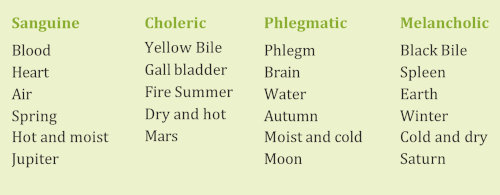
Interestingly, the National Library of Medicine hosts an online exhibition examining how the language of these four humors pervades the literary works of Shakespeare: And there’s the humor of it. 2 In Elizabethan times, ‘humorism’ as taught by the physicians of Ancient Greece was still the prevailing medical theory. According to the exhibition, the humours were thought to be “connected to celestial bodies, seasons, body parts, and stages of life”. Carried by the bloodstream, they bred “the core passions of anger, grief, hope, and fear – the emotions conveyed so powerfully in Shakespeare’s comedies and tragedies”. The National Library of Medicine finds a connection between Shakespeare’s age and our own in the common understanding that “the emotions are based in biochemistry and that drugs can be used to alleviate mental suffering”.
While this perspective limits medicine to the realm of effects, a more causal approach to balancing the four human temperaments is practiced in Waldorf education in accordance with Rudolf Steiner’s teachings. “Temperament”, said Steiner, “stands between the things that connect a human being to an ancestral line, and those the human being brings with him out of earlier incarnations”. 3 Waldorf education pays close attention to harmonizing the four temperaments into what might be regarded as a good and wholesome ‘sense of humour’ – the quality that H.P.B. considered to be the second most important thing necessary for esoteric training. And when this is combined with the first and third most important things – common sense – the disciple achieves that most important of goals on the path – spiritual balance – a dynamism that is wonderfully portrayed for us in the motion of the gyroscope.
We might equate the ‘adaptive stability’ of the gyroscope with the ‘immovable will’ of those spritualised human beings who have achieved an inner calm at the centre of their being. Such people recognize their own centre in relation to the centre of others and so demonstrate a dynamic social awareness. They know how to share psychological space with others – holding all relationships in a state of joyful, spiritual tension. And where we see the gyroscope demonstrating the maintenance of its orientation regardless of how the frame around it is moved – we see in advanced human beings an unswerving alignment with their spiritual source, no matter how much the buffeting forces of the surrounding environment may attempt to divert them.
With regard to the pure physics of gyroscopic motion, a great authority on the subject was Eric Lathwaite, who became known as the ‘Father of Maglev’ for developing the technology of magnetic levitation on which the high-speed, wheel-less trains of Japan, Korea and China run. He was, nevertheless, branded a heretic for maintaining that the gyroscope displays a “levitational capacity” that defies the laws of classical physics. 4 In more recent times, the physicist, Wal Thornhill suggested that the spin of the gyroscope offsets its atomic nuclei to the extent that “it becomes more strongly influenced by ‘cosmic attractions’ than by Earth’s gravity, perhaps even repelled by the Earth”. 5 This explanation is mentioned because it seamlessly bridges between exoteric and esoteric science; it also provides a key to understanding the subjective correspondences to levitation.
From the perspective of esoteric psychology, the ‘substance of the mind’ has to be brought into a state of rhythm or harmonious vibration. It is “the attainment of the point of perfect balance and of equilibrium. This point of perfect balance then produces... [among other things]... the liberation of the essence which the form confines”. 6 Through the reconciliation or balancing of the psychological forces and counterforces that operate on the lower planes of manifestation, consciousness is released along the ‘narrow razor-edged path’ (the noble middle path of the Buddha) that leads between the pairs of opposites into the kingdom of the soul.
Paradoxically, pilgrims on the path travel by standing still. Through meditation, study and service, the spin of all the atomic lives that comprise their bodies of manifestation is accelerated to the point that their hold on consciousness is offset. Then, in Alice Bailey’s words: “When the point of rhythm or balance is reached…then the occupier of the form is loosed from prison; he can withdraw to his originating source, and is liberated from the sheath which has hitherto acted as a prison; and he can escape from an environment which he has utilised for the gaining of experience and as a battle ground between the pairs of opposites.” 7
In this difficult transition period, humanity is faced with the collective challenge of balancing the pairs of opposites and safely moving into the Aquarian age. It is therefore heartening to know, that in this transition period through which the world is now passing, the influence of Libra – the sign of balance and equilibrium – is “steadily coming into pronounced control and into a position of power in the planetary horoscope”. 8 As the forces of political polarization divide and ravage societies across the globe, let us take hope from this fact and trust that humanity will, in time, acquire the common sense and good humour needed to find its centre of spiritual balance, raise its vision into the light, and affirm the great keynote of this sign: “I choose the way which leads between the two great lines of force.”
In the companionship of the One Work,
Headquarters Group Lucis Trust
- Sylvia Cranston, H.P.B: The Extraordinary Life and Influence of Helena Blavatsky, p.337.
- And there’s the humor of it, National Library of Medicine, www.nlm.nih.gov/exhibition/shakespeare-and-the-four-humors/index.html
- The Four Temperaments. GA 57: Rudolf Steiner Archive.
- www.youtube.com/watch?v=NnonSwMn4Ig&t=53s
- Wal Thornhill, The Long Path to Understanding Gravity, www.youtube.com/watch?v=YkWiBxWieQU
- A.A. Bailey, A Treatise on Cosmic Fire, p.158.
- A.A. Bailey, A Treatise on Cosmic Fire, p.159.
- A.A. Bailey, Esoteric Astrology, p.238.
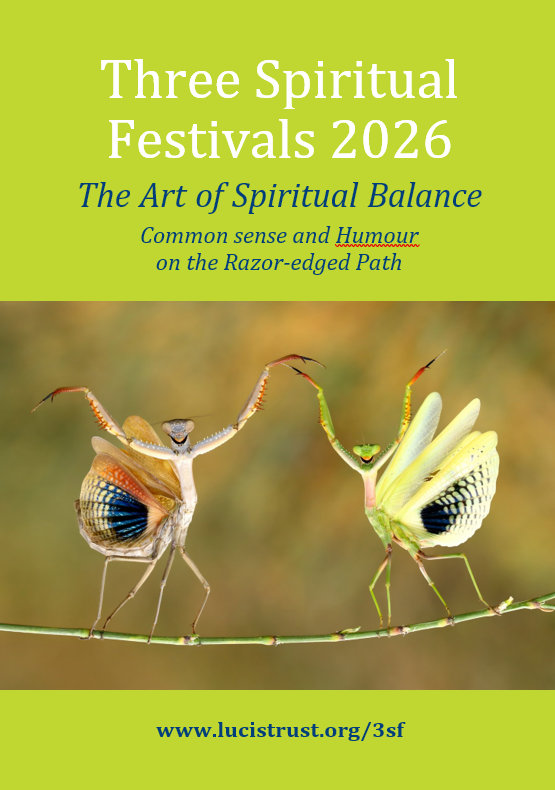 View UK version |
View US version |
THE THREE SPIRITUAL FESTIVALS
The sun’s symbolic passage through the zodiac brings into focus the subtle energies it represents and marks the year’s spiritual progress. The higher interlude of this annual cycle begins in Aries with the spring equinox in the northern hemisphere and continues through Taurus and up to the solstice at the close of Gemini. The three festivals of Easter, Wesak and Goodwill celebrate the fresh divine energies that set the tone for the service initiatives to come.
The Easter Festival brings the restoration of life force from the mind of God, stimulating creative mental activity; the Wesak Festival follows with enlightenment emanating from the heart of God related to divine understanding and love-wisdom; and, from the will of God, the Festival of Goodwill vitalises constructive forces, synthesising energies, that help transform theoretical unity into a practical, spiritual unity – the divinity within humanity. These festivals focus on the divine vibration received and offer the opportunity to consciously engage with the renewed spiritual influences, facilitating their fuller expression in personal and group life.
Further information about the Three Spiritual Festivals, their meaning and influences is available via the links below. For information in printed form, please use the contact details at the bottom of this page.
www.lucistrust.org/3sf/how_can_we_help
www.lucistrust.org/3sf
www.lucistrust.org/3sf/resources
Festival of Easter (Aries) . . . . . . . . . . . . . . . . . . . . . . . . . . . . . . . . . . 1 April 2026
Festival of Wesak (Taurus) . . . . . . . . . . . . . . . . . . . . . . . . . . . . . . . . . . 1 May 2026
The Festival of Goodwill,
Christ’s Festival and World Invocation Day (Gemini) . .. . . . . . . . . . . . . . 31 May 2026
See https://www.lucistrust.org/events for the actual days of the Festival Meetings
held by Geneva, London & New York headquarters
A NEW DAWN
It happens, almost without your knowing it: the rising sun. In the pale light of the early morning, before you’ve had a chance to notice, it happens: the new day is full of brilliant light. In those few moments of early dawn the earth turned, and your world is transformed from darkness to light. In one degree of earth-turn great changes take place. All up and down the hemisphere, millions of people like you are suddenly motivated to get up and start a new day. It is a small change but it has widespread results.
A similar effect can be seen when a person shifts his or her personality focus one degree inward towards the soul. That small turn of the personality life is sufficient to let a considerable amount of light into that person’s consciousness. The light of the soul is illuminating and enables a person to see the world in a new way, with new eyes. This small expansion of awareness can produce a major change in the way one conducts his or her outer life. And one illuminating lifetime may be all it takes to set the expansion process in motion. One lifetime is but a moment in the long history of the soul. But, as with the rising sun, great changes take place in that small turn of the personality life.
Spiritual initiatives, such as Triangles, are helping to deepen the rapport between the lighted and the material realms. This awakening of the individual personality life is not an isolated event; in fact it’s happening worldwide. Millions of people are becoming more sensitive to the soul’s light. And this illumination is creating, in many countries, progressive changes. It is the collective effect of millions of people turning towards the light that creates a critical mass of sufficient intensity to express a new quality in human consciousness. This has led, for example, to a tremendous worldwide growth in philanthropy, in service and aid agencies and in the founding of thousands of NGOs. This growth in the collective will to share resources and meet human need—a definite soul quality—is seen in the huge spontaneous worldwide outpouring of money and aid for the victims of tragedies and natural disasters. Tremendous energies are released by the movement of the earth’s tectonic plates. Likewise, human energies are released when the crisis of death evokes the soul of the world. It happened before anyone could notice it: the earth moved, literally, and a new consciousness appeared on the horizon.
As consciousness turns inward—even by a small degree—the inpouring light sensitizes the heart into action. The ability to feel deep compassion is more widespread than we realise. It is evidence that the mind that is in Christ is emerging. Just by being who we really are—spontaneous, sharing souls—we are creating that pathway of light for the feet of the Coming One, the World Teacher.
***
If the light rises in the Sky of the heart… and, in the utterly pure inner man attains the brightness of the sun or many suns… then his heart is nothing but light, his subtle body is light, his material covering is light, his hearing, his sight, his hand, his exterior, his interior, are nothing but light.
Najm Razi, 1256
SPIRITUAL ARTS
We cannot talk about art without also talking about beauty. For the search for beauty and its expression in form is one of the main reasons for the existence of art. At a materialistic and superficial level, art is often used to divert and entertain, but throughout history we find that art has also been consciously employed as a spiritual tool to awaken us to the beauty of the soul at the heart of the cosmos, and the beauty in every human soul too.
It is perhaps true that the greatest artistic achievements of the past have flowered as an expression of the religious impulse. But spirituality embraces a far wider panorama of human thought, aspiration and activity than the purely religious. Beauty can be perceived in all things, and artists of every kind have always known this. Whether we look at music, painting, drama, poetry or dance, examples abound of composers, artists, actors, writers, and choreographers whose work is inspired by the soul. They have taken the mythical events that eternally express the great archetypes of the human psyche, embodying them in a form that has given these a meaning and power for their own time. Through their own sensitivities they have enabled us all to become more sensitive to the wonders of our environment. They have also grappled with the mystery of the unfolding divine plan and through their work have been able to focus our thoughts on a constructive use of the new energies that are constantly making an impact on human hearts and minds.
A wonderful example of this is the collaboration of the artist Nicholas Roerich, the composer Igor Stravinsky and the dancer and choreographer Nijinsky in creating the famous ballet “The Rite of Spring”. This caused a riot when it was first produced in Paris in 1913. Yet now, many more years later, we can see it as an archetypal embodiment of the incoming energy of order, ritual and regeneration, with the potential to bring new life, new understanding and new civilisation to a humanity about to be ravaged by the first World War in 1914.
Great art, spiritually inspired, is never bland. It always breaks new ground in ideas, frequently in style and especially in the evocation and perception of beauty. As such it often has an initially disruptive effect as it breaks down conventional attitudes and accepted standards of taste. But if it is truly great, and therefore spiritual, it will also be able to reveal hitherto unrecognised aspects of beauty and truth embodied in the universal mind.
The best of television drama does just this. When the British screenwriter and journalist Dennis Potter died, commentators spoke of his stature as an artist. His work had always been controversial, at times portraying the more sordid side of life. Yet, as critics made clear, he used his art with intensity and integrity as a mirror so that we could see ourselves as we truly are, souls embedded in a material world with personalities which can sometimes measure up to the noblest ideals and transmit with purity the qualities of the soul, but which can at other times block these out.
The artistic life of humanity is immensely rich and varied. To get an idea of its range, think for a moment of the long tradition of imaginative storytelling, Italian renaissance painting, indigenous peoples' art, Greek tragedy, Indian temple dancing, Beethoven – that great musical apostle of humanity's search for and realisation of freedom, and the many contemporary experiments in new forms of expressing beauty.
Nevertheless, we can see that from a spiritual point of view the purpose of art is surely something very simple. This something is the recognition that beauty can powerfully reveal the deep truths of existence; in fact more than this – in a mysterious way beauty is this deep truth. As Khalil Gibran wrote in The Prophet: “Beauty is life when life unveils her holy face. But you are life and you are the veil. Beauty is eternity gazing at itself in the mirror. But you are eternity and you are the mirror.”
THE ETERNAL STREAM
Eternal life flows unconditionally from the heart of our sun to all of existence within our solar system. Its physical effects, heat and light, give sustenance to the myriad of forms upon our planet. Its higher correspondence nurtures the development of consciousness and the ability of every planet, planetary centre, kingdom and individual life to reveal its spiritual nature. In understanding the ebb and flow of divine energy into our planetary scheme, such as the full and the new moons, comes increasing responsibility to work with these available spiritual energies to renew the divine circulatory flow and to link the higher and the lower worlds.
The Ageless Wisdom teaches that the human family occupies a unique position pendant between the spiritual and the material. Humanity stands as a bridging kingdom, which will eventually convey the loving purpose of God to all of the diverse life-forms that embody the lower levels of embryonic consciousness, and consequently promote them into a new cycle of spiritual unfoldment.
What, then, interrupts the divine flow of spiritual life throughout the planetary whole, emanating from the Secret Place of the Most High down to the atomic matter studied by science? It is a lamentable, yet thought-provoking notion, that humanity is both the cause and the solution to this planetary dilemma. If humanity is to fulfil its destined role as an outpost of the consciousness of God upon the planet, then one of the many prerequisites leading to this momentous development will be the flowering of right relationships.
In our Triangles work, we are offered a profound opportunity to act as a bridging group, as relaying points of energy, relating humanity to its divine source. Each time we engage in our daily Triangles, it is as if we complete a divine electrical circuit allowing the life and light of spiritual essence to connect with the human family, offsetting the resistance of materialism. And, in so doing, we help to raise the developing lives that constitute the animal, vegetable and mineral kingdoms. For they too have a profound purpose to fulfil for the good of the whole.
We all recognise that the maintenance of a healthy form requires the free flow of vital energy throughout all the organs of the body. So, correspondingly, too, the well-being of all life upon our small planet is dependent upon humanity awakening to its divine purpose, so that ultimately the Will of God may progress unimpeded from point to point, from sphere to sphere and from glory to glory.
March 2026
Aquarius New Moon
Aquarius New Moon
New Moon Meditation Meeting, New York
February 16, 2026
Welcome everyone. Thank you for joining us tonight to work together with the energies of the Aquarius new moon. For those of you who might be new to these meetings the format opens with a talk, followed by a group meditation and closes with a time for group discussion.
At this Aquarius new moon we are entering a powerful time because it is accompanied by an annular, solar eclipse. The appearance of an annular eclipse is quite striking, the moon is surrounded by a ring of fire. This brings to mind the task of the disciple which is to burn away the dross of the lower self. Esoterically understood the moon, in one sense, represents that lower self, the embodiment of an ancient thoughtform. As the dead shell of the lower aspects of oneself are burned away, the path is made straight for the influx of the veiled planet Uranus, the Hierophant or Initiator through which the illusion of the lower self fades from view.
Eclipse cycles occur in the same pair of opposite signs over a period of 18-24 months and this new cycle will surely be monumental. We are shifting into the Aquarius-Leo axis which mirrors the larger cycle of the precessional age and is supportive of Aquarian energies. And Leo provides the integrated vehicles through which the higher energies can pour.
Eclipses heighten the already intensified energies surrounding the new and full moon periods. They are inlets for the influx of the spiritual will, an influx which has been stimulated by 2025’s hierarchical conclave and the accompanying first ray impulse from the highest center Shamballa. A solar eclipse is generally recognized as a time of beginnings and there are other astrological factors at play now that present similar signatures of rebirth and the inflow of new life. As disciples we are charged to use the tools at our disposal to provide a group channel through which the energies can find expression and turned towards the purposes of the Plan.
We know O Lord of Life and Love about the need,
Touch our hearts anew with Love, that we, too, may love and give.
The Aquarian age, conditioned by the seventh ray supports the forces of manifestation and the creation of new forms. This combination of energies is and will continue to electrify the planet. As we pass through the many challenges arising on all sides today, a symbolic passage describing the direction of Ray VII is perhaps useful for us to consider in relation to the task of the new group of world servers. The picture emerges of a man sitting between two rooms with a teetering arc above his head. His back is to the room full of peace and calm and direction. In front of him is a room he’s been staring at for ages–a room of chaos, despair and disorder which has left him bereft as to what to do. This room is both the outer world but it is also that which is within himself. He is focused on the failures all around and within.
Then, through an impulse from the soul he shifts his focus and turns the other way. He looks at the room of peace and quiet. Then, through an influx of energy from his soul he is transformed and becomes a distributing center of soul life. He turns again to face the room of chaos and begins to see beneath the outer fragmentation and an expanded perspective unfolds before him. He sees the world with new eyes and the pattern of the Plan begins to emerge. This transformation, this ability to view the world through a new lens, is the potency contained within the new group of world servers.
The Tibetan provides us with keynotes which encapsulate the qualities of soul light which each sign emits. The keynote for Aquarius is arresting and holds out the promise of the coming age. The soul light of Aquarius is “that [which] shines on Earth, across the sea. This is the light which ever shines within the dark and cleansing with its healing rays that which must be purified until the dark has gone.” We know that our Earth, our Logos, is in process of becoming sacred and this involves the establishing of those conditions through which there evolves a greater responsiveness to light on the part of all three planetary centers. A key to the Logos’ ability to make this shift is connected with the process of group initiation which is evolving now as we enter Aquarius, the sign of group work. This achievement on the part of humanity we’re told is affecting changes within the highest center Shamballa and this for the first time in the long history of humanity. It is this group initiatory achievement on the part of humanity that we’re told makes possible the initiation of the Logos himself.
The result of this initiatory cycle will involve the emergence before our eyes of a new divine quality. The Tibetan calls it the emergence of a solar characteristic which is slowly crystallizing into manifestation. This use of the term “solar characteristic” relates this emerging quality directly to the Great Invocation which he called a solar instrument The Invocation here is seen as an invocation to the Sun itself and to Sirius, the great Sun of Suns which pours forth from the heart of the Sun. The Tibetan wrote, “The Great Invocation…is a potent solar instrument designed to bring about changes and needed readjustments. It is so powerful that when it was suggested for general use in the world of men some opposition was evoked among the members of the Hierarchy because They feared its potent effects upon the unready, and undeveloped people. Its use has, however, been justified and it is desired that its usefulness should be very greatly increased and its use far more widely spread.” This solar characteristic that is emerging appears to be an influx of light that is reflective of that which occurred long ago on Venus, Earth’s higher self.
The second part of the Aquarian keynote appears to be active at this time, “...the light which ever shines within the dark and cleansing with its healing rays that which must be purified until the dark has gone.” The harshness and horror that is presently being revealed is of long-standing duration. Crimes, corruption and abuse by the rich and powerful upon the most vulnerable is nothing new but it is coming to light in a manner that people are listening. Previously such things were dismissed by people of goodwill because they could not or chose not to believe or simply closed their eyes to the sheer horror of what was being revealed. So as the light shines upon the dark we as citizens have to be willing to stand the pain of revelation and take steps to assure that people are held accountable. This involves the mobilization of public opinion which is happening, particularly among the young. It will lead eventually to reforms and new systems of governmenal and global structures coming into manifestation as well as legislation for the protection of children
This darkness, this under-belly of our planetary Life has for ages been hidden from view. This is all wrapped up in the mysteries of the matter aspect that is working out on planet Earth illustrated by our very name. These mysteries are hidden within the sign of Capricorn which has a close link with the sign Aquarius. Capricorn, a sign of deep contrast, representative of both the highest and the lowest aspects of human nature. Humanity must resolve this situation. We’re told that “man is given the task of raising matter up into heaven, and of glorifying rightly the form side of life through his conscious manifestation of divine powers” It is not through ordinary means that this task can be accomplished. It involves concerted effort and fortunately this Capricornian influence that pours in via the Festival Week provides this group with strengthening in full measure.
Capricorn and Aquarius are also linked through the planet Saturn. Prior to the discovery of Uranus, Saturn governed in both signs. In Capricorn Saturn governs both exoterically and esoterically. Exoterically it is the planet of karmic wreckoning. For those individuals who have not yet placed themselves on the path of return the unredeemed Saturn holds a powerful grip. This includes people who despite their high intelligence have chosen the left hand path, the path of immersion within matter. For individuals who are aligning with the soul’s light, Saturn becomes the tool through which one moves forward into light, undeterred by the inevitable obstacles along the way. Saturn then no longer functions as the conveyer of disaster and becomes that which fixes the person decidedly upon the mental plane. For those individuals caught in the grip of the materialistic forces, the strong influx of Saturnian and Capricornian energies signals the crumbling of the mountains of accumulated karma. For the disciple, they strengthen the group to press forward no matter what the odds, doing what they can to prepare the way for the externalization, evoking the Great Ones to emerge from their mountain retreats.
Capricorn and Aquarius are also linked through the light supernal. This is the light which pours in upon the mountaintop of initiation. This is the light which can only be contacted through means of the group. The light supernal is a key quality of Capricorn and it becomes available when the Sun is in Aquarius accompanied by the seventh ray. This is a rare occurrence which has only come into play six times in the last million years. Each time it does, it results in illumination and the emergence of this supernal light. The difference now with this seventh instance of this combination of energies lies in the sheer amount of people who are responding to this light and taking the higher way.
The next Festival Week takes place in December, augmented by the fact that this year it contains a full moon.This period is an outgrowth of the Law of Group Progress, governed by Capricorn, the seventh ray and its symbol is the mountain and the goat. The goat here stands for the discipleship group and this special week is a week dedicated to the new group of world servers. The energies that are pouring into our planetary life are such that they can only be safely appropriated in group formation.
The subjective work which we are called to do as we move forward into the new age, no matter what other outer form of service we might undertake, is concerned with this growing ability to work in group formation. This is the key to what is possible and this is what is being demanded at this time. An understanding of group work is as yet in its infancy but things are accelerating now and surely the years ahead will see rapid progress. With each passing decade, those who are coming into incarnation are increasingly free from the drag of the outgoing dispensation and are therefore possessed of an elasticity within consciouosness which enables them to respond more adequately to the opportunities of the time.
As a result of the 2025 Conclave, the accumulated impact of the Festival Weeks and the impacts from Shamballa there has been a great elevation – the Law of Group Progress has for its esoteric name The Law of Elevation. As a result all along the chain of Hierarchy there has been forward movement. Hierarchy has been lifted up in its position within the Triadal planes just as the discipleship group has moved into a deeper hierarchical affiliation. Through the intensification of the light to which humanity has been subjected the group is coming into its own as a functioning center within the planet. The promise of this turning point in planetary history comes through this working out of the group life.
Materialism and the Transmutation of Desire
Materialism and the Transmutation of Desire
New Moon Meditation Meeting, New York
January 16, 2026
Michael Galloway
Hello everyone and welcome to this new moon meditation meeting.
At the new moon we work within the lower interlude of the monthly cycle. Lower interludes are generally concerned with the process of spirit moving into form, so with objectivity and expression. It is a time to consider what it really means for the soul to be externalized and or “made flesh” and how we can each aid in the manifestation of the Divine Plan on Earth.
The lower interlude is often looked upon as a time to focus on the distribution of spiritual energies, though technically the lower interlude is the period of preparation which precedes that distribution. In our meditation work, energy is contacted, appropriated, focused, and then sent forth on its mission. But before it is sent forth, the ways and means by which it is to go forth must be visualized and the thoughtforms through which it is to work must be prepared. These final preparations are made in the lower interlude. Distribution, we might say, follows upon the scientific use of both interludes as a daily habit; it is the right employment of energy in service.
When reflecting on the interludes we are confronted immediately with the basic trinity present in all spiritual work: the lower, the higher, and the mediating agent (the soul) which links the two. Our work is fundamentally scientific work, but it is also magical work, which means that it is creative, and that it has to do with thought, for thought is the basis of all energy direction. The right use of the interludes therefore requires first of all mental polarization. The soul operates upon the mental plane and from there it directs and governs through the employment of three minds. Our work in meditation at the new and full moons is effective to the extent that we are able to work as souls, on the plane of mind, and with all three aspects of mind, in both interludes, and with the period of meditation which we might liken to an intercessory activity between the two.
This new moon occurs in the sign of Capricorn, a sign of both deep materiality and of high spiritual triumph. It is a good time to reflect on the dual nature of all things, and the fact that Life is just as present in the highest expressions spirit as it is in the lowest expressions matter and of course everything in between.
This new moon meditation meeting will include a short presentation on the Problem of Materialism and the Transmutation of Desire. We will then have a meditation followed by a group discussion.
NGWS Mantram
May the Power of the one Life pour through the group of all true servers.
May the Love of the one Soul characterise the lives of all who seek to aid the Great Ones.
May I fulfill my part in the one Work through self-forgetfulness, harmlessness, and right speech.
When considering the problem of materialism, we are confronted with a basic—maybe the basic—problem of form. It is a problem which is universal and perennial, and is very much tied up in the nature of duality itself—so we could say archetypal as well.
In the esoteric science, number is the basis of all that is, and so a very effective means of looking at cause and effect in a deeply foundational sense.
The entire Esoteric Cosmogeny can be narrated through the progression of number. From the Zero (The Absolute) emanates the One, Two, and Three at which point the worlds are formed and creation begins as Three again, then Seven, and eventually the Twelve which symbolizes the many and all subsequent numbers. These numbers, being the basis of all manifestation, are reflected again and again throughout it.
Within this cosmogeny we have Spirit-Matter (the basic archetypal duality) producing the objective universe; it does so through the medium of a third factor which is always and at every level Consciousness. This is why esoterically, the entire universe is said to be modeled on the basic form of the Triangle. Consciousness extends from the very highest to the very lowest. Once Spirit and Matter are brought together, there is no duality which is not also a triplicity.
The problem of materialism is basically a problem of desire and of form-attachment. Matter itself is not the problem. What we call the problem of materialism is fundamentally a problem of consciousness because it has to do with the relationship of the self and the not-self. This basic duality is the fundamental spiritual problem faced by all aspirants as they tread the path. Today, it is increasingly being recognized as a problem by Humanity as a whole.
The average aspirant or person of goodwill may look at one of the many versions of this problem of form-attachment and find themselves sort of stuck somewhere within this duality: striving for the higher, for the good, for virtue, but not quite able to relinquish the desire for or attachment to the lower pull of form. Aspiration is present, but not yet the capacity and experience to fulfill it.
Every spiritual problem can be boiled down to some version of this basic duality of right relationship between higher and lower, right or left, spiritual and material, personality and soul. Even if this duality may oversimplify it from the exoteric angle, the solution is always to bring in the third factor which is in every case the soul itself.
What this looks like in context varies. The soul as the “third factor” often appears “outside” the scope of the duality or problem under consideration, yet at the same time may be discovered “within” it. Sometimes rather than resolving the duality into a singularity, the soul actually preserves the relative truth of both ways. Sometimes it opens a third and new way or choice. Sometimes this third way perpetuates the duality, sometimes it abolishes it, sometimes it absorbs it. Sometimes it does all of these things simultaneously. In every case, the soul models its work upon the Plan. The forms and circumstances necessitated by this Plan may not always be what we think.
The soul as agent of the Plan is the perennial factor which resolves every pair of opposites and holds the key to every paradox—it does so paradoxically by establishing duality—the basic duality of the Plan and its expression on Earth. Psychologically, the soul is both the seat of individuality and also the group itself. It is both One and Many, it is both the higher and the lower. The soul is present within the form, but it also that which substands or overshadows it. But the soul is not the form. It is neither the form on the right nor the form on the left; the soul is consciousness. It is a bridging agency, a bridge which carries salvation from the higher worlds. But this bridge only operates when one “becomes” the soul as a living fact. This “becoming” is what we mean when we speak of service. The redeeming force of Hierarchy requires a living medium through which to pass—the soul (the self) in full incarnation is this vehicle.
Soul consciousness is essentially the factor of self or the “one who knows himself to be”. It is the basis and foundation for the discovery of all that which is true and real. Man must know the divinity within himself, before he can begin to know God in nature.
When we say that soul consciousness is something which must be discovered, what this means is that it is a knowledge which is ultimately derived from one’s own experience. It is not something which can be learned from a book. This is because it has to do with the full objectivity and expression of the subjective life. Often very drastic and transformative measures are required to facilitate this process of externalization—a process which is also called the great reversal of the wheel or the treading of the Path.
On this Path, one must dramatically shift one’s center of identity and polarization out of the desire body and into the mind. This is far more difficult than most realize.
There are many misconceptions about what mental polarization is and how it is achieved. It is far more than just developing the intelligent mind and learning to control one’s emotions. It has to do fundamentally with the transference of energy and the transmutation of desire or astral substance.
The astral or desire body is a medium between man’s thought-faculties and the sense perceptions of the physical world. Blavatsky described it as the storehouse of all psychic iniquities. It absorbs all that man has put into it over the ages and today is like a great pollutant surrounding the Earth, acting as a source of great moral and physical suffering for humanity. It is today like a great barrier—a crucible through which every aspirant to soul consciousness must struggle and pass. Another name for this great cloud of suffering is glamour, it can be imagined as a dense fog surrounding the thoughtforms through which the human mind operates, thereby obscuring the truth. To really achieve mental polarization, one must learn to identify this glamorous substance and observe the way it distorts and veils human thought, speech, and action. The strength of glamour lies in the fact that we are blind to it—we cannot see it. The ability to see glamour from the right occult altitude is the key to its dissipation.
It is the soul that sees, but bringing the perception of the soul into operation requires first of all the practice of dispassion and discrimination as a daily and regular habit. It also requires daily meditation wherein a bridge in consciousness is established which links the soul to all aspects of its form.
This is the basis whereby the dynamic power of the soul is cultivated. This Power is basically the ability to see reality and to fundamentally change the form. The soul works above and sees the Plan, and it lives below and through the form, lifts and redeems the lower worlds.
One stage of this redemptive process—wherein the form is fundamentally changed—is called transmutation. Esoterically, transmutation is the means whereby force is changed into energy and that which is lower is absorbed into the higher. This occurs through the magnetic effect of soul contact, scientifically, consciously, and rhythmically induced.
This is distinct from the approach of many well-meaning aspirants who simply attempt to establish the jurisdiction of the soul through the imposition of the will in an attempt to negate the form. Opposing the form in this way is not soul-power. It intensifies the already established astral polarization, leading basically to suppression and in almost every case failure. Only the third factor (soul) can resolve duality, putting matter, form, and desire each in their proper place.
There is great need today for humanity as a whole to establish a scientific understanding of the soul as foundational in the thinking through of solution to humanity’s problems. Esotericism—which is essentially the science of the soul—offers a paradigm of duality and its resolution which has the potential to revolutionize almost every discipline if it were understood and applied. More than that, scientifically induced soul consciousness at a racial level would end the reign of materialism and thereby place the matter aspect in its rightful place as a divine vehicle for the indwelling life. Established soul consciousness would also clear the entire astral plane of glamour and it would mean that the thoughtforms upon which human civilizations is built would be displayed in the full light of day, and the spiritual sustenance of a higher plane would then precipitate down through them to all like a heavenly golden rain.
This worldwide expression of soul consciousness is exactly what is meant by the statement that the solution to every one of humanity’s problems is the reappearance of the Christ. Christ, the World Teacher, is the soul of the planet itself. Because the soul is both the Many and the One, we have in the person of Christ the planetary soul externalized as One and that same principle of soul externalized in Humanity as Many. In this basic juxtaposition you have again the soul linking and resolving a basic duality.
2026 Full Moon Talks - London
World Goodwill Newsletter 2025 #2 Hope as a Spiritual Potency FLIPBOOK

While for many the mounting and interrelated crises in human affairs at this time leads to a stultifying sense of hopelessness, this issue of the Newsletter focuses on its antidote: hope as a spiritual potency rooted in that place where heart, soul and spirit unite. World Goodwill’s work is inspired by ideas in the Alice Bailey books, including the prophecy of an important Hierarchical Conclave in 2025 ultimately leading to a crisis in humanity, bringing unusual opportunities in the years and decades to come for initiatory-type advances towards a new moral order.
In 2025 the Catholic church (representing a little over 17% of the global population) having passed through an important Conclave to select a new Pope, is observing a Jubilee Year under the motto ‘Pilgrims of Hope’, with a call to ‘turn debt into hope’. Furthermore, the UN General Assembly voted this year to observe July 12th annually as International Day of Hope.
May the articles which follow help you explore the nature and meaning of hope during this time of spiritual crisis, always remembering that hope is a central quality in most religious and spiritual traditions.
Download the Newsletter in PDF
World Goodwill Newsletter 2026 #1 The Spiritual Dimension of the Nation

This issue of the Newsletter explores the idea of nations as living psychological and spiritual entities, each with their own soul. This higher dimension of the collective psyche holds blends of qualities to form a reservoir of energies destined to shine through the life of the nation as it proceeds on its path towards ultimate integration and wholeness. The blend of qualities for each national soul is distinct.
Humanity’s entrance into a new level of international integration is dependent upon, and proceeds in harmony with the integration taking place within each nation. A more truly whole and integrated world will surely be a world of almost infinite diversity as each nation draws increasingly on its soul to become its true and integrated self.
As the articles which follow illustrate, people of goodwill provide a useful service by training themselves to seek out and observe the qualities of their own nation’s soul, noticing its expression in the tumultuous events of the current period. Discernment grows as this work of observation consciously aligns with the soul of the observer.
Download the Newsletter in PDF
Réflexions sur l’Ame Nationale
Kimberley Riley
Quel bénéfice peut-on tirer de l’idée que les nations aient une âme ? La plupart d’entre nous luttent pour comprendre et honorer notre propre âme, encore plus pour saisir ce que pourrait signifier l’âme de notre propre nation, ou les âmes de tous les états qui ont constitué l’humanité au cours de nombreux millénaires, ou qui constituent le monde tel que nous le connaissons aujourd’hui. La migration mondiale complique davantage le problème. De nombreuses nations sont actuellement composées de personnes venant de nombreuses régions du monde. La diversité culturelle modifie-t-elle l’âme nationale ? Et puisque l’idée de l’État-Nation est relativement récente, qu’en est-il des âmes de toutes les autres formes d’organisation étatique — les empires, les royaumes et les chefferies du passé. Ont-ils aussi des âmes ? Ces âmes continuent-elles d’exister en tant que vestiges de civilisations passées ? L’esprit pratique ou académique peut voir de nombreuses complications avec l’idée d’une âme nationale, et pourtant si nous pensons à l’âme nationale comme un réservoir vibrant d’énergie, prêt à aider la croissance humaine, tout comme notre propre âme aide à notre développement personnel, nous pouvons trouver une source d’inspiration utile pour promouvoir activement la bonne volonté dans la communauté mondiale.
L’une des grandes difficultés à réfléchir sur l’âme d’une nation provient du fait que le terme « âme nationale » ou « âme de la nation » a été utilisé, souvent trop librement, pour désigner de nombreuses facettes différentes de la vie nationale. En dehors des cercles philosophiques ésotériques, il n’y a pas de définition communément acceptée pour ce qui pourrait constituer l’âme d’une nation. Quelques exemples illustrent ce point. Cherchant à susciter un sentiment d’urgence ou à invoquer la morale, les politiciens se réfèrent souvent de manière hyperbolique à leurs campagnes agissant pour « l’âme de la nation » sans jamais expliquer ce que cela pourrait signifier au-delà d’un cri de guerre excitant pour leur électorat, ou une vague référence au sens moral national. Dans ce contexte, l’âme connote des normes éthiques ou une philosophie politique particulière considérée par les partisans comme particulièrement morale dans son opposition à d’autres groupes politiques. Après la Seconde Guerre mondiale, il était courant que des érudits ou des observateurs politiques expliquent les origines de la guerre et de l’holocauste, non pas comme des décisions politiques prises par des dirigeants particuliers, mais comme faisant partie d’une âme nationale plus large, une sorte de péché originel émanant du peuple lui-même.Alternativement, de nombreux auteurs utilisent « l’âme » pour se référer à la langue et à la culture comme le font Thea Dorn et Richard Wagner dans leur livre de 2011, L'âme Allemande. De même, des œuvres plus anciennes, telles que celle du Bushido : L’âme du Japon d’Inazo Nitobe (1900) ou L’âme de l’Allemagne de Thomas F. A. Smith (1915), situent l’âme nationale dans l’expression culturelle et la forme linguistique fondamentales. Bien que les chercheurs d’aujourd’hui soient moins susceptibles d’utiliser le concept d’âme nationale pour expliquer le développement politique ou historique, nos esprits conservent encore de manière floue beaucoup de ces concepts, et des livres avec des titres comme L’âme de la Russie, ou L’âme de la Chine sont encore écrits par des auteurs qui prétendent révéler l’identité cachée d’un groupe national ou animer la force vitale à travers les habitudes, la culture et les ambitions politiques courantes. Dans cette forme de langage, l’âme d’une nation est obscurément cachée dans les choix alimentaires de ses habitants, la langue, l’humour, l’art et la littérature, ou dans les tendances politiques récentes ou les politiques internationales.
Mais tout comme l’âme individuelle n’est pas vraiment incarnée dans les goûts personnels, les croyances ou les modes de vie matériels, l’âme d’une nation ne peut pas être limitée à sa politique et à sa culture. Comme nos propres âmes, l’âme d’une nation existe sur un plan supérieur et abstrait, dans l’océan de lumière et de vie, et contient les germes énergétiques de notre volonté collective de vivre, nos meilleures impulsions, notre sens de la communauté et de la bonne volonté, ainsi que le désir d’innovation et de croissance continues. Tout comme l’âme n’est pas corrompue par des échecs individuels, de même l’âme nationale n’est pas corrompue par des échecs collectifs. Les pires impulsions de l’humanité proviennent de son incapacité à voir et à comprendre correctement sa propre énergie spirituelle, et non de la nature du réservoir lui-même.
Si nous voulons comprendre la nature de toute âme collective, nous devons diriger notre vision au-delà des formes extérieures d’expression nationale et de nos propres goûts personnels. Tout comme nos personnalités recouvrent la vie intérieure de notre âme, la politique et la culture cachent également la force de vie intérieure d’une nation. Grâce à la méditation individuelle et collective, nous pouvons percer les échecs et catastrophes visibles jusqu’à la vie qui soutient l’apparence. Les humains commettent des erreurs ; les âmes rayonnent d’énergie. Méditer sur l’idée de l’énergie de l’âme nationale nous élève au-delà du soi limité dans la vie des groupes auxquels nous appartenons. Beaucoup de gens aujourd’hui sont familiers avec la forme de base d’une méditation sur l’amour bienveillant. On commence par rayonner l’amour vers soi-même, puis la famille, la communauté élargie, la nation, la communauté des nations, le cosmos élargi et au-delà. Bien que puissante, cette méditation commence avec l’individu en tant qu’agent, la force d’animation. Et si nous la retournions et voyions le cosmos, la communauté des nations et la nation au sein de laquelle on existe rayonnant l’énergie en retour vers nous. Peut-être pourrions-nous voir l’énergie de l’amour et de la bonne volonté se déverser en flux toujours plus puissants. Comment pourrions-nous alors penser aux nations du monde ? Moins en termes de guerre, de cruauté, d’ambition égoïste, de conflit et de catastrophe, mais plutôt comme puissants réservoirs de lumière et de vie attendant le contact.
La plupart d’entre nous devraient rompre avec les habitudes de leur vie pour voir les nations du monde comme des sources d’énergie spirituelle. En tant que chercheur en histoire et enseignant, je sais que, pour la plupart des gens, l’histoire est une narration du pire de l’humanité. Qu’est-ce que l’histoire sans une analyse de la guerre, de la révolution et de l’ambition humaine ? De même, la politique internationale tend à se concentrer sur les menaces et les échecs. Essayer de « chercher le bon » serait considéré comme naïf au mieux, et un signe de mauvaise érudition, de compréhension limitée et d’échec intellectuel au pire. De plus, pour nous concentrer sur l’idée de l’âme nationale comme réservoir de bonne volonté, nous devrions admettre que nous aimons les histoires de violence, de trahison, de torture et de conflit. En trente ans d’enseignement de l’histoire, je n’ai jamais vu une classe ne pas se lever avec un intérêt passionné lorsque les pires aspects de l’humanité sont exposés. Cette tendance révèle notre propre véritable niveau d’intérêt, notre propre concentration négative et limitée dans un monde à la fois passé et présent qui, aux côtés de la guerre, de la terreur et de l’oppression, contient simultanément des sources infinies de force, de guérison et de bonne volonté. Notre éducation historique et politique traditionnelle forme nos esprits à voir le pire dans l’humanité, en particulier au niveau national.
Mais tout comme nous ne devrions pas identifier nos faiblesses et nos échecs personnels comme représentant nos véritables personnalités, de même nous ne devrions pas voir le pire dans nos nations comme leur réalité fondamentale. Chercher l’âme dans nos nations, travailler à absorber cette énergie dans nos vies et notre expression, c’est amplifier la bonne volonté qui existe, non seulement chez quelques individus et groupes isolés, mais au cœur même de chaque couche de la création, de ses niveaux les plus abstraits jusqu’à nos vies collectives en tant que nations, communautés et familles. En fait, il est difficile d’imaginer une recherche efficace de coopération internationale et de bonne volonté sans ce changement de perception. La bonne volonté imaginée s’altère face à l’hostilité mondiale, mais prospère lorsqu’elle est comprise comme faisant partie de la constitution naturelle des nations. Imaginez comment notre idée de l’humanité pourrait changer si nous avions pour habitude de percevoir le génie créateur au cœur de toutes nos nations, à la fois passées et présentes. Tout comme la personnalité en méditation construit un lien avec l’esprit qui finalement emplit la personnalité d’énergie de l’âme, nous construirions un canal afin que la force spirituelle circule plus librement dans nos vies collectives.
La méditation de groupe de Michael Beckwith, qui ouvre la Journée Mondiale de la Méditation des Nations Unies, « Guérir le monde de l’intérieur », modélise cette nouvelle attitude envers la vie de la nation et les relations internationales. Beckwith affirme quelque chose que nous observons tous les jours sur les réalités sociales et culturelles : « Le monde est la condensation des croyances et des points de vue. » Lorsque nous ne voyons dans notre propre esprit que des conflits, nous sommes susceptibles d’en produire davantage. Mais lorsque nous puisons dans quelque chose de plus élevé que l’activité humaine la plus brute, c’est-à-dire la source de nos meilleures impulsions, créativité et capacité de croissance dynamique, nous aidons activement à faire exister cette signature énergétique. Comme l’indique Beckwith, « nous ne changeons pas le monde par la force, nous le changeons par la fréquence. » Imaginer nos nations, chacune animée par une âme bienveillante qui tend vers nous, tout comme Dieu tend une main vivifiante vers Adam dans la fresque emblématique de la chapelle Sixtine de Michel-Ange, La Création d’Adam, déplaçant notre perception vers le pouvoir potentiel de la fréquence du groupe dans la vie de la nation, et forgeant l’idée qu’il y a quelque chose qui nous atteint, tout comme nous nous orientons vers la force divine. Cette idée d’une âme nationale est à la fois invocatrice et évocatrice. Alors que nous servons de canaux pour l’énergie de croissance et de bonne volonté, de ponts entre l’énergie divine et les valeurs humaines, notre invocation suscite une réponse, changeant lentement la qualité de notre vie nationale collective. Et nous réalisons que nous ne sommes pas seuls dans ce projet. La bonne volonté n’est pas une faible force dans un monde hostile, mais fait partie de la nature de la création elle-même, elle est disponible aujourd’hui comme dans le passé, pour quiconque est prêt à regarder au-delà de ses propres croyances vers la réalité divine.
Télécharger le Bulletin en PDF
Vers Bulletins
A Living Presence at the Heart of the Nation
While the idea of the soul as a real living presence at the heart of a nation has ancient roots, it has largely lost favor amongst historians and commentators. But it is alive in many evolutionary, “second axial age”, approaches to spirituality.[1]
From around 1875, when HP Blavatsky founded the Theosophical Society, through to the period of the two world wars in the twentieth century, a wave of thinkers from all the major faiths developed new, universal understandings of ancient teachings on the relationship between the worlds of human experience and the sacred. Drawing on what was then a very new, dawning sense of interconnectedness and wholeness, humanity was seen to be on a challenging initiatory-type evolutionary path towards a whole new level of integration. As a part of this awakening, spiritual fires of love and wisdom, purpose and power came to be recognised as radiation pouring out from the divine, through the souls of people and nations.
Influential religious thinkers like Teilhard de Chardin (Christian) and Sri Aurobindo (Hindu), along with theosophical writers (notably Rudolf Steiner and Alice Bailey) who carried forward Blavatsky’s work into new expressions, tended to see all the dimensions of world affairs in terms of a dynamic, moving pattern of relationship between the inner forces of the spiritual world and the natural creativity and intelligence of human beings.
It would be naive to suggest that all these thinkers echoed the same view of a national soul, or of a spiritual force flowing through human thought and human affairs. But what they did have in common was the recognition that humanity was on the verge of entering into a new alignment with the spiritual worlds, and embedded within this was an emerging intuitive sense of synthesis that impacted the perception of nations on a path towards increasing interdependence.
Steiner (1861-1925), Aurobindo (1872-1950), and Bailey (1880-1949) all present distinct ways of understanding the souls of different nations and the impact this has on the national story. Drawing on theosophical and clairvoyant insights together with a deep study of Goethe, Steiner delivered a series of lectures in 1910 on ‘The Mission of Folk-Souls’.[2] Spiritual hierarchies, Archangels and Folk-souls relate the spirit of human beings with nationalities. These souls give nations a specific mission as well as physical/etheric aspects of their national character. The people of the Italian and Iberian peninsulas, for example, are said to find expression as the sentient soul, while France expresses the mind soul, Britain the spiritual soul and Central Europe the Ego. As a sort of anima mundi, the nations of the world also emanate distinct etheric auras rooted in the land and its human occupants. “Every one of these etheric auras is in a certain respect a fusion of what comes from the ground and of what has been brought there by the migrations of the peoples.”[3] New waves of migration affect and change the patterns of these auras.
Drawing on the Vedas, Aurobindo, writes that an individual, consciously, “half-consciously” or “with an obscure unconscious groping”, naturally seeks its own self-development, discovering in the process the “law and power of its own being” and acting to fulfil that power. This occurs because the individual is, in essence, “a being, a living power of the eternal Truth, a self-manifesting spirit.” A nation or society is similar, with “a body, an organic life, a moral and aesthetic temperament, a developing mind and a soul.” And so it is that “the primal law and purpose of a society, community or nation is to seek its own self-fulfilment.”[4] This explained, for Aurobindo, the impulse driving independence movements in the colonial age, with Ireland and India described as the first nations to be driven by the impulse “to be ourselves”. He noted that the early expressions of this national urge to a deeper self-consciousness often found expression in “a really barbarous and reactionary crudeness”, tending to repeat “the Teutonic lapse, preparing not only ‘to be oneself’, which is entirely right, but to live solely for and to oneself.”[5] Likewise, much of the history of nations is concerned with their objective anchoring in social and cultural structures, driven by more basic and emotional political and economic forces, whereas Aurobindo saw a new communal consciousness emerging in nations, leading them to aspire to embody the laws and principles of their higher Selves.
Bailey’s primary approach to the relationship between the soul and personality of nations is developed in Destiny of the Nations. This is further expanded in a series of titles, notably The Externalisation of the Hierarchy (exploring, from the perspective of the soul and spiritual kingdoms, the unfolding history of international relations leading up to and including the Second World War), and Problems of Humanity containing a series of articles first published in 1948.
This latter book, which has since been revised several times, considers issues like childhood education, capital and labor, racial minorities, and international unity from the perspective of the souls and personalities of nations and the impulse of an evolutionary plan held in the Mind of God. While the dominant character of the soul (in groups, nations and individuals) is this divine purpose, actuated by love, the personality (the separated self) tends to be controlled by self-centered desires.
“Impressions from the Hierarchy [the kingdom of souls]”, Bailey writes, “have been received, distorted, misapplied and misinterpreted.” It is the task of the group of world servers (all people in all nations who work in some way with energies of soul) to inspire, educate and organize the people of goodwill to freely choose to “offset this evil” of separateness and selfishness and thereby “restore the divine circulatory flow”.[6]
In the Bailey teachings, the soul and personality of a nation are conditioned by seven archetypal energies, seven rays, each distinguished by unique qualities, in association with astrological influences. As the energies of rays and constellations pour into and through each of the bodies of the nation (soul, personality, mind, emotion, physical/etheric) changes in outer affairs are stimulated, often through the presentation by the soul of moments of crisis, generating conflict that will evoke inspirational leaders who can move the nation forward towards greater inclusiveness and a deeper sense of contributing to the common good of all nations.
One key insight from Bailey relates to the wide variety of combinations of ray energies and astrological influences said to characterize specific nations. The diversity of these incoming forces, and the effects they have not only within the nation but also in relations between nations, mean that there can be no definitive literal interpretations, and students of esoteric philosophy must draw on the intuition in their efforts to understand current events.
Second Axial Age spirituality affirms that higher realms of consciousness are leading humanity into an initiatory-type transformation characterized by a response to two primary ideas: one, the oneness of humanity and of all life; the other, the uniqueness and sanctity of every individual human life, and every form of life, bestowing sovereign rights and responsibilities on individuals, communities and nations. The history of this time, and these years following the end of the Second World War and the founding of the United Nations, are all about each nation treading its own path towards right relations between the recognition of the oneness of life in all its manifestations and the recognition of the integrity and sanctity of every individual human being. As an initiatory path, we proceed to new and higher harmonies often through conflict, as age-old forces of separation and materialism resist newer impulses carrying the laws and principles of the soul.
While Teilhard de Chardin has little to say about a nation’s soul, he speaks of love as a geophysical force of attraction, a “radial energy” built into the universe and leading consciousness towards both increased differentiation and sublime unity: “a paroxysm of harmonized complexity”.[7] As Christ consciousness becomes more embedded in individuals (and, we might add, in communities and nations) it leads them to become themselves more fully in their particularity while also becoming more aware of themselves as a species embedded within the oneness and wholeness of life.
For Steiner, while “nationalism grows naturally in people… like bodily growth”, it is through the national soul that we discover the power of love with its sense of relationship to other nations, and its concern for the good of the whole. Our feeling for internationalism is like the feelings that arise from contemplating the beauty of nature; they grow “in proportion to our learning to love.” [8]
And Aurobindo affirmed that the soul of humanity is a “higher synthesis” than the synthesis of the national soul and “beyond that there is a still higher synthesis, this living, suffering, aspiring world of creatures, the synthesis of Buddhism; there is a highest of all, the synthesis of God.” Yet nationalism is the immediate challenge that “must be realized in life… We must live as a nation before we can live in humanity.”[9]
Second axial age spiritual perspectives have become widely influential amongst people of intelligent goodwill. From the soul of the nation to the soul of humanity, Homo sapiens stands at a gateway, preparing to become the world disciple.
Download Newsletter in PDF
Go to Newsletter Home
[2] Rudolf Steiner, The Mission of Folk-Souls. https://rsarchive.org/Lectures/GA121/English/APC1929/MF1929_index.html
[3] Rudolf Steiner, The Mission of Folk-Souls, Lecture II. https://rsarchive.org/Lectures/GA121/English/APC1929/19100608p01.html
[4] Sri Aurobindo, The Human Cycle: the Ideal of Human Unity, War and Self-Determination: The Discovery of the Nation-Soul, p. 34
[5] Ibid, p.39
[6] Alice Bailey, Problems of Humanity, 1964, p. 7
[7] Pierre Teilhard de Chardin, Human Phenomenon, p. 186
[8] Cited in Gary Lamb & Sarah Hearn eds, Steinerian Economics: A Compendium. P. 63
[9] Sri Aurobindo, Karmayogin, CWSA volume 8, pp 84-85. https://auromere.wordpress.com/2013/02/02/sri-aurobindo-on-nationalism/
Nations as Living Psychological Organisms
In 1958, Carl Jung wrote that, despite possessing “an intimate knowledge of modern man in his national setting”, he could not “muster up the courage” to confront the most “unwieldy” of psychological problems: the question of the national psyche. It was “unwieldy”, Jung argued, because to propose even the most rudimentary principles of a psychology of nations would require freedom from “national prejudice”, which, in his view, “causes almost insuperable difficulties for the rational intellect”.[1]
Nearly seventy years later, the problem of the national psyche remains largely unexplored and thus vulnerable to a simplistic dichotomy. On the one hand, national character is often reduced to popular clichés, used primarily to emphasize difference and division. On the other, it is sublimated into vague rhetoric, resurfacing mainly in moments of crisis or collective mobilization. This latter tendency may explain why the public imagination is stirred when a leader speaks of the “soul of a nation,” as former President Joe Biden did when addressing Americans from the “sacred ground” of Independence Hall.[2]
Even if a thinker of Jung’s stature felt unable to address this issue, the urgency of our time compels us to do so collectively, moving beyond the above dichotomy toward deeper reflection and meaningful action. For the future of nations—and thus of humanity—may not depend solely on economic growth, peaceful international relations, or sustainability. It may also depend on our capacity to reflect deeply on the national psyche within the broader context of human evolution.
To pursue this reflection, we can return to Jung and two of his contemporaries—Roberto Assagioli and Abraham Maslow—drawing as well from the Wisdom Teachings as articulated by Alice Bailey, and propose a working hypothesis: that a nation is not merely a legal framework or a geographical entity, but a living psychological organism. As such, it possesses both a personality, expressed through culture, habits, institutions, and behaviour; and a Soul, a reservoir of spiritual qualities that become the source of inspiration for founding myths, shared narratives, and collective aspirations.
The Soul contains latent potential as well as the capacity for growth, transformation, and self-actualization. The function of the personality is to serve as the vehicle through which this potential is expressed in the material world. Like an individual, a nation is therefore engaged in an ongoing journey toward self-actualization: a constant process with the goal of expressing the potential of the Soul through the personality.
If this process is demanding for an individual, it is exponentially more complex for a nation. It requires, first, a phase of personality integration: the recognition and coordination of strengths and distortions, and of conscious and unconscious forces, so that a coherent collective sense of identity can emerge. This would be followed by Soul–personality integration, in which a guiding force would gradually reshape the vehicle until it is capable of expressing the qualities of the Soul.
Assagioli offered a practical framework for this dual process under the rubric of Psychosynthesis. Although primarily focused on individual development, he explicitly suggested that Psychosynthesis could be applied to groups and nations. A Psychosynthesis of nations would involve consciously linking diverse communities, institutions, and social forces so they can work harmoniously toward synthesis. This does not imply uniformity or standardization, but rather unity in diversity—an expression of the deeper unity underlying human life.
Such transformation requires an appropriate collective environment and this is where Maslow’s concept of eupsychia becomes relevant. Derived from the Greek eu (“good”) and psyche (“soul” or “mind”), and purposely echoing the notion of utopia, eupsychia refers to a social environment that allows individuals to express innate values such as truth, goodness, and beauty. Eupsychia describes the social conditions that allow the Soul’s potential to unfold: an atmosphere that fosters psychological, cultural, and moral growth.[3] Even more importantly, it refers to a society that encourages a high level of “synergy”[4] among its constituent parts, in effect becoming an active agent in the process of integration.
Following the above hypothesis, the stages of national personality integration and Soul–personality integration may be described as follows.
1. Embryonic stage. The population is governed largely by mass consciousness and herd instinct. Individuals seek protection through belonging, but there is little genuine integration among groups. Religion may offer limited cohesion at certain levels, but the country cannot yet be considered a nation in the full psychological sense.
2. Movement toward integration. Groups of enlightened thinkers begin to emerge and influence the wider population. Individual reflection is stimulated, though it remains largely emotional rather than reflective. The drive toward unity is fuelled primarily by patriotism.
3. Integration of the personality. Different groups and communities begin to coordinate around a shared sense of identity. National borders and institutions are strengthened, and a sufficient number of individuals develop self-consciousness, expressing the traits of the collective personality—traits that can be expansive or limiting. The nation asserts itself internationally, through expansion, competition, or trade. Success and pride often lead to arrogance, reinforced by propaganda.
As this stage unfolds, a point is reached when the flow of integration is resisted and rigidity sets in, giving way to a process of crystallization. Social, political, and economic crises accumulate, undermining trust in institutions. Collaboration weakens, individualism dominates, and the ideal of citizenship loses meaning. In response, parts of the population attempt to revive what is idealized as “most glorious” forms from the past. Patriotism degenerates into extreme nationalism, characterized by rigid identity and the scapegoating of foreigners or minorities.
At the individual level, this point is about the existential crisis that might precede spiritual awakening. Ambition loses meaning, desire wanes, and inner emptiness emerges. The crisis drives the individual inward—a turn that may be understood as an invocation of the energies of the Soul, whether done consciously or unconsciously. If the crisis is resolved, the light of the Soul gradually dawns within, revealing the next steps in the process.
The same dynamic applies nationally. Today, many countries seem to be in the crystallization stage, which, without a guiding spiritual vision, may culminate in implosion. However, when citizens respond to a shared ideal inspired by the nation’s Soul, the transition to the next stage can emerge.
4. Alignment and contact with the Soul. Guided by enlightened citizens who articulate a compelling ideal, the nation consciously commits to embodying it.
These stages do not unfold uniformly. Within any nation, individuals and groups exist at different levels of consciousness. Even while some individuals remain attached to earlier stages and resist change, some others are preparing for Soul alignment.
Those who envision and work toward the fourth stage are what Assagioli called “the group of the best citizens”[5]: individuals who consciously serve the nation by resisting inertia, fragmentation, and nostalgic regression. They closely resemble what Bailey termed “the New Group of World Servers”—men and women motivated by an intuitive recognition of humanity’s shared destiny.
How might those who recognize themselves as part of this group contribute to those tasks? The first obstacle is the one Jung identified: national prejudice. Even when subtle or unconscious, it distorts perception and limits inclusive thought. Yet prejudice is only a surface symptom. Beneath it lies fear—fear of loss, change, the unknown, and ultimately the dissolution of identity.
This fear is only a symptom of a yet deeper issue—our attachment to the illusion of separateness and difference, and our resistance to the reality of life as a constant process. We cling to the illusion of fixed identities and stable narratives, despite the fact that life itself is defined by constant process and transformation. Projected collectively, this resistance becomes a powerful force shaping human history, fuelling the illusion that regression to earlier stages of development is possible.
One central task of the “group of best citizens”, therefore, is to help shift the collective orientation from fear to trust, from fixation to creative reasoning, and from exclusion to synthesis. This requires replacing national pride with humility grounded in self-knowledge, recognizing a nation’s strengths and limitations, affirming the value of other cultures, and acknowledging interdependence. In this way, this group will be actively participating in healing the psychological, moral, and cultural wounds that inhibit national evolution.
In a parallel effort, this group can assume a leading role in guiding society through sustained reflection across all fields and around a fundamental question: What can this nation offer the world in terms of spiritual qualities? This question shifts attention from competition to contribution, and from self-assertion to service. It invites each nation to identify the values it is uniquely positioned to embody, whatever they may be. It also helps the nation articulate a vision of its future and develop an Ideal Model grounded in the spiritual qualities of its soul—a model that serves both as an invocation of those qualities and as a roadmap for embodying them.
As they lead the process of national Soul-personality integration, the “group of best citizens” prepare the ground for the next evolutionary step: integration as One Humanity. National self-actualization thus culminates not in domination or isolation, but in conscious participation in the shared evolution of humankind.
Download Newsletter in PDF
Go to Newsletter Home
[1] C.G. Jung Letters. Vol. 2, 1951-1961. Gerhard Adler et. al. eds. London: Routledge, 1976. pp. 430-433.
[2] https://millercenter.org/the-presidency/presidential-speeches/september-1-2022-remarks-continued-battle-soul-nation.
[3] Maslow, A. “Eupsychia. The Good Society”. Journal of Humanistic Psychology 1, 2 (1961) p. 6.
[4] Maslow, A. The farther reaches of human nature. London: Penguin, 1971. p. 213.
[5] Quoted by Uta Gabbay in Awaken the Will to Love: A Guide to Personal and Collective Transformation through Meditation and Psychosynthesis. Independently published, 2018. p.78.
In-person Registration: 2026 Arcane School Conference (New York)
Fill in the form below to register for the 2026 Arcane School Conference in New York which takes place May 2-3.
Conference Programme coming soon.
{embed="forms/registration_as_newyork" form_title="In-person Registration to Attend 2026 Arcane School Conference in New York"}
In-person Registration: 2026 Arcane School Conference (Geneva)
Fill in the form below to register for the 2026 Arcane School Conference in Geneva which takes place May 23-24.
Conference Programme coming soon.
{embed="forms/registration_as_geneva" form_title="In-person Registration to Attend 2026 Arcane School Conference in Geneva"}
In-person Registration: 2026 Arcane School Conference (London)
Fill in the form below to register for the 2026 Arcane School Conference in London which takes place May 30-31.
Conference Programme coming soon.
{embed="forms/registration_as_london" form_title="In-person Registration to Attend 2026 Arcane School Conference in London"}
Arcane School Conference 2026
|

2026
| Festa del Capricorno | Download PDF |
| Festa dell'Acquario | Download PDF |
| Festa dei Pesci | Download PDF |
| Ariete/Festa della Pasqua | Download PDF |
| Toro/Festia del Wesak | Download PDF |
| Gemelli/Festa del Cristo | Download PDF |
| Festa del Cancro | Download PDF |
| Festa del Leone | Download PDF |
| Festa della Vergine | Download PDF |
| Festa della Bilancia | Download PDF |
| Festa dello Scorpione | Download PDF |
| Festa del Sagittario | Download PDF |
2026 Full Moon Talks - New York
World Economic Forum - Davos, 19-23 January 2026
|


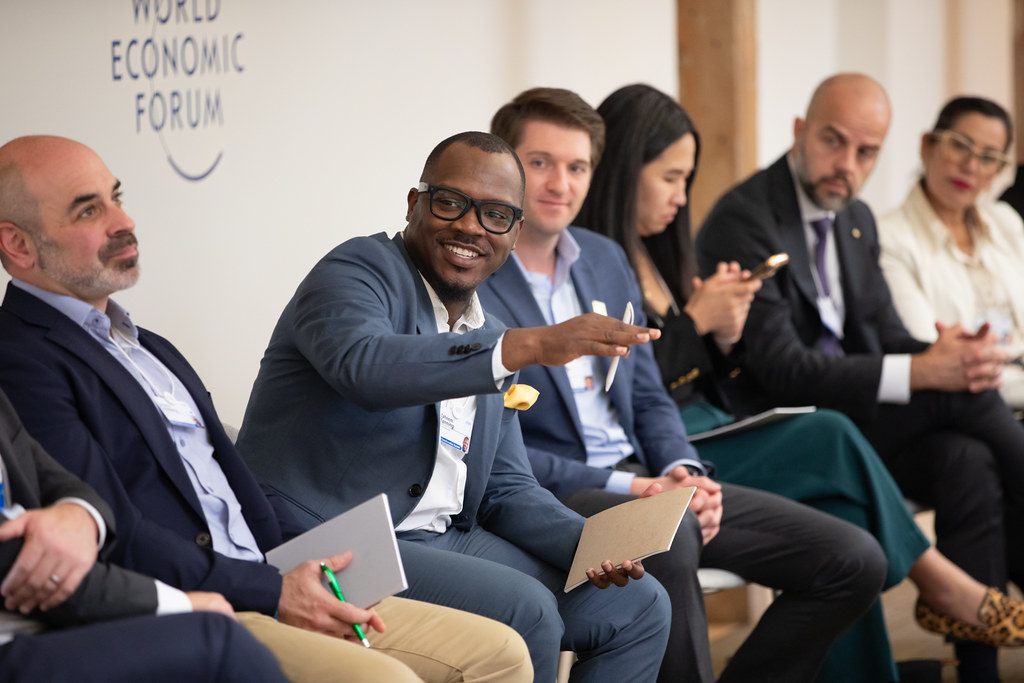



January-March 2026
Subscription > 1 year > 2 years > 3 years | Single issue > Sample issue >
CONTENTS:
Editorial – Sacramental Living
A sacramental approach to life is one of constant revelation – for it is a life that embraces the highest order of creativity.
A Vision of a New World Order – Dwjhal Khul
FThe enterprise of united living will produce an interior work which will flower forth in the production of a beauty and a richness which will distinguish humanity as a whole…
On the Esoteric Significance of the Sacred Word
Every human being might be thought of as an imperfect echo of the music that was ringing throughout the heavens as the soul descended into incarnation. The disciple’s task is to bring this echo back to vibrant life…
The Sacred Inner Lodge of all True Masons - Steve Nation
The Ancient Mysteries… are destined to become living Presences at the centre of the spiritual life of humanity, increasingly shaping the purpose and expression of world servers everywhere.
Will: Free and Divine - Jeferson Cheriegate
The bridge—the Antahkarana—can ultimately be completed only through free will.
The Great Chain of Hierarchy and the Science of Relations - Katherine Hendon
Love, or the attractive, magnetic, cohering force in the universe, is responsible for all relationships. Spiritual love expresses itself through relationship… Relationship is love in action
Transfiguration and the Silver Thread - Steven Zagoudis
The silver thread is the magnet of the heart—the living current connecting disciple and Teacher…
Illumining Faith: The Rebirth of Religion in the Age of Cooperation - Sebastian Sęk
All major religions warn against relativism, which abandons truth, and exclusivism, which abandons compassion. The path between them [is] truth held in love...
Triangles of Light: Music and Esotericism - Anne Woodward
Sound is the elemental force that shapes perception and mediates between the human and the divine.
Aquarius: The Heart of the New World Cycle - Nazanin Zohdi
Through Aquarius, a new rhythm of spiritual life is established, blending love with order, and inner realization with outer cooperation.
Awakening in the Land of Oz: An Esoteric Exploration of the Wizard of Oz - Karly Way Schauwecker
Like Dorothy, the aspirant learns that the way home is not a flight from the world but a deeper presence within it…
Pope Francis – A Forerunner – Mayte Gómez
Following Bergoglio’s journey from his youthful days… through his years as Bishop of Buenos Aires… we can better understand the program he would bring to the global Catholic Church.
Subscription > 1 year > 2 years > 3 years | Single issue > Sample issue >
THE GREAT INVOCATION - TRIANGLES BULLETIN
| THE GREAT INVOCATION | THE GREAT INVOCATION (Adapted) |
|
From the point of Light within the Mind of God From the point of Love within the Heart of God From the centre where the Will of God is known From the centre which we call the race of men Let Light and Love and Power restore the Plan on Earth. |
From the point of Light within the Mind of God From the point of Love within the Heart of God From the centre where the Will of God is known From the centre which we call the human race Let Light and Love and Power restore the Plan on Earth. |
*Many religions believe in a World Teacher, a “Coming One”, knowing him under such names as the Lord Maitreya, the Imam Mahdi, the Kalki Avatar and the Bodhisattva. These terms are sometimes used in versions of the Great Invocation for people of specific faiths.
Triangles is a world service activity in which people link in thought in groups of three to create a planetary network of Triangles of light and goodwill. Using a world prayer, the Great Invocation, they invoke light and love as a service to humanity. Further information is available on request from Triangles.
The Triangles Bulletin is for people of goodwill and is published four times a year in Dutch, English, French, German, Greek, Italian, Polish, Portuguese, Russian and Spanish. Triangles is an activity of the Lucis Trust, a non-profit educational charity which exists to promote right human relations.
For further information and literature write to:
| Suite 54 3 Whitehall Court London SW1A 2EF UK |
Rue du Stand 40 Geneva CH-1204 SWITZERLAND |
866 United Nations Plaza Suite 482 New York NY 10017 USA |
INNER LIGHT
Darkness has always had the power to strike fear in human hearts, so the sudden loss of light, caused by eclipses of the sun or moon, was once a frightful experience. In these days, however, the occurrence of an eclipse is met with great public interest and wonder. Astronomers eagerly await these events as opportunities to deepen their scientific investigations, knowing they might bring valuable discoveries. Such was the case with the solar eclipse of 1919 that confirmed Einstein’s theory of general relativity and greatly furthered the understanding of gravitation and the behaviour of light.
On a more philosophical level, eclipses of a psychological nature also allow us to understand light of different kinds and/or frequencies. The light of the personality tends to dominate our everyday lives and it may be only when dark points of crisis eclipse this light that the more subtle inner light of the soul is sought and registered. The path of wisdom leads us to examine our experiences and reactions, and esoteric teachings indicate that the most important and valuable truths are those whispered by the still small voice of the soul. So, we strive to pause the hectic 24-7 living and take time for meditation. In the life of the spirit, this practice helps us to develop a continuity of consciousness that is able to observe outer events without being overwhelmed by them.
Minor psychological eclipses may be common and frequent but they offer a chance to question our perspectives and allow the insights that prompt inner or outer adjustments that may alter our direction. Also, in the wider world, events offer challenges and opportunities that may similarly alter our views. With the breakdown of social norms, mass migrations and natural disasters that we are now witnessing, long held beliefs no longer seem adequate to explain the world around us. All of this adds to a climate of fear. But by abiding in the soul’s light, even with all the noise and confusion, we may reach into the world of causes and find a greater understanding of these external manifestations. Then we can also perceive that the accompanying darkness provides a backdrop for points of spiritual light that are coming into view. We have the assurance of spiritual teachings that, through distress, humanity’s consciousness is rapidly awakening from a long sleep, that the great and fundamental reality of the human state of mind is beginning to focus itself upon the things which matter and to express itself in a living fashion.
Individually we may be powerless to effect major changes in the wider world but an immense potential is found in the network of Triangles as a synthetic group. Its service relates spiritual realities to human experience through its focused meditation, sending enlightened goodwill to all those who love humanity worldwide. Together we have the opportunity to lift the world from its gloom into the light of a new age. We use this opportunity of our troubled times to strengthen the work of Triangles and of the New Group of World Servers, amplifying the points of light and irradiating human consciousness.
SHARING GROUP THOUGHT
I have been working in Triangles for quite a few years now, and in fact, I can’t remember when I first started. I do know I left my first Triangle because I couldn’t sense how it was making any difference! I very quickly regretted that decision and fortunately one member was open to forming another Triangle with me again. So, I am very glad to say I love this work! It is so profound, subtle but incredibly powerful. In time, the bonds between the members in a Triangle become even closer and stronger as does the network itself.
Needless to say, we seem to be in the thick of it now, collectively. The strength of our bond in Triangles and our work together is a consolidation of many lifetimes of work which I now feel is protecting humanity and assisting the ascension process. As we steadily anchor divine qualities on to the earth plane, the outcome is assured even though things look precarious.
UK
THE MUSIC OF THE SPHERES
Sit, Jessica. Look how the floor of heaven
Is thick inlaid with patens of bright gold.
There's not the smallest orb which thou behold'st
But in his motion like an angel sings,
Still choiring to the young-eyed cherubins.
Such harmony is in immortal souls,
But whilst this muddy vesture of decay
Doth grossly close it in, we cannot hear it. (Shakespeare, from The Merchant of Venice – 5.1.57)
Amidst humanity’s current turmoil and crises, and in stark contrast with our daily experiences, the idea of singing stars or a harmonia mundi might seem a naïve dream. Is a Music of the Spheres, described throughout history by many cultures, not just an illusion and a longing for a utopia where harmony reigns and life is predictable? On the contrary, the realisation of a musically ordered universe can still be a beacon for everyone seeking a deeper truth to reveal a new relationship between order and disturbance, or in musical terms, between harmony and dissonance.
We can consider that the inspiration for all earthly music, sacred or profane, might be this Music of the Spheres, which, as some suggest, can only be heard by the soul. But should music therefore always be sweet, harmonious and devoid of dissonance? It seems not, because even in Early and Classical music, dissonances were always points of tension necessary for musical expression representing a pair of opposites in sound to enrich our experience. Yet, for a long time, dissonances were considered as phenomena needing resolution. This was the basis of the Harmonic system. At the end of the nineteenth century, however, Schönberg proposed that music based on this system alone could no longer serve to connect our minds to the divine because it had become too comfortable and predictable. Humanity needed an emancipation of the dissonance as a valuable and independent sound in its own right, a principle that has been integrated in much music ever since.
What we might conclude is that dissonance and disturbance have infinite potential to be integral to harmony itself. And the fabric of any true utopia would also include such elements of disturbance, with life’s hardships being understood as opportunities to learn and grow. Their contribution is not to make life more chaotic, but, rather, to make it richer and more complete. They are steps on the path to love and to a deeper connection with the divine, just as the work of Triangles aims at infusing the world of all experiences with the wisdom and love of the spiritual realm. So, when we imagine and perhaps even experience the Music of the Spheres, let us welcome the dissonance and its integration into a harmony of reality.
TRANSFORMATIONAL CHANGE
Change is an essential part of life. It is the dynamic that moves us through the present, away from the past and into the future. Its cycles of growth are natural, just like the distinct stages that the fetus passes through in the womb leading up to the crisis of birth. But change can also be stimulated by active, confident planning to move in a direct path towards some desirable future by revising our behavior, laws or social programs.
The will to improve can also be oriented towards something more spiritual with the intention of transforming and lifting inner qualities of mind or heart to better express the soul in daily living. Responding to a deeper sense of group purpose within an organization, adjustments may be initiated to enhance working relationships that enable a more useful and positive impact on world need. Transformational changes that flow from the spiritual level of the soul into the material world of time and space are causal in nature, deeply affecting outer behaviors and social norms, ultimately revitalizing and irradiating the substance of many lives.
The prayer, meditation and invocation that we practice within the Triangles network supports this sort of transformation, calling on the energies of soul and spirit to initiate and take the lead in lifting the qualities of being and relationship. This enlightenment is not just within ourselves and our individual triangles, but also brings light into the wider environment of social behaviors and economic relations. This is being amplified because the oneness of Humanity, as expressed in esoteric teachings, is becoming more widely recognized outwardly. It is this development that seems of critical importance against the backdrop of social upheaval and constant mutability in the everyday lives of citizens throughout the world.
Both an understanding of human nature and the evolutionary growth of consciousness form a required framework for transformational change. For it is only with such a framework that we can begin to observe the world of time and space from a stable, fixed point of spiritual identity, independent of time and space. It is only from the detached perspective of the soul, wise and loving, that we can recognize that we are living through a cycle in which the spirit of oneness is re-shaping consciousness. Out of all the current distress, humanity is in the process of reorientation and can experience a rebirth.
The art of transformation is a work in progress – altering the substance of our nature takes time, rhythm and quiet persistence, and all the more so when it is Humanity itself that is in the process of metamorphosis. By seeing our lives and our communities as places of transformation, we aid what is a natural birthing process.
December 2025
Alice Bailey’s Rules for Disciples and Initiates
Alice Bailey’s Rules for Disciples and Initiates
By Zachary Landsdowne
Alice Bailey (1880 – 1949), an author of many books, founded a spiritual movement that grew out of the theosophical tradition. Her final book, The Rays and the Initiations, presents fourteen symbolic “Rules for Disciples and Initiates” and states that “they are rules for initiation which, if followed, will take the disciple and the group through a major spiritual experience.” Initiations are milestones on the spiritual journey, so rules for initiation are instructions for attaining those milestones.
Bailey acknowledges, however, that these rules are written in an abstruse manner: “They are not what they appear to be on the surface—trite truisms and spiritual platitudes,” and “The interpretation of these Rules must involve capacity to pass beyond the usual attitudes and what one might call the usual metaphysical and theosophical platitudes.” Accordingly, her book predicts: “These instructions … will, therefore, go out to the general public who will not understand.” Nevertheless, the purpose of the present book is to elucidate these fourteen abstruse rules so that they can be understood.
This new book, Alice Bailey’s Rules for Disciples and Initiates, may be downloaded free of charge by using the following link:
Free Download: https://www.icloud.com/iclouddrive/03cD4DZlX_79oqpB_18Yr_OXw#RDI
Second World Summit for Social Development and COP 30
|


Meditation: Strengthening the Hands of the New Group of World Servers
 newmoon_medform.pdf
MEDITATION: STRENGTHENING THE HANDS OF THE NEW GROUP OF WORLD SERVERS
I. GROUP FUSION:
I am one with my group brothers and all that I have is theirs.
May the love which is in my soul pour forth to them.
May the strength which is in me lift and aid them.
May the thoughts which my soul creates reach and encourage them.
II. ALIGNMENT:
We recognise our place, as a group, within the heart centre of the new group of world servers. Mentally extend a line of lighted energy towards the spiritual Hierarchy, the planetary heart centre; to the Christ, the "heart of love" within the Hierarchy; towards Shamballa, "where the Will of God is known".
III. HIGHER INTERLUDE:
Hold the mind focussed for a few moments on the planetary role of the new group of world servers mediating between Hierarchy and humanity, responding to hierarchical impression and meditating the Plan into existence.
IV. MEDITATION:
Reflect on the seed thought:
Through the impression and expression of certain great ideas, humanity must be brought to the understanding of the fundamental ideals which will govern the new age. This is the major task of the new group of world servers.
V. PRECIPITATION:
Visualise the precipitation of the will-to-good, essential love, throughout the planet, from Shamballa, through the planetary heart, the Hierarchy, through the Christ, the new group of world servers, through all men and women of goodwill everywhere in the world, and finally through the hearts and minds of the whole human family.
VI. LOWER INTERLUDE:
Consider the many ways in which the "power of the one Life" and the "love of the one Soul" are working out in the world through members of the new group of world servers, so building the "thoughtform of solution" to world problems.
VII. DISTRIBUTION:
As the Great Invocation is sounded, visualise the irradiation of human consciousness with light and love and power:
From the point of Light within the mind of God
Let Light stream forth into the minds of men.
Let Light descend on Earth.
From the point of Love within the Heart of God
Let love stream forth into the hearts of men.
May Christ return to Earth.
From the centre where the Will of God is known
Let purpose guide the little wills of men-
The purpose which the Masters know and serve.
From the centre which we call the race of men
Let the Plan of Love and Light work out
And may it seal the door where evil dwells.
Let Light and Love and Power restore the Plan on Earth.
OM OM OM
* Many religions believe in a World Teacher, a “Coming One”, knowing him under such names as the Lord Maitreya, the Imam Mahdi, the Kalki Avatar and the Bodhisattva. These terms are sometimes used in versions of the Great Invocation for people of specific faiths.
Reflections on Envisioning a New Global Culture: The Search for Unity between East and West
Preparing for the online World Goodwill Seminar,
Saturday, 15 November 2025 – Geneva, London and New York.
We are not lacking in the dynamic forces needed to create the future. We live immersed in a sea of energy beyond all comprehension. But this energy, in an ultimate sense, is ours not by domination but by invocation.
Thomas Berry, “The Dynamics of the Future” in The Great Work, p.175
Culture is esoterically related to those within any area of civilisation who specifically, precisely and in full waking consciousness, through self-initiated effort, penetrate into the inner realms of thought activity which we call the creative world. These are the realms which are responsible for the outer civilisation
Alice A. Bailey, The Reappearance of the Christ, p.129
The new world order will not impose a uniform type of government, a synthetic religion and a system of standardisation upon the nations. The sovereign rights of each nation will be recognised and its peculiar genius, individual trends and racial qualities will be permitted full expression. In one particular only should there be an attempt to produce unity, and that will be in the field of education.
Alice Bailey, The Externalisation of the Hierarchy, p.191
Culture is activity of thought, and receptiveness of beauty and humane feeling. Scraps of information have nothing to do with it.
Alfred North Whitehead, The Aims of Education and Other Essays, p.1
… philosophical education should strive for transdisciplinarity. In a knowledge ecology increasingly fragmented into various scientific specializations, disciplinary silos, and ideological ghettos, students of philosophy should be encouraged to play the role of intellectual interloper, trespassing across prematurely fixed boundaries to carve out pathways for more integral forms of scholarship and knowledge creation. Absent such philosophical daring, universities will struggle to contribute to deepening the relationship between human consciousness and the cosmos which birthed it. The future of life on Earth depends at least in part upon the revitalization of humanity’s educational processes.
Matthew Segall
Sri Aurobindo [writes]: “When the Thought returns to the surface, humanity has its periods of light.” By thought he simply means “deeper aims”. Beyond political tug-of-wars, economic subterfuge, social striving, and actual war – beyond the material world – there are always ideas and ideals at play. These are the deepest forces that move mankind – they most often manifest in our religion, art, and dreams. These are the secret levers of matter. The world is one long limb to the central nervous system composed purely of thought.
Jash Dholani https://www.brhat.in/dhiti/shriaurobindoandthewest
The East brings the West a true and needed message: Seek the “law and truth of the soul” – find “an inner reality greater than the material”. The East tells the West: Guard against “exaggerated intellectuality”, an isolated “mechanical genius”, and “erroneous theories of the Absolute”.
The West too brings the East a true and needed message: “Man also is God and it is through his developing manhood that he approaches the Godhead; Life also is the Divine, its progressive expansion is the self-expression of the Brahman, and to deny Life is to diminish the Godhead within us.”
Jash Dholani https://www.brhat.in/dhiti/shriaurobindoandthewest
Authoritarianism appeals, simply, to people who cannot tolerate complexity: there is nothing intrinsically “left-wing” or “right-wing” about this instinct at all. It is anti-pluralist. It is suspicious of people with different ideas. It is allergic to fierce debates. Whether those who have it ultimately derive their politics from Marxism or nationalism is irrelevant. It is a frame of mind, not a set of ideas.
Anne Applebaum, Twilight of Democracy: The Seductive Lure of Authoritarianism
Planetary democracy does not yet exist, but our global civilization is already preparing a place for it: It is the very Earth we inhabit, linked with Heaven above us. Only in this setting can the mutuality and the commonality of the human race be newly created, with reverence and gratitude for that which transcends each of us, and all of us together. The authority of a world democratic order simply cannot be built on anything else but the revitalized authority of the universe.
Vaclav Havel. 1994
When we study consciousness historically, contrasting perhaps what men perceive and think now with what they perceived and thought at the same period in the past, when we study long-term changes in consciousness, we are studying changes in the world itself, and not simply changes in the human brain. We are not studying some so-called “inner” world, divided off, by a skin or a skull, from a so-called “outer” world; we are trying to study the world itself from its inner aspect.
Owen Barfield,(History, Guilt, and Habit 11) https://owenbarfield.org/consciousness/
… there are two great power shifts going on in this century. One is a power shift from West to East, which means from basically Europe and the Atlantic to the Pacific and Asia… The other great power shift is what I would call “vertical” rather than horizontal. That’s the power shift from governments to non-governmental and transnational actors. This is driven by technology and by changes in not economic, but in ecological globalisation.
Joseph S. Nye Jr. Harvard University Professor. April 2021
… historically there is no question about the fact that the Confucian tradition can serve as a very important identity for the Chinese. And in fact some people go so far as to say, I think with persuasive power, that without Confucianism it is difficult to imagine what the shape of China’s culture would be, especially Chinese cultural identity. That’s a very important observation. But look at the Confucian tradition as a flowing stream: It began in the 6th Century B.C. as a tiny stream then became a major intellectual tradition in China, then for a while it actually went underground, Buddhism and Daoism turned out to be more powerful, especially as models for some of the most brilliant minds in China. There was a revival of Confucianism in the 11th Century, and that revival helped the Confucian tradition to spread beyond Chinese borders. Now, see, in the mid 19th Century the tradition was marginalised. Its very survival became questionable because some of the best people wanted to get rid of it. And now it can reemerge again. But now it cannot afford to be Sinic, it cannot even afford to be East Asian, it has to be global.
Tu Wei-ming https://philosophynow.org/issues/23/Interview_with_Tu_Wei-ming
[The] question is why “China” as a spiritual, almost abstract entity – as a place with physical boundaries that also exists powerfully and convincingly as an emotional reality, while often defying neat characterisation – has proved so successful. It has emerged slowly, but overwhelmingly, as history has unfolded. Linked to cultural, historical, ethnographic, social and mythical factors, and despite all the energy invested by so many in wishing or explaining it away, it constitutes one of the most successful symbolic achievements of the modern world.
Kerry Brown. https://insidestory.org.au/reinventing-china/
Nobody… would dream of considering the laws of nature as identical with or even similar to moral laws, if he considers physical existence in the right way. As soon as we enter the higher worlds this is changed. The more spiritual the worlds which we enter, the more do moral law and what may be termed natural law in these worlds coincide
Rudolf Steiner, “A Road to Self-Knowledge”
In many Eastern cultures, group cohesion is valued highly. This often leads to conflict being smoothed over or redirected. In Western cultures, the emphasis on individual expression can lead to conflict being escalated – sometimes more than is necessary. Yet both tendencies can fall short. Eastern silence may hide resentment. Western bluntness may break bonds. Each culture, in its own way, may undernourish what the other holds. But they are not opposites. They are reflections. What one underplays, the other overplays.
This opens a profound opportunity: when cultures recognize each other’s shadow sides, they gain the chance to grow together, not by imitation, but through mutual becoming…
The true divide today isn’t between East and West. It’s between surface and depth. Pseudo-harmony and pseudo-conflict are both shallow. What we need – across cultures, generations, and technologies – is to meet each other deeply. Because in the long run, only depth heals.
Jean-Luc Mommaerts https://aurelis.org/blog/sociocultural-issues/harmony-vs-conflict-in-east-west
While the environmental movement has been a societal response to the pollution and destruction of our outer nature (environmental pollution), the awareness-based movement for human and planetary flourishing that we see emerging now, can be seen as a response to the pollution and destruction of our inner nature (spiritual pollution), i.e., our deeply felt relationship with the planet, with people, and with ourselves.
Otto Scharmer https://ottoscharmer.medium.com/
Ecological Civilization: An Emerging Paradigm in China
Ecological Civilization: An Emerging Paradigm in China
Mary Evelyn Tucker
Many individuals and groups in China are diligently trying to find the next stage beyond rapid industrialization and unsustainable development, which brought red-hot economic growth, as well as biodiversity loss, climate upheavals, and pollution that damaged public health.
Now the goal is to create a new “ecological civilization”, one that embraces the health of both ecosystems and of people. This is based in part on a critique of modernity in its scientific reductionism, mechanistic materialism, and mindless consumption that is present both in China and the West. This same effort to find corrective measures is being made in Western countries as well.
What is ecological civilization?
While ecological civilization may appear to be a government sponsored initiative, this is not the whole story. Certainly, President Xi Jinping and other government leaders have promoted this notion. Xi, who has tried to reconcile ecological protection with economic development, proposed the theory that “lucid waters and lush mountains are invaluable assets”
However, this idea of ecological civilization has also been broadly embraced by Chinese society, especially as a result of education. The concept has many concrete applications. Theory and practice are seen as interwoven.
There are many definitions of ecological civilization, but the most important aspiration is: Moving from unlimited economic growth that is polluting land, air, and water to an ecological civilization that cares for the well-being of both people and the planet. …
Shift in Chinese universities and academic institutions
We have been traveling to China since 1986 and have seen many changes over these past three decades. On an extended trip to China in September of 2023 we witnessed the spread of ecological civilization in academic institutions from the north to the south. The discussion of ecological civilization has clearly risen rapidly in the last few years. Every university now has departments or institutes promoting ecological civilization as a context for environmental education and training. The premier Chinese think tank, the Chinese Academy of Social Sciences (CASS), has created an institute for Eco-civilization. …
Ecological civilization drawing on cultural values
A dynamic, ever-changing China is trying to rediscover its traditional cultural roots while embracing modernization and tackling environmental challenges. The Chinese are searching for social and ecological wisdom from their own traditions of Confucianism, Daoism, and Buddhism. Yet they are still pursuing economic prosperity while initiating the energy transition. Clearly contradictions abound between pursuing economic growth while environmental issues continue to multiply. This is, of course, not confined to China, but is a common dilemma for humanity.
The search for ecological values from all the world’s cultures has the potential to inspire diverse, but complementary perspectives on environmental ethics. This is the work we have been doing for almost 30 years. This began with our three-year research project at Harvard surveying the world’s religions and their ecological perspectives with hundreds of scholars (1995–1998). There were 10 conferences held and 9 volumes published by Harvard for which we were series editors. (The Shinto volume was published in Japan.) The books on Confucianism, Daoism, and Buddhism have been translated and published in Chinese. Our motivation in beginning the Harvard conferences was to highlight these traditions knowing that the rapid modernization and industrialization of China with over one billion people would inevitably result in environmental degradation.
The role of Confucianism is an example of how cultural values can provide a basis for a vibrant ecological civilization in China. The revival of the teaching of Confucian texts and tradition is making this possible at present in China. Thus, there is potential for the tradition to be brought into discussions on ecology and environmental ethics
Confucian holistic worldview and environmental ethics
While clearly Confucianism has many historical variations, cultural particularities, and national differences, there are certain central ideas and values that have spread across East Asia from China through Korea and to Japan. These ancient values constitute key elements of the tradition that have endured despite historical changes, political upheavals, and environmental deterioration.
There are major resources for contemporary environmental ethics in China as well as for an emerging global ethics. This is also the case for resources from Daoism and Buddhism and other religious traditions, including environmental knowledge of Ethnic Peoples.
Of singular importance for China is the rich cosmological worldview of Confucianism that promotes harmony of humans with nature amidst change. This is a significant perspective for seeing nature as intrinsically valuable and for understanding the role of the human in relation to natural processes as critical.
This worldview is characterized by four key elements: an anthropocosmic rather than an anthropocentric perspective; an organic holism of the continuity of being; a dynamic vitalism of material force (qi); a comprehensive ecological ethics embracing both humans and nature (“Humans and nature are one”).
All these ideas from Confucianism can be further developed as a basis for building a robust ecological civilization in China.
The 12th century Neo-Confucian philosopher, Zhang Zai, wrote on the wall of his study, The Western Inscription. This exemplifies the all-embracing dimensions of identity with Heaven and Earth, and compassion for other humans. It is one of the most inclusive texts in all Confucian thought and frequently quoted.
“Heaven is my father and Earth is my mother, and even such a small creature as I find an intimate place in their midst. Therefore, that which fills the universe I regard as my body and that which directs the universe I consider as my nature. All people are my brothers and sisters, and all things are my companions. The sage identifies his character with that of Heaven and Earth, and the worthy is the most outstanding person. Even those who have no brothers or children, wives or husbands, are all my brothers who are in distress and have no one to turn to.”
This inspiring text encompasses a comprehensive worldview of humans as part of a vast cosmos, emerging out of Earth’s great fecundity, and completing the triad as the mind and heart of Heaven and Earth. Within this familial cosmology of the great parents giving birth to humans, their deep humaneness can be extended to other humans and biodiversity. Surely this is a basis of an anthropocosmic ethics for the well-being of future generations.
Extracts from an article published in August 2024:
https://deepchina.substack.com/p/ecological-civilization-an-emerging
Lucis Trust 2026 Order Form
You are being redirected.
Note: You will be redirected to the order form soon.
If this page does not redirect you please click this link: https://www.lucistrust.org/store/order_form/order_form_3sf
Powershifts on the Road to Global Democracy: The East-West Dichotomy
Powershifts on the Road to Global Democracy: The East-West Dichotomy |
Whether it is in the East or the West, the path to freedom in a social context involves a steady transition
from the individual mindset to that of the collective.
Dear co-worker,
An interesting symbolic event has been unfolding in the Gobi Desert – one that can be tentatively related to Shamballa, the focal point of spiritual power on Earth, which is also said to be located in the Gobi Desert albeit in a state of matter invisible to human eyes. For it is in this region of the world that China has unveiled a working nuclear reactor fuelled by thorium – an element billed as “the great green hope” of clean energy production. Thorium produces far more energy and far less waste than the current fuel source, uranium; the reactor is also meltdown-proof and has no weapons-grade by-products.1 A much larger thorium reactor is also being built in the same location, scheduled to start up in 2030. This development is likely to further accelerate China’s growth in economic power and political influence; and in anticipation of this, the question might be asked: What is China’s vision for humanity’s future and its own role as a guiding force towards it? There has been much debate on this issue following a speech by China’s President, Xi Jinping, to the United Nations’ Geneva Office in 2017, Work Together to Build a Community of Shared Future for Mankind.2
The concept of this speech has been reflected in a number of UN documents in the last few years, but this has raised concerns for Amnesty International, which sees it as “a model that emphasizes economic development, cooperation and, above all, national sovereignty at the expense of individual human rights”.3 However, as China exerts an increasing influence in UN affairs, it is promoting its own Human Rights Discourse as part of its broader diplomatic goals. Most recently, in September of this year, the Shanghai Cooperation Organization held its 25th summit, with the participation of UN Secretary-General Antonio Guterres. The highlight of the summit was the Global Governance Initiative4 outlined by Xi Jinping, reaffirming the aspirations of the “Global Majority” for an inclusive and balanced world order based on the continued validity of the UN Charter.
As China’s influence grows, it is interesting to note that the Alice Bailey writings predicted that a cycle of radioactivity would occur in China reaching its peak towards the middle of this century, “rendering radioactive of some of the foremost thinkers of that race”. The hope is that this will deepen the spirituality of China’s vision as the new multilateral world order unfolds:
“… when a movement is instituted by the Lodge, working in connection with the fourth root race; it will also be part of the stimulative process, and will result in the rendering radioactive of some of the foremost thinkers of that race. It will be their day of opportunity, and so great is the importance attached to this that a Member of the Lodge, Confucius as he has been called in the past, will incarnate in order to superintend the work. The preliminary steps are being taken now, and Egos are coming in who will endeavour to direct the energies of this race on to the right line though the peak of the cycle of stimulation will not be until the middle of the next century. It is needless for me to point out that all such movements are first felt as disturbing, and only when the dust of turmoil, and the noise of clashing forces have died away will purpose be seen emerging.” 5
Since the above was written in the middle of the last century, the “stimulative process” is presumably well-underway now. With this in mind, there is much to learn from leading East Asian thinkers on the cultural values of Confucianism and the part it may have to play in helping the people of East Asia onto the path of freedom and liberty that humanity is collectively building towards the spiritual realms. In an article entitled The Confucian Conception of Freedom, Professor of Chinese philosophy, Li Chenyang, writes:
“The Confucian conception of freedom… does not imply an unencumbered free will as the origin and initiator of choice. Instead, the agency of freedom is the person through the heart/mind. As agency the choosing person is always situated in an environment that is fundamentally social in nature… the Confucian ideal of freedom has to be achieved in the context of human society and liberty is indispensable to a healthy human society, Confucianism must have room – if it has not, it must make room – for liberty. Moreover, if the main goal of Confucianism is to achieve human freedom as choosing the good, then it must support and promote social institutions that contribute to such a goal.” 6
Whether it is in the East or the West, the path to freedom in a social context involves a steady transition from the individual mindset to that of the collective. This reflects the spirit of the great law under which Sanat Kumara (“the life and the informing intelligence upon and within our planet”) functions, and the creative sacrifice He made to “bring release to the myriad forms of His creation”. Humanity’s understanding of freedom is evolving slowly but surely, and insular concepts of freedom are being challenged – their voluntary sacrifice for the greater good of society being one of the lessons of this period. And this leads us to speculate on how the contrasting ideologies of the East and West on matters such as freedom, human rights and global unity might steadily evolve and converge to express a point of planetary synthesis.
In pondering this difficult issue, some helpful insights are provided by the journalist and political commentator, Martin Jacques, who has long contended that China is more a “civilisation state” than a nation state. He points out that the most important political value for the Chinese people is unity through their strong sense of ancient, cultural identity; having a weak concept of cultural difference and little tolerance of it, China is unlikely to conform to the western ways of liberal democracy; individual human rights will always be viewed in the context of maintaining the cultural integrity of Chinese civilization.
Professor Jacques maintains that China cannot be understood by observing it through Western eyes and values; the problem, he says, is well summarized by one of the West’s preeminent historians of China, Paul A. Cohen, who remarked that, while the West may regard itself as the most cosmopolitan of all cultures, in many ways it is the most parochial. This is because for the past two hundred years the West has been so dominant in the world it has not really needed to understand other civilisations and cultures, which, by contrast, have been forced to understand the West because of its strong presence in their societies. According to Jacques, East Asia is the world’s largest economy with a third of the world’s population, and it is far more knowledgeable about the West than the West is about East Asia. This is germane because the world is now starting to be driven and shaped, not by the old, developed countries, but by the developing world.7
These observations chime with the esoteric perspective that, while “this is the Aryan or fifth root-race”, the Chinese are a “fourth root race people”. There is much to think through here, for the planetary ajna centre through which… the human family are fused and blended is related to the 5th root-race; so what does this mean as far as the fusion and blending of the Chinese people into the one human family are concerned?
Humanity… planetary ajna centre… 5th Ray of Knowledge… 5th root-race.8
The ajna centre is the centre between the eyebrows and is found in the region of the head just above the two eyes; having only two real petals, it is “not a true lotus in the same sense as are the other centres… Its petals spread out like the wings of an airplane to the right and left of the head”.9 On a planetary scale, we can imagine the two major petals of the ajna centre spreading out to the Eastern and Western hemispheres of the globe, just as they spread out in front of the right and left hemispheres of the brain in the human being. Bringing right functioning activity and relationship between the two petals of the planetary ajna centre and therefore, the Eastern and Western hemispheres of the world cortex, is crucial for humanity’s future.
Of further significance is the fact that the ajna centre is the great “organ of idealism” – and on the planetary scale, we are told that this centre is just beginning to express itself in a recognisable manner through the New Group of World Servers whose major task is to bring to humanity “the understanding of the fundamental ideals which will govern the New Age”. As to how this might manifest itself in a point of planetary synthesis between the East and West, we turn to the thoughts of Oliver L Reiser, who wrote the foreword to Alice Bailey’s book Education in the New Age. Here, he comments on the pressing need to harmonize relationships between East and West, and how the divergent ideologies of the two might be synthesized in some way to create a new form of planetary democracy.
Reiser described the highest type of thinking in the West as scientific humanism, and considered this to be close to the Chinese way of practical idealism. He envisioned the synthesis of the two to create “a new world of semantic insight”, in which the West would “draw freely upon the wells of wisdom in Chinese thought for ethical enlightenment and political realism”. Describing the fusion of these two perspectives as “organismic logic”, he wrote:
“Modern civilization is approaching the end of an era. For twenty-five centuries the human intellect has been guided by the axioms of that great creator of Western culture whom the medievals designated as The Philosopher. Now we face a new era of thought, an age of non-Aristotelian orientation. Just as the old logic, and the science and philosophy resulting from it, were connected with what may be termed the fallacy of the absolute individuality of the subject, so the coming age of culture, when and if it emerges, will be characterized by a new type of reasoning based on a logic of parts and properties within dynamically organized wholes.” 10
This type of reasoning is in perfect harmony with the esoteric philosophy of the Alice Bailey writings – of the establishing of right relationships between all parts of that great planetary life “in whom we live and move and have our being”. But as tensions continue to build between the West and China, there are many looming flashpoints for potential conflict. In this climate, Reiser’s call for “a prodigious effort at synthesis of the two cultures while there is still time”, is a pressing one. As the sinologist, Kerry Brown, Director of the Lau China Institute, remarked: “The West needs to initiate a concerted, cultural engagement with the Chinese to better understand the energy, dynamism and aspirations of what amounts to a fifth of the world’s population.” 11
As divine potencies continue to pour into human consciousness from a variety of sources, it is vital at this time in world history that vision and purpose are more firmly grounded in global affairs to direct the surge of spiritual power into right channels. As the world moves through this difficult transition period into the New Age, we find sound advice in Alice Bailey’s own words. Although the world has changed radically since the time it was written, they can nevertheless be applied in a general sense to the current situation:
“Both East and West have specialized in their thinking. Each, therefore, has the virtue of its own sincerity and its own peculiar penetration. But specialization has its value only as it leads to an ultimate integration. Is not the time ripe for bringing East and West together in this profoundest region of the life of each of them, the region, namely, of their philosophical and psychological thinking?” 12
In lighted group companionship,
Headquarters Group Lucis Trust
1. Alex Kimani, China Unveils World’s 1st ‘Meltdown Proof’ Thorium Reactor, https://oilprice.com
2. Xi Jinping, Work Together to Build a Community of Shared Future for Mankind, www.XinhuaNet.com
3. Amnesty International Glossary, https://whatchinasays.org
4. Xi Jinping, Global Governance Initiative, www.youtube.com/watch?v=nxal70pXgWg
5. A. A. Bailey, A Treatise on Cosmic Fire, pp.1079–80
6. Li Chenyang, www.researchgate.net/publication/257140002_The_Confucian_Conception_of_Freedom, pp.18–20
7. Martin Jacques, Understanding the Rise of China, www.youtube.com/watch?v=imhUmLtlZpw
8. A. A. Bailey, Esoteric Astrology, p.454
9. A. A. Bailey, Esoteric Healing, p.149
10. Oliver L. Reiser, The Promise of Scientific Humanism, p.43. Internet Archive
11. Professor Kerry Brown, China’s rise: The three key things everyone needs to know, www.youtube.com/watch?v=VKNzht-JOXE&t=15s
12. A. A. Bailey, The Soul and its Mechanism, p.10
 View UK version |
View US version |
October-December 2025
Subscription > 1 year > 2 years > 3 years | Single issue > Sample issue >
CONTENTS:
Editorial – Fiery Ordeals.
Beacon articles concern ideas and experience understood through the lens of esoteric teachings. Familiar words often convey deeper meaning in esoteric texts...
Humanity’s Rapid Progress upon the Upward Way – Dwjhal Khul
For ages it remained a question whether humanity would choose the slow but safe method of achievement. Yet in the past two hundred years, unforeseen even by the Hierarchy, the entire picture has been altered...
Esoteric Opera – Anne Woodward
The subjective union between the philosopher Arthur Schopenhauer and the composer Richard Wagner finds expression in Wagner’s monumental Ring Cycle. Performed in the magical Festspielhaus at Bayreuth, this six-day drama offers both unimaginable beauty and profound esoteric knowledge.
Discipleship as a Self-Imposed Experiment – Eduardo Gramaglia
Self imposition, as a “useful experiment,” is in fact an intelligent and bold use of the “As If” technique... it is “bold” because it carries a potentially destructive effect on old patterns of reaction and behavior, thus producing a crisis.
Time and Its Cycles – by a Student
Spiritual evolution for any individual occurs over a great deal of time, within a succession of bodies that exist in space, on this planet. Paradoxically, neither time nor space exist...
Sentinels of the Soul: Minorities and the Hidden Currents of World Power – Barry Horton
From the standpoint of the Ageless Wisdom teachings, racial difference is a superficial aspect of the greater human identity. Humanity is a single spiritual entity evolving through time, and diversity of form is part of the richness of that unfolding.
Crisis – Incubator for Transformation – Dermot Carroll
The words ‘crisis’ and ‘chrysalis’ not only carry a similar sound but also a similar meaning. Like the chrysalis of metamorphosis, crisis becomes a metaphor for life transition.
Republican Virtue Revisited in the New Age – Colleen Maguire
Republican Virtue is defined as the core values that citizens of a republic must uphold in the performance of civic duties to ensure its proper functioning and stability. The Founding Fathers believed this virtue essential to government and sought to build in safeguards for the future.
Music that never stops – David Svetly
A short and moving anecdote on understanding death.
Alvin Toffler – A Forerunner – Kim Sangbok
An appreciation of the work of the American author and futurist whose work focused on the impact of modern technologies on global culture.
Subscription > 1 year > 2 years > 3 years | Single issue > Sample issue >
World Goodwill Seminar 2025 Geneva
ENVISIONING A NEW GLOBAL CULTURE:
|
Both East and West have specialized in their thinking. Each, therefore, has the virtue of its own sincerity and its own peculiar penetration. But specialization has its value only as it leads to an ultimate integration. Is not the time ripe for bringing East and West together in this profoundest region of the life of each of them, the region, namely, of their philosophical and psychological thinking?
A. A. Bailey
GENEVA
10.00 - 13.00 CET
This Seminar was an Online ZOOM event
2025 Seminar Home >
Translation into French, Spanish, Italian, German, Dutch, Russian and English
Transcripts of the talks for download
 |
 |
 |
 |
 |
 |
 |
Seminar Recordings
Geneva
Schedule & Programme
Geneva
10:00 CET
Introduction and opening talk
World Goodwill Geneva
10:10 CET
 Vincent Claessens – Headquarters Group – World Goodwill – Geneva.
10:20 CET
Politics of Being: A Pathway to a "Civilisation of the Universal"
Dr. Thomas Legrand
 Dr. Thomas Legrand Holding a PhD in Economics, Thomas Legrand is the author of the internationally acclaimed book “Politics of Being. Wisdom and Science for a New Development Paradigm” (2022). He leads the UNDP-convened Conscious Food Systems Alliance and lives next to Plum Village, the monastery of Zen master Thich Nhat Hanh, in the Southwest of France.
10:30 CET
EARTH CITIZENSHIP – an emerging source for co-creating
a planetary culture of unity in diversity: Live Experiences from the One Home Journey 2024-2030 – 7 Years for 7 Generations.
Prof. Alexander Schieffer and Dr. Rama Mani
 Alexander Schieffer is an integral philosopher, academic activist, passionate and transformative educator, and poet. He is Co-Founder of Home for Humanity movement for planetary regeneration and Co-Initiator of the One Home Journey 2024-2030 – 7 Years for 7 Generations. He is a Professor of Integral Development at Da Vinci Institute, South Africa and at St. Gallen University, Switzerland. Author of many books, as well as two poetry volumes and a novel. Rama Mani is a transformative performing artist, peacebuilder and justice activist. She founded the ground-breaking artform and methodology “Theatre of Transformation”, based on her 30+ years of experience in crisis transformation worldwide. She authored Beyond Retribution: Seeking Justice in the Shadows of War, and co-edited Responsibility to Protect: Cultural Perspectives from the Global South. She is a French National and an Overseas Citizen of India.
10:40 CET
The Culture of Synthesis
Ursula Raab
 Ursula Raab has been dedicated to developing the goals of the Community of Living Ethics (CEL) for over 15 years, where she has found her profound purpose. Her fields of work are art and astrosophy. During her career in real estate financing, she has completed various self-training courses at the CEL (Creative Meditation Course, School of Group Focusers, School of Spiritual Economy, School of Esoteric Astrology, Human Types Course) and other institutions (e.g., the Institute of Psychosynthesis, Basel). She is councillor and secretary of the steering committee of CEL. She coordinates and focuses the School of Astrosophy and cooperates with the Community's India initiative. She serves as President of the Association Nuova Era spreading culture and art, particularly Agni Yoga books in Italian and the writings of Enzio Savoini.
10:50 CET
10 Minute Break
11:00 CET
Round table discussion with panelists
11:45 CET
Visualisation
11:50 CET
Group Discussions in Breakout Rooms
(English, French, Spanish, Italian, German, Russian and Dutch)
12:45 CET
Group Meditation
Strengthening the Hands of the New Group of World Servers.
13.00 CET
Closing
World Goodwill Seminar 2025 New York
ENVISIONING A NEW GLOBAL CULTURE:
|
Both East and West have specialized in their thinking. Each, therefore, has the virtue of its own sincerity and its own peculiar penetration. But specialization has its value only as it leads to an ultimate integration. Is not the time ripe for bringing East and West together in this profoundest region of the life of each of them, the region, namely, of their philosophical and psychological thinking?
A. A. Bailey
NEW YORK
2.00 - 5.00 PM EST
This Seminar was an Online ZOOM event
2025 Seminar Home >
Seminar Recordings
New York
Schedule & Programme
New York
2:00 pm EST
Welcome and Introduction
World Goodwill - Chris Morgan
2:15 pm EST
 Jack Bagby (he/him/his) received his PhD. in philosophy from Boston College in 2021, and a B.A. in philosophy and ancient Greek language, from the Pennsylvania State University in 2013. Professor Bagby conducts research on the history of philosophy, focusing on problems related to consciousness, nature, and evolution. He has published in Epoché and Journal for the British Society of Phenomenology, on ancient Greek philosophy and phenomenology (especially Henri Bergson) and has strong research interests in Baruch Spinoza, 19th-20th century European philosophy, process philosophy, philosophy of music, and aesthetics. He is currently working on a translation of Bergson's 1902-3 Lectures at the Collège de France The History of The Idea of Time (Bloomsbury Press), and finishing up the manuscript of his monograph Integrals of Experience: Aristotle and Bergson. When thinking about complex concepts or solving textual problems, Jack loves to construct diagrams and concept maps. Between 2016-2018 he combined his love for creating visualizations with his love of Spinoza to create a website that maps the complex textual citations used in his magnum opus, the Ethics.
3:00 pm EST
 Jay McDaniel is Chair of the Board of the Center for Process Studies. He is professor emeritus of Religious Studies at Hendrix College in Arkansas, and founder of the website Open Horizons, which focuses on exploring a process outlook on life and way of living in the world. Active in the development of process thought in China, he is a consultant to the Institute for Postmodern Development of China, and the Cobb Institute. His books include With Roots and Wings: Christianity in an Age of Ecology and Dialogue; Living from the Center: Spirituality in an Age of Consumerism; and Gandhi’s Hope: Learning from Other Religions as a Path to Peace.
3:45 pm EST
10 Minute Break
4:40 pm EST
Meditation on Goodwill
Meditation to strengthen and increase the goodwill that is in all people, invoking energies
of lighted goodwill and cooperation into world affairs. Read more >
Download the Meditation
5.00 pm EST
Closing
World Goodwill Seminar 2025 London
ENVISIONING A NEW GLOBAL CULTURE:
|
Both East and West have specialized in their thinking. Each, therefore, has the virtue of its own sincerity and its own peculiar penetration. But specialization has its value only as it leads to an ultimate integration. Is not the time ripe for bringing East and West together in this profoundest region of the life of each of them, the region, namely, of their philosophical and psychological thinking?
A. A. Bailey
LONDON
2.00 - 5.00 PM GMT
This Seminar was an Online ZOOM event
2025 Seminar Home >
Seminar Recordings
London
Schedule & Programme
London
2.00 pm GMT
Welcome and introductory thoughts -
Laurence Newey, for World Goodwill
2.15 pm GMT
Presentation
Kerry Brown, Guest Speaker
 Kerry Brown is Professor of Chinese Studies and Director of the Lau China Institute at King’s College, London. He is an adjunct of the Australia New Zealand School of Government in Melbourne, and the co-editor of the Journal of Current Chinese Affairs, run from the German Institute for Global Affairs in Hamburg. He is President of the Kent Archaeological Society and an Affiliate of the Mongolia and Inner Asia Studies Unit at Cambridge University. He is the author of almost 20 books on modern Chinese politics, and has written for every major international news outlet, and been interviewed by every major news channel on issues relating to contemporary China.
2.35 pm GMT
Panel discussion with Kerry Brown
3.00 pm GMT
5 Minute break
3.05 pm GMT
Presentation
Christopher Hancock, Guest Speaker
 Christopher Hancock is the Founding Director of Oxford House Research Ltd. Historically a theologian who taught at Cambridge and in the USA, his work has focused in the last 20 years on culture, ethics, and religion in contemporary geopolitics. As an Asia specialist, he was Dean of Bradford Cathedral and helped launch the new China Centre at King’s College, London. Having taught around the world and published across a wide range of disciplines, he is currently a Visiting Professor at St. Mary’s University, Twickenham. His book Christianity and Confucianism: Culture, Faith and Politics was published by Bloomsbury in December 2020.
3.25 pm GMT
Panel discussion with Christopher Hancock
3.50 pm GMT
10 Minute break intermission
4.00 pm GMT
Reflections on the Seminar theme
Mayte Gomez
We know that consciousness evolves through a series of processes of integration. We might consider that the unity between the East and the West is one of those processes. As humanity nourishes its will-to-good, it will move towards accepting that each part of the world is holding an integral part of the whole.
4.10 pm GMT
Break-out group discussions
Group
4.40 pm GMT
Meditation
5.00 pm GMT
Close
Die Seele der Nationen hervorrufen
|
Tian Ai Qigong,
Tempelhofer Damm 178, 12099 Berlin
Samstag 11. Oktober 2025
10:00 - 12:00 und 14:00 - 17:00
Mehr erfahren
Nie war es so wichtig, die Bewusstseinsveränderungen zu verstehen, die sich überall auf der Welt vollziehen. Wenn die Weltseele ihr Licht auf die Menschheit wirft, offenbart es sowohl die Verbundenheit aller Dinge als auch das, was verborgen ist. Die Arbeit des Lucis Trust und der Arcane School hat sich zum Ziel gesetzt, die Magie der richtigen Beziehungen zwischen Seele und Persönlichkeit, zwischen Weltseele und Menschheit zu verwirklichen.
Eintritt frei. Für weitere Informationen oder zur
Anmeldung (optional): schreiben Sie an [email protected]
Programm für Studierende der Arkanschule (nur auf Einladung)
10:00
Einführung und Begrüßung Jüngerschaft im 21. Jahrhundert
Christine Morgan: Vorsitzende des Lucis Trust
Bücher in mehreren Sprachen und ASMIS III
Mintze van der Velde: Direktor von Lucis Trust, Genf
Reflexionen und Arbeit in Kleingruppen
Gruppenmeditation
12.00 CEST
Abschluss
Programm für alle Gäste
14:00
Begrüßung und Einführung: Lucis Trust, die Arkanschule und unsere Aktivitäten.
Verbinden, verschmelzen und dienen: Die Seele der Nationen hervorrufen
Christine Morgan: Vorsitzende des Lucis Trust
Meditation - der Weg des Schülers
Regine Laaser: Deutsche Abteilung Lucis Trust, Genf
Erfahrungsberichte
Studenten der Arkanschule
Visualisierung
15.00 CEST
Pause
15:15
Mantram Liebe und Erkenntnis - Integration der Gedanken von Max Scheler und Alice Bailey
Swaan Barrett
Reflexionen und Arbeit in Kleingruppen
Gruppenmeditation
17.00 CEST
Abschluss
2026 Moon Charts and Meeting Schedules
2026 Moon Chart
|
2026 Moon Chart
|
2026 Moon Chart
|


2026 Meetings
|
2026 Meetings
|
2026 Meetings
|
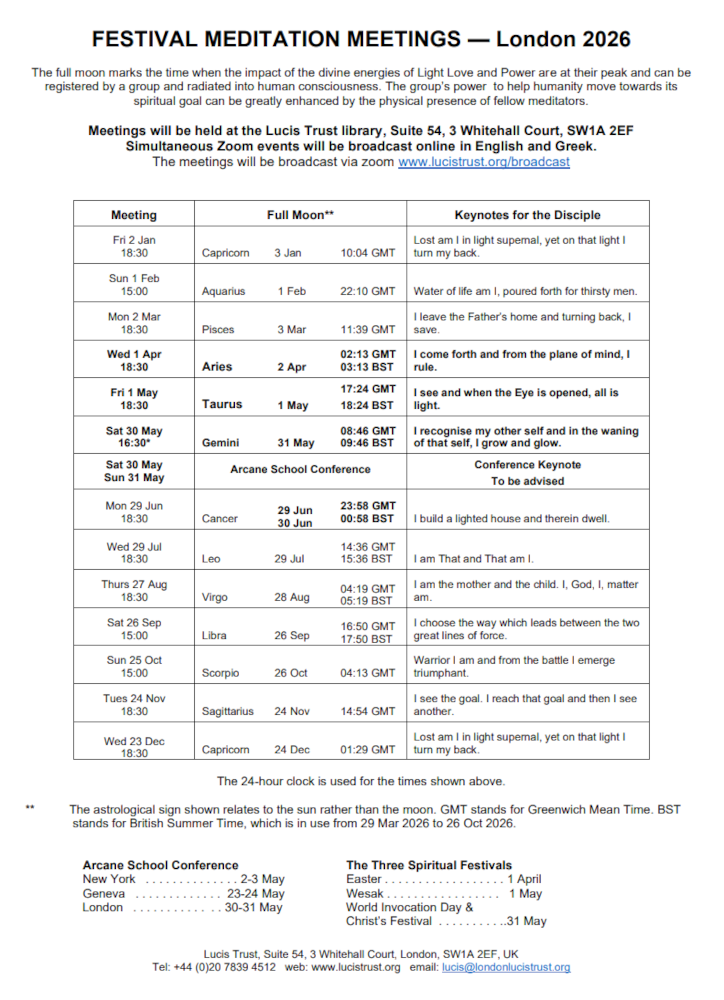
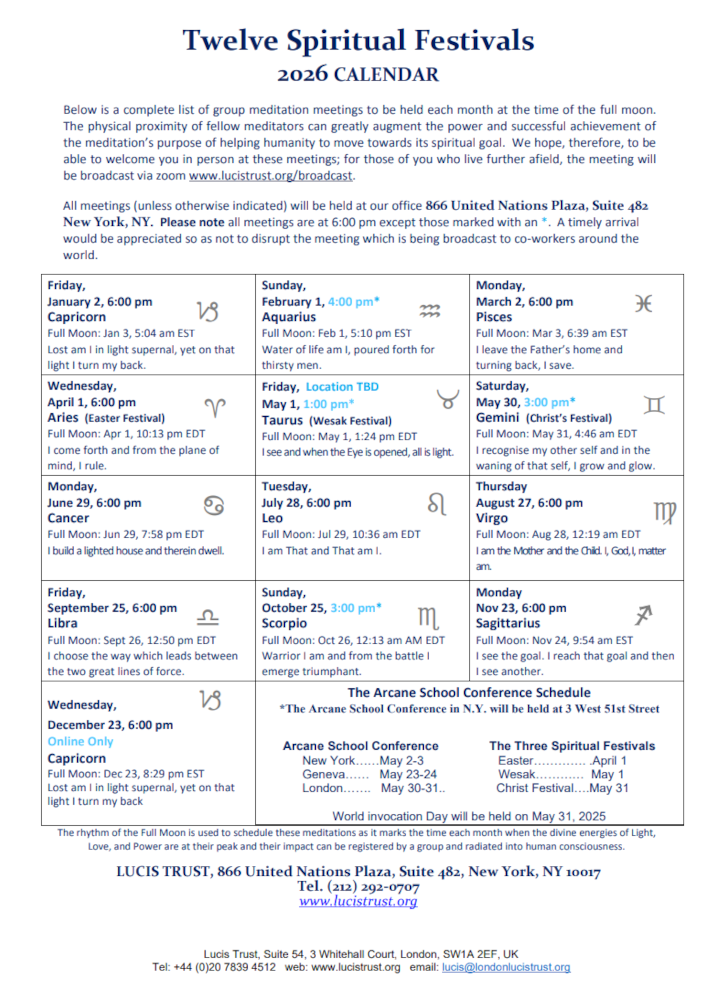
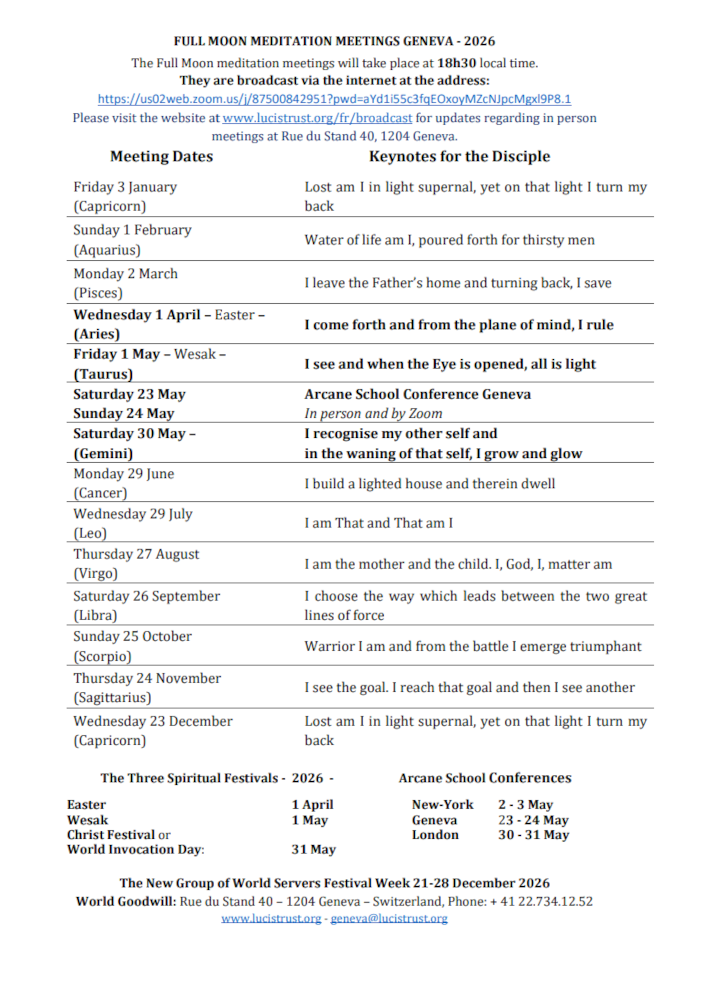
The Great Invocation - September 2025
| THE GREAT INVOCATION | THE GREAT INVOCATION (Adapted) |
|
From the point of Light within the Mind of God From the point of Love within the Heart of God From the centre where the Will of God is known From the centre which we call the race of men Let Light and Love and Power restore the Plan on Earth. |
From the point of Light within the Mind of God From the point of Love within the Heart of God From the centre where the Will of God is known From the centre which we call the human race Let Light and Love and Power restore the Plan on Earth. |
*Many religions believe in a World Teacher, a “Coming One”, knowing him under such names as the Lord Maitreya, the Imam Mahdi, the Kalki Avatar and the Bodhisattva. These terms are sometimes used in versions of the Great Invocation for people of specific faiths.
Triangles is a world service activity in which people link in thought in groups of three to create a planetary network of Triangles of light and goodwill. Using a world prayer, the Great Invocation, they invoke light and love as a service to humanity. Further information is available on request from Triangles.
The Triangles Bulletin is for people of goodwill and is published four times a year in Dutch, English, French, German, Greek, Italian, Polish, Portuguese, Russian and Spanish. Triangles is an activity of the Lucis Trust, a non-profit educational charity which exists to promote right human relations.
For further information and literature write to:
| Suite 54 3 Whitehall Court London SW1A 2EF UK |
Rue du Stand 40 Geneva CH-1204 SWITZERLAND |
866 United Nations Plaza Suite 482 New York NY 10017 USA |
JOY
Joy is a special quality that comes from deep within us. It is a radiating light that uplifts human consciousness, bringing strength, love and compassion to others. It is described in the Agni Yoga writings as the manifestation of the Creator’s Power, illumining a world in darkness.1 And in Alice Bailey’s writings, we find advice to ponder on joy, happiness, gaiety and bliss, as these release the channels of the inner life and reach – in a wide circle – many others. They heal and cleanse the physical body and can help servers to do their work “with little effort, a proper sense of values and a detachment which is based on love and not isolation”.2
In spiritual terms, there is a distinction between happiness and joy. Happiness concerns the physical life with its desires, events and mental constructs. Happiness comes and goes; there is a constant ebb and flow. Joy is not worked up from below as an objective or goal but is a spontaneous manifestation of the love and light of the soul. It is a universal quality that transcends prejudices and man-made barriers. Joy is not dependent on worldly status or position, neither is it a reward for services rendered or for honours bestowed. Paradoxically, in the midst of personality distress and unhappiness, the joy of the soul may be known and felt.3 When the simplicity of the soul guides life and relationships in a spirit of self-forgetfulness, joy can emerge when least expected as an illuminating light revealing the good, the beautiful, and the true, which are so often veiled by illusion and glamour.
Joy uplifts the spirit, and we can tune into this special quality daily in so many ways. Not only might it be found in the sacred spaces of the world’s cathedrals, churches, mosques and temples, but it can also come to us through the arts and music, through the beauty of the natural world, in the mountains with their sparkling streams and in the ebb and flow of the oceans. It may be sensed in the innocence of children playing, in the relationships with loved ones or as we stand awestruck at the beauty and grandeur of the dark night sky, pondering the meaning of life and our place in the cosmos. In the silence and solitude of the inner worlds, joy is all around us.
"Joy settles as a bird within the heart
but has winged its way from the secret place within the head.
I am that bird of joy.
Therefore, with joy I serve." 4
- Leaves of Morya’s Garden, Book One, The Call, S.240
- Alice Bailey, Discipleship in the New Age, Vol.1, p.170
- Alice Bailey, A Treatise on WhiteMagic, p.370
- Alice Bailey, Discipleship in the New Age, Vol.1, p.158
Reach up to the heights of the soul and, having sought and found that pinnacle of peace and that altitude of joy whereon your soul immovably stands, then look into the world of living men—a threefold world in which all men, incarnate and discarnate are found. Find there that which your soul can and will recognise. The glamours of one's own distress, the maya of the past distorts one's point of view. Only the soul stands clear from illusion, and only the soul sees things as they are. Mount, therefore, to the soul.
A. Bailey, Discipleship in the New Age, Vol.1, p.463
MADE VISIBLE BY LIGHT
Transparency is very much in the news these days, particularly in relation to the realms of government, politics and business. Yet it also plays a key role in Triangles work, or in any spiritually inspired program of service. In one sense, this is about being real with oneself and with trusted colleagues, recognizing shadows transparently, working through glamours and vulnerabilities in the personality, and viewing them in relation to the more inclusive and lighted energies of the soul. Through the transformation process, these higher energies become transparently present for all to see – shining through thoughts, words, speech and actions without pretense or contrivance.
In another sense, the “entire evolutionary process” can be conceived as the “working out of the inter-relation between God and His world”. Matter can then be seen to be destined to become a pure, “transparent medium for the revelation of divinity”.1 In the Triangles work, the three participants link together for no other purpose than service of the whole by irradiating human consciousness with the energies of soul and spirit. Any sense of a separate self with its individual desires, needs and wishes are, for the time at least, put aside so that the lighted, loving energies of divinity may shine freely into and through the realms of time and space, without interruption or resistance. The network is designed to function as a transparent medium to let in the light.
In optics, a transparent medium transmits light without any appreciable scattering. Glass and water, for example, let light through as if they were made of nothing, even though they are “full of atoms”.2 The deeper, loving mind has something of this quality and there are today significant numbers of people undergoing training in meditation with the goal of aligning with this transparent level of mind. When all the distractions of a self-centered and hyperactive mind are exposed to the light during regular periods of meditation, it as if the veils that inhibit appreciation of and alignment with the spiritual realm begin to part – a rent within the veil widens. As the mind becomes still, poised and focused, direct or intuitive knowledge and wise understanding become possible – something of the magnificence of life can then be sensed, “not theoretically, but in vibrating response to its existence”.3
When intuitive understanding renders a truth transparent it changes our orientation to life – allowing us to look out on the world through a new lens, transforming the way we live. Hermann Keyserling suggests that all the phenomena of life and events can be seen as symbols. And every symbol that is an ultimate expression of a conscious state “is in itself transparent for another deeper one, and so on into eternity; for all things in the sense-connexion of life are inwardly connected, and their depths have their roots in God”.4
- Alice Bailey, Esoteric Astrology, p.626
- https://www.universeofparticles.com/light-travelling-through-a-transparent-medium/
- Alice Bailey, Glamour: A World Problem, p.181
- Hermann Keyserling, The Recovery of Truth, pp.91-92
Triangles Webinar: Broadcast on the second Monday of every month
www.lucistrust.org/triangles/webinar
HARMONY
There are many ways to view the need for greater harmony in the world. As spiritual servers, we have the opportunity to work in a new way. At this time of greater world conflict, when many ideologies are competing for power and control in the world, there is a level of harmony and cooperation that can only be forged from shared goals that rise above individual opinions or beliefs. This may mean having to accept that others think very differently about how to solve many of the world's problems and being willing to work with them to realize a higher purpose. This understanding is an integral part of Triangles service.
When we start a new Triangle, we may not know much about our fellow Triangle members. They may not share the same set of beliefs as we do, despite being in the same group, but we know from the Triangles work that we are doing together, that we are all seeking to serve and bring needed changes to the world. In Triangles work, therefore, we work with others beyond our own political, religious or philosophical beliefs to reach a higher level of consciousness together. When we do this, we are growing the Triangles network from a place of unity: it is beyond these differences where true unity and harmony resides.
In reality, we cannot know what the future will look like, it being born from the aspirations of the many who are working to bring it into manifestation. It may look very different from what we can conceive of it now. We work in Triangles together beyond our illusions and glamours about this future reality, so that the divine can work through us, as a group. It is through this impersonal willingness to serve humanity together that the Aquarian age is being born. These glamours will continue to dissipate as this greater harmony is sought to realize the universal reality beyond it. This may be a new approach for some, but it allows a fluid synthesis to arise so that a greater unity and harmony can be achieved.
The work of synthesizing and harmonizing differences between opposing ideas will be the work of the Aquarian Age. This is replacing the fanatical adherence to ideals that so characterized the Piscean Age at the expense of greater harmony. Finding points of synthesis and compromise allows for greater cooperation to manifest and can harmonize differences of thought. The ability to consider opposing viewpoints on how to work together allows the universal truths which lie behind them to be discovered and the harmony from their integration to be realized.
September 2025
The UN Declares An International Day of Hope
In March of this year the Ambassador of the small Pacific Island state of Kiribati introduced a resolution to the UN General Assembly calling for the establishment of a UN Day of Hope to be observed every year on July 12.
H.E. Teburoro Tito spoke of hope as “a force that has carried humanity through the darkest of times and propelled us toward a future of possibility, resilience and renewal.” The Day of Hope would, he suggested, “serve as a global symbol of perseverance, unity and the unwavering belief that a better world is within our reach”.
Global mental health leaders initiated moves for the UN Declaration, recognizing that the Day marked a call to “make Hope a public health priority and recognize it as a protective factor against violence, addiction and suicide.” Understanding hopelessness as the core predictor of suicide, one key NGO promoting the Day of Hope, iFred, focuses its work on evidence-based programs designed to ensure that all know ‘how’ to Hope. These include: Hopeful Minds, applying the idea that “hope is a teachable skill” in work with students, educators and parents; and Hopeful Cities offering resources and strategies in fields of Government, Science, Education, Workplace, Healthcare and Art for cities to cultivate and sustain hope within their communities.
The UN refers to the Day as a way of highlighting a universal need in uncertain times:
“In a world facing growing unrest, widening social divisions, and persistent economic and environmental challenges, the global community continues to seek values that unite rather than divide. Among these, hope stands out as a deeply powerful and universally resonant force. Recognizing this, the United Nations General Assembly has designated 12 July as the International Day of Hope—a day to celebrate and promote hope as a guiding principle for individuals, communities, and nations alike.”
Member states, institutions, civil society and individuals are all called on to “cultivate environments where hope can thrive”. Ideas for participation in the Day include organizing small local “Circles of Hope” to discuss local challenges and imagine solutions. Other suggestions are to “dedicate an hour to service”, and to ”incorporate reflections on hope into lessons, meetings, or faith gatherings to spark ongoing dialogue.”
It is worth noting that the UN’s declaration of a Day of Hope was not without some political drama, reflecting the current state of the cooperative spirit in the General Assembly. Governments had agreed unanimously to approve the resolution without vote, but at the last minute the United States called for a vote. The vote to declare the Day easily passed with the support of 161 nations: four, including India, abstained, and one (the US) voted against, arguing that this represents an unnecessary proliferation of International Days like the Day of Peace and of Happiness, and also opposing the resolutions references to “diversity, equity and inclusion that conflict with US policies”.
All this tells us that, following on from the high aspirations when the UN was founded in 1945, the work of fostering the spirit of cooperation in relations between nations is still very much a work in progress, and needs, now as much as at any previous time, “perseverance, unity and unwavering belief that a better world is within our reach”.
Download Newsletter in PDF
Go to Newsletter Home
Goodwill as Hope, Will and Aspiration
Catherine Crews
In this significant year of 2025 the world abounds with “solutions” to the many problems we face. It may be that our greatest difficulties center around widely differing ideas about how we are to resolve the conflicts we see. Do we do more of the same? Do we seek new approaches to problem solving? There is a sense that time is running out, that we must do something and do it quickly. At the same time, we seem to be unable to move toward solutions that bring a sense of completion, of comfort and peace.
And yet this time of struggle is also a time of opportunity, and the energy of goodwill is the agent of this opportunity. Goodwill and understanding bring a spirit of community that spans the abyss between sides and opens a way to cooperation not previously seen. With goodwill, forces supporting divisiveness can be creatively reshaped to support a common vision. Goodwill can be described as the love of God in action; humanity expressing goodwill as hope, will, and aspiration can change the world.
These words: hope, will, and aspiration, have in common that each name an idea, yet they all come into being only in activity. The idea must be expressed through action, or it remains lifeless. Perhaps a more complete naming of these ideas would be hoping, willing, and aspiring. And in this recognition the necessity of relationship is born. When that relationship is with the soul and the Divine, the hoping, willing, and aspiring working in every human heart become invocation. God’s response is evoked and thus the relationship of invocation and evocation turns desire into experience. Religion is the name we have given to the relationship between humanity’s invocative appeal and Divinity’s evocative response to the plea.
The following fundamental truths underlie this relationship that can be described as vertical, linking us to spiritual levels of awareness:
- The fact of God, both transcendent and immanent
- We are related to God; we are all “children of the one Father”
- We are essentially divine, immortal and eternally persistent
- There is a continuity of divine revelation, and of divine approaches
If relationships with God are vertical, relationships with each other can be described as horizontal, linking us to our fellow humans and the environment. This includes our family and friends, our community, our nation and all nations, expanding to include the entire human family and the planet itself. On this horizontal level, hoping, willing, and aspiring become the foundation of right human relationships that encourage the maximum evolutionary growth of all individuals and groups. Goodwill is the name given to the energy that supports the growth of right relationships.
Invocation and evocation are the essential components linking the vertical and horizontal paths of relationship. In these together we find the power of Unity manifesting in time and space, responding to humanity’s need. We come to sense the presence of a divine Plan working out through the agency of men and women of goodwill all over the world as they apply hope, will and aspiration in actions to solve humanity’s problems.
Faith is the spiritual partner of hope. From the Christian tradition we have the words of St. Paul in his letter to the Hebrews, “Now faith is the substance of things hoped for, the evidence of things not seen. For by it the elders obtained a good testimony. By faith we understand that the worlds were framed by the word of God, so that the things which are seen were not made of things which are visible.” Hebrews 1: 1-3 NKJV
Elsewhere in the Bible we are told the strength of faith is the power that emerges when we pray “in Jesus’ name.” In other religious traditions as well, invocation of the Divine name, whatever name we may use, is understood as bringing prayer into harmony with the vision of divine love for humanity and the manifested worlds, and thus gains power as invocation.
Without faith, hoping would be irrelevant, for faith assures the experience of the Father’s love and secures the spiritual recognition of God’s close, subjective and unbreakable relationship with all humankind, everywhere. This unshakable conviction of God’s living presence within and among us is the foundation of humanity’s invocative power, and the source of the inevitable evocative response aroused in God. The men and women of Goodwill bring this certainty to the solving of our world’s problems; it is of inestimable value regardless of the seemingly unsurmountable difficulties involved. We need not have the answers to our world problems, but as we prepare our minds and hearts and lives for service and identify with others of similar intention, we have a real influence on the process of solution. In this knowing we find hope.
Willing invokes the Will-to-Good. When we think about will, we may be thinking about determination, or getting something done our own way, but spiritual will is another thing altogether. Spiritual will is the Will-to-Good, Divine purpose, God’s loving desire for the good of all. In humanity the Will-to-Good works out as goodwill, expressing the love of God in the worlds of everyday life. Goodwill is the foundational energy of right human relations, and thus the key to our future. The spirit of goodwill, essential to solving the many problems humanity now faces, is service, love in action. It is found in the understanding, cooperation, and sharing which exists among all peoples throughout the world.
The potency of goodwill depends on its agreement with divine will to the extent we can understand it. Directing our personal will toward goodwill requires inclusive thinking. Modern systems of communication make clear the interdependence of humanity; problems seen to arise in the few are in truth shared by all, problems seen to arise locally are in truth global issues. Here we come to recognize the power of invocation: as increasing numbers of people individually and in groups direct their energies toward humanity’s highest good the evoked response of the One Life is certain.
These facts support the strength of our invocation:
- Energy follows thought, and goodwill is directed by thought. We can affirm, “As a person thinketh in their heart, so are they.”
- The mind is light. Holding the mind steady in the light becomes a practice of invocation sure to evoke divine response.
- The “will to that which is good and ought to be” is a dynamic force for constructive action, capable of remaking the world
Aspiring is goodwill in action. This time of turmoil is also a time of spiritual opportunity., People of goodwill everywhere are turning their attention to service, to the intention of bringing goodwill into the reality of the lives of all. Aspiration is desire expressed as loving action on the physical planes, and as invocation on the spiritual planes. It leads us unerringly to world service, to self-forgetfulness, and to radiant, magnetic living. It leads us to truly say of the work we are doing, “Thy will be done.”
We have been given a world prayer, the Great Invocation, as the most potent tool for the work of goodwill today. In this prayer we are invoking the energy of God’s profound love for humanity, forming a pattern or blueprint of a divine Plan, leaving humanity free to choose to build upon this pattern. As we hold within our minds and hearts the light and love and power of this prayer we are evoking from God assurance of the spiritual capacity to see the divine Plan work out. The Great Invocation (adapted version below) is the fulfillment of our hope.
From the point of Light within the Mind of God
Let light stream forth into human minds.
Let Light descend on Earth.
From the point of Love within the Heart of God
Let love stream forth into human hearts.
May the Coming One* return to Earth.
From the centre where the Will of God is known
Let purpose guide all little human wills –
The purpose which the Masters know and serve.
From the centre which we call the human race
Let the Plan of Love and Light work out
And may it seal the door where evil dwells.
Let Light and Love and Power restore the Plan on Earth.
Download Newsletter in PDF
Go to Newsletter Home
World Goodwill Newsletter 2025 #2 Hope as a Spiritual Potency
While for many the mounting and interrelated crises in human affairs at this time leads to a stultifying sense of hopelessness, this issue of the Newsletter focuses on its antidote: hope as a spiritual potency rooted in that place where heart, soul and spirit unite. World Goodwill’s work is inspired by ideas in the Alice Bailey books, including the prophecy of an important Hierarchical Conclave in 2025 ultimately leading to a crisis in humanity, bringing unusual opportunities in the years and decades to come for initiatory-type advances towards a new moral order.
In 2025 the Catholic church (representing a little over 17% of the global population) having passed through an important Conclave to select a new Pope, is observing a Jubilee Year under the motto ‘Pilgrims of Hope’, with a call to ‘turn debt into hope’. Furthermore, the UN General Assembly voted this year to observe July 12th annually as International Day of Hope.
May the articles which follow help you explore the nature and meaning of hope during this time of spiritual crisis, always remembering that hope is a central quality in most religious and spiritual traditions.
Download the Newsletter in PDF
Jubilee 2025: Pilgrims of Hope in a Global Crisis
Hope: An Ancient Message
Scholars note that, in its earliest days, Christianity was characterized by an initiatory structure and a form of language drawing on the heritage of the ancient Mystery religions. It offered soteria (σωτηρία, or salvation, in Greek) to all humanity, in place of the gloomy afterlife of the pagan faiths, which envisioned Hades as a hopeless subterranean land of shadows. Yet, as often happens with revelations later enshrined in dogma and institutions, little is truly known of the earliest Christian groups—when the World Teacher, incarnated in Jesus, spoke with simplicity and humility on the Mount of Olives, before theology recast Him as a doctrinal figure of the Trinity. Priest and Theologian Alfred Loisy once remarked: “The peoples once awaited the Kingdom of God, but instead came the Church.” Indeed, very little survives of that original religion we call primitive Christianity, but it can be conjectured from the relatively few extant testimonies that its most prominent note was hope—a luminous, transformative hope that shone upon a world where ancient religions were in decline and the human spirit longed for a new era to dawn.
Biblical scholarship acknowledges that the Gospels—written decades after the passing of Joshua —cannot be regarded as strictly historical records; they are, in fact, largely anonymous works, with the names Matthew, Mark, Luke, and John likely assigned by tradition toward the end of the second century. Even so, they still carry the enduring echoes of that original note of hope that the Christian movement sounded in a desolate world, as the ancient Philosophical and Mystery Schools, though still lingering, were already fading and would soon be eradicated from the Mediterranean under imperial decrees.
A singular and striking expression of the note of hope woven into every thread of the New Testament is found in Revelation. It remains something of a mystery that this enigmatic work secured its place in the canonical Bible. And yet this strange, visionary book endured, as though its fierce symbolic poetry whispered a truth the early Councils could never fully silence: the hope of salvation, not only for Christians, but for all humanity.
“Then I saw a new heaven and a new earth... and I heard a loud voice from the throne saying, ‘Behold, the dwelling place of God is with man... He will wipe away every tear from their eyes... Behold, I make all things new.’” (Revelation 21:1–5)
“Then the angel showed me the river of the water of life, bright as crystal, flowing from the throne of God and of the Lamb... On either side of the river, the tree of life... and the leaves of the tree were for the healing of the nations... They will see His face, and His name will be on their foreheads.” (Revelation 22:1–4)
These twin visions sketch Christianity’s ultimate horizon of hope: a transformed world where life flows freely, unstained by scarcity or fear. The “water of life” in Revelation 22 is not a private spring but an Aquarian torrent for all humanity, poured forth for “the healing of the nations”. Hope, therefore, is always pressing outward, reshaping economic habits and social structures so that earth’s fruits may reach every table. It is deeply significant that “seeing His face” (a true metaphor for the face-to-face meeting with the Soul) is linked to the distribution of the “river of life,” the resources of the planet, for all humanity. “For now we see through a glass, darkly; but then face to face” (1 Corinthians 13:12), Paul reminds us. He then gives hope its theological backbone when faith is defined as “the assurance of things hoped for, the conviction of things unseen” (Hebrews 11:1).
Poised between the promise of a river and a not-so-flourishing reality, we may help create thought‑forms of a just world and act as if the new earth were already sprouting beneath our feet—a living demonstration of the ancient truism that “energy follows thought.” Yet hope, rightly understood, is never meant to remain unfulfilled promises. Greek myth gave symbolic form to this unease when it left hope sealed at the bottom of Pandora’s jar—the very vessel that had unleashed all the evils into the world at the close of the golden age of the gods. Was hope, then, for the Greeks, a subtle evil in disguise? It is a question scholars continue to ponder to this day. Paul, by contrast, spoke of an active and transformative hope. Later, the words of the Nazarene would make it clear that “only as a child shall one enter the Kingdom of God” (Mark 10:15), implying that the true development of consciousness demands a return to wonder and innocence—a second “immaculate” birth into the sacred, the realm of the soul. What seems clear is, that authentic hope must translate into concrete choices—into what Pope Francis called “restoring access to the fruits of the earth to everyone.”
A Modern Apostle of Hope
Whenever a supply chain becomes more ethical, or a budget prioritises the poor, the unseen future flickers into view. Such moments reveal, in fragmentary form, the hope that Revelation promises and faith insists upon. In that interplay of vision and practice, Paul’s definition finds its fullest expression: hope drives the creative imagination and carves channels for the river of life to reach every corner of the earth. Pope Francis strongly suggested that true spirituality is grounded in a commitment to justice and the fair distribution of resources.
It is precisely this understanding of hope—not as passive optimism, but as a sacred and actionable force—that found new expression in Catholicism’s Jubilee tradition. Revived for 2025 under the motto “Pilgrims of Hope,” it echoes Revelation’s river by urging a just redistribution of global resources, including the cancellation of unpayable debts that lock whole nations out of sustainable development. When faithful communities advocate for debt relief, climate finance grants, and fair trade, they turn Paul’s assurance into an esoteric axiom. They declare the obvious though still not fully recognised fact that the world’s resources are destined for renewal and distribution, not exploitation.
The tradition of the Jubilee has deep historical roots. Its biblical framework comes from Leviticus 25, where Israel’s fiftieth year canceled debts, freed slaves, and let the land rest. Medieval popes adapted this idea into a Christian pilgrimage centered on Rome, and after 1475 the 25-year interval became the norm. Echoes of this tradition can be found in the ancient world: in Greece, measures like Solon’s Seisachtheia (6th c. BC) canceled debts and freed debt-slaves; while in Rome periodic amnesties, debt remissions, or the Lustrum rite symbolically renewed the life of the community.
The Catholic Church’s coming Holy Year opened on Christmas Eve 2024 and will extend to 6 January 2026. By tradition every quarter-century year—1475, 1500, … 2025, 2050, etc. —receives the title “ordinary Jubilee,” a rhythm fixed by Pope Paul II in 1470. That rhythm invites each generation to pause, look back with gratitude and forward with confidence. Pope Francis chose the motto “Pilgrims of Hope”; in the bull Spes non confundit (“Hope does not disappoint”) he invites the faithful to a kind of meditation: “to dream again,” to walk the earth as guests rather than owners, and to ensure that everyone shares “the fruits of the earth.”
The biblical mandate to cancel debts returns with force in the current global crisis: 54 low- and middle-income nations are now in debt distress, more than double the figure in 2015. Caritas Internationalis and its partners have launched the “Turn Debt into Hope” campaign, urging the G20 to create an automatic, transparent mechanism for restructuring sovereign liabilities and to channel climate-finance grants rather than loans to vulnerable nations. Francis equated unpayable debt with modern slavery and asked Christians to pressure their governments “to open a door to peace” by writing off or converting arrears into health, education and green-transition spending.
This Jubilee opened in a time of transition. With Pope Francis now at rest and Pope Leo XIV newly elected, the Catholic Church stands in expectation between ages. Around the globe, pilgrimages rise like prayers in motion: in the Philippines, actions to plant trees and forgive debts; in Nigeria, youth carry light into prisons and refugee camps; in the Amazon, canoes glide like living psalms over endangered waters. These gestures speak of a hope that refuses confinement—a force bending history toward healing, perhaps even the first signs that the “river of the waters of life” is beginning to flow across the earth.
This kind of hope is ancient: It once moved seekers to Eleusis and Delphi for glimpses of hidden wisdom, led Israel toward Zion in holy expectation, and kindled in the first Christians a daring faith that salvation belonged to every soul. Today, Jubilee 2025 calls us into that same, timeless procession as “pilgrims of hope,” walking toward the day when Christ, the true Hierophant, returns to restore the Mysteries, gather His children together, “as a hen doth gather her brood under her wings” (Luke 13:34), and make all things new.
Download Newsletter in PDF
Go to Newsletter Home
Hope in a Centennial Conclave Year
In ageless wisdom teachings there is an understanding that spiritual forces, sometimes understood as the hierarchy of enlightened beings honored by the world’s cultures and spiritual traditions, act as a living reservoir of light and love, at the heart of the human soul. These higher forces inspire all forward-thinking evolutionary progress. Students of several wisdom teachings share a sense that the light of these Spiritual Intelligences is today leading us as a species towards an initiatory Omega-like point of transformation. As the Forces of Light hold the fires of love unfolding in humanity within their gaze, ever-deepening intuitive understandings of the synthesis and wholeness of life unfold.
The idea of a reservoir of light and love at the heart of the human soul is central to an understanding of hope in today’s traumatic and chaotic world. As Martin Luther King has reminded us, a deep and wise passion for social justice does not come from a “super-ficial optimism, but from a deep faith in the possibilities of human beings when they allowed themselves to become co-workers with God.” Or as Vaclav Havel, another visionary server who has had a huge influence on the modern world, commented, “hope is a dimension of the soul … an orientation of the spirit, an orientation of the heart.” In the “deep and powerful sense” that Havel is referring to, hope has nothing to do with ‘things going well’ but rather draws on the ability to “work for something because it is good, not just because it has a chance to succeed.”
The inner reservoir of spiritual power follows its own natural rhythms and cycles, rather like the cycle in the relations between soul and personality (in individuals, groups, nations, and the one humanity), or the cycles underlying astrological approaches to human development. Just as humanity approaches the Forces of Light through invocations, prayers and rituals, these Forces also make rhythmic approaches to humanity. The Alice Bailey writings refer to a rhythm of monthly pulses (symbolized by the sun’s rays during the full moon) of lighted, loving qualities, and of a special pulse of energy nourishing communities dedicated to world service every seven years and culminating in a powerful ‘hierarchical conclave’ during the 25th year of every century.
This makes 2025 a significant year to imagine what the Enlightened Ones might observe as they look out on the consciousness of humanity today, and more importantly as they review the values and qualities of spiritual intelligence alive in human relationships at this time – seeing both the deeply embedded paradigms of what has been called the colonial mindset of competing separate parts (modernity) and an emerging paradigm, still coming into focus, which is more centered on the quality of relationships between parts and over-arching wholes.
This image of a ‘conclave’ amongst transcendent Beings in the heavenly worlds, and the impacts it has through the immanent presence of these Beings within the human soul, does not suggest that some sort of divine intervention will magically solve all our problems for us. In the immediacy of time and space there is work to be done which only we human beings can do. We are constantly challenged to grow in our response to soul impulses within us – grow in the electrification and breadth of our experiments in the practice of love in an interconnected world of relationships. The substance of the world and the substance of human beings evolve in response to conflicts, challenges and crises. It’s often a painful, gritty process. Spirit informs, matter (the substance of our human personalities, our inherited habits and many of our cultural norms) resists – and through the inter-play, over lifetimes a deepening soul consciousness develops through freely made choices and decisions. This is how a new moral consciousness develops in the world of time and space. And it is where we can situate our hope in “the future waiting to be born”.
From the esoteric vision presented in the Bailey writings the Centennial Conclave is a time for the Spiritual Hierarchy to come to humanity’s aid in ways that will inevitably result in some form of crisis over the coming years. We often speak today of a meta-crisis in human affairs, and as this idea intensifies over time, we perhaps get some hint of the sort of spiritual crisis which might be envisaged by heavenly Forces. Crises are always difficult and challenging – we only need think of the Second World War or, more recently, of the tensions leading to the fall of the Berlin Wall or the ending of apartheid in South Africa. The value of spiritual crises is that they provide the mental and emotional environment, the psychic disturbance, which can push those who already sense the spirit of synthesis, understanding its distinction from enforced unity, to clarify their thinking, deepen their sense of moral responsibility, and refine their experimentation in the practice of building an outer world that is a clearer reflection of the wholeness of life.
One of the characteristics of the Bailey perspective is the expectation that the current period (especially in the decades following the 2025 Conclave) will see a new cycle in the engagement of Forces of Light with human affairs – an externalization of some elements of the Kingdom of Souls – reflected in humanity through the strengthening of the soul in the world, the growth of wise leadership and the emergence of a stronger presence of the universal spirit of such Beings as the Christ and the Buddha in areas like economics, education, healthcare, religion and governance. And we can also envisage that an approach from the spiritual kingdoms to humanity, matched by humanity’s approach to spirit and soul, is of special significance at a time like this when the intensity of the problems of the materialistic consciousness threatens the very survival of the human species. As the Gita states “wherever there is a withering of the law … and an uprising of lawlessness on all sides, then I manifest Myself.”
The current worldwide breakdown of order, with accompanying wars and a massive increase in expenditure on ever more lethal weapons, is the result of a failure to express moral power. While this triggers a sense of hopelessness and nihilism amongst many people of goodwill, for others it acts as a spur to draw more deeply from the reservoirs of hope – and an invocation to the spiritual resources within us that form the ground for that hope. What is most crucial currently is the response of the deeper thinkers in all societies and those who are actively seeking to mold their lives around universal spiritual values.
True hope centers on this notion that a new moral sense is being forged within the minds and hearts of millions of people of goodwill, and that this is part of a broader metaphysical transformation involving both the human and the divine elements of our collective being. The idea of a ‘Centennial Conclave’, presenting a crisis in some form that will have a transformative effect on those in humanity drawn to a discipleship-like approach to the establishing of a new moral order determining the direction of thought and world affairs for the coming hundred years is something to welcome, yet it also brings with it dangers. A deepening spirituality always involves the treading of a ‘nar-row, razor-edge path’. While a new ‘moral order’ can be understood from an Aquarian sense of relationship with its spirit of universality, sharing and cooperation, it can also be approached from a narrower sense of obeying strict partisan rules with the aim of either returning to a mythical past, or magically transporting into a dream-like state of ideological correctness.
Kate Davies writes about “intrinsic hope” as a key to living courageously in troubled times. She has noted that standard dictionary definitions refer to conventional or “extrinsic hope, … based on the naïve expectation that life will give us whatever we hope for.”1 This sort of results-based hope, when it does not work out as desired, leads to despair and breeds hopelessness. Yet, Davies notes, many dictionaries offer a secondary definition, of hope as ‘trust’: “an unshakeable faith in whatever happens and in the human capacity to respond…. It comes from inside – from our hearts, souls and spirits.”2
2025 is a year to contemplate what impact a new ‘push’ from the Forces of Light might have in the world. In such a year we can imagine that the spirit of hope which ‘comes from the inside’ of our very being is solidifying, deepening and becoming a driving force in the human kingdom.
1 Kate Davies, Intrinsic Hope: Living Courageously in Troubled Times. 2018. P. 14.
2 https://www.resurgence.org/magazine/article5090-where-theres-life.html
Download Newsletter in PDF
Go to Newsletter Home
High Level Political Forum, July 14-23 2025
|



July-September 2025
Subscription > 1 year > 2 years > 3 years | Single issue > Sample issue >
CONTENTS:
Editorial – Thought Directs Energy.
Thinking within the heart, sometimes called brooding, is a process of nourishing a special vision – a seed crystal for a new civilisation perhaps.
The Value of Knowing the True Nature of Man – Dwjhal Khul
Science, exoteric or esoteric, is a collective mental and imaginative project to represent the nature of the cosmos consistently at all levels. As such, it’s a definite strand in the building of the collective antahkarana, serving to clarify the shared structures of consciousness and form in which circulating energies are differentiated, materialised and re-synthesised.
The Macrocosmic Mind: Learning to Think Abstractly – Katherine Hendon
The distinction between purificatory and initiatory fires lies in their intent and function. The former prepares, cleanses, and purifies.... The latter transforms and elevates, activating the divine potential within and bringing the aspirant into alignment with the universal order. Purification is the prerequisite; initiation is the fulfillment.
Love as the Spirit of Construction: On the integration of Buddhist and Christian Thought – Swaan Barrett
Love is the unifying force that both builds the universe and integrates Buddhist detachment with Christian compassion through active soul-infused service.
Pythagoras – Genius and Piscean Forerunner – Joanne Kutzler
The Ladder of Life – Caroline Fisher
Freewill and sacrifice allow us to climb the living ladder of life, uniting love, intelligence, and will in service to the planetary whole.
Personal and Worldly Tension – by a Student
Tension marks the meeting point of opposites and calls forth transformation, both in personal development and planetary evolution.
The Externalization of Consciousness: Yogic, Biological, Astrological, and Quantum Perspectives – Zed James
The human kingdom now stands at a unique moment upon its evolutionary arc—a moment characterized by our growing capacity to concretely externalize (as conscious evocation) those internal truths which have previously remained esoteric.
The Problem of Wealth and Poverty – Catherine Crews
In a sacred economy we recognize that we are one with our group brothers, that the love of the soul guides the sharing of all we have, that the strength and encouragement of each are necessary for the well-being of all.
Black Elk – A Forerunner – Edith Naas
Subscription > 1 year > 2 years > 3 years | Single issue > Sample issue >
The UN Ocean Conference, June 9-13 2025
|


INTERNATIONAL UNITY
One might ask: what does international unity have to do with Triangles? The short answer is: quite a lot. The longer answer, showing the deeper connection, is a little more obscure. Obscurity, however, does not imply a lack of relevance or potency. The divine plan may be obscure from the usual view of the world, but the relevance and potency of its basic ideas are what is slowly and inevitably moving human consciousness in the direction of its divine objectives, and the service of Triangles has the potential to exert a similar potency on the idea of world unity.
World unity is an ideal, the need of which has become obvious as a result of wars, past and present. A world of divisive nationalism, separativeness and greed does not provide a fitting vessel for the expression of the energies of light, love and the will-to-good. These energies, inherent to the divine plan, must be allowed to flow and circulate freely so that they may express the intent of a compassionate world of cooperation and sharing. The Triangles work has a unique part to play in this process by assuring a continuous flow of goodwill across boundaries.
Triangles workers might like to consider the deeper links of this subjective service. This work is not without its higher counterpart. Esoteric texts say that the work is dear to the heart of the Hierarchy, and it is from the emanations that pour through the Hierarchy that we draw strength and inspiration. Members of the Hierarchy also work through a triangular pattern, distributing the energies of light and love into the world. Beyond that realm, the teachings relate that triangular patterns control the flow of energies among constellations, the solar system and the planets. The triangle is a basic symbol of stability, strength and balance throughout the universe, an archetypal geometry of service. The daily work of Triangles is helping to elevate human consciousness to vibrate in synchronisation with this universal pattern. It assists humanity to draw closer to the working methods of the higher realms. It is the primary way of distributing the universal energy of love as it expresses goodwill, and goodwill is the touchstone that will transform the world.
In the light of recent events, the goal of international unity may still seem as unlikely as it had in the distant past, or perhaps, more so now than ever before. But the goal of this transformation process is unity, not uniformity – a significant difference. If we consider the most common forms of unity – marriage, partnerships and families – where both diversity and unity do flourish, we see that they provide countless examples of loving understanding and goodwill overcoming seemingly insurmountable difficulties. More than ever, we are all connected to each other and other cultures through the telephones in our pockets, radio, television, emails, the internet, social media, travel and migrations. Through these endless connections and interactions, we find not only extraordinary diversity within humanity but also our common needs, hopes and dreams of peace and well-being. In this, our unity is abundantly evident – within this richness of human diversity, we find unity. The group consciousness of the soul, through its growing influence, builds our relationships around the world. The network of Triangles provides energies of light and goodwill daily, a unifying emanation poured forth to a world in need.
Triangles Webinar: Broadcast on the second Monday of every month
www.lucistrust.org/triangles/webinar
June 2025
THE GREAT INVOCATION - JUNE 2025
| THE GREAT INVOCATION | THE GREAT INVOCATION (Adapted) |
|
From the point of Light within the Mind of God From the point of Love within the Heart of God From the centre where the Will of God is known From the centre which we call the race of men Let Light and Love and Power restore the Plan on Earth. |
From the point of Light within the Mind of God From the point of Love within the Heart of God From the centre where the Will of God is known From the centre which we call the human race Let Light and Love and Power restore the Plan on Earth. |
*Many religions believe in a World Teacher, a “Coming One”, knowing him under such names as the Lord Maitreya, the Imam Mahdi, the Kalki Avatar and the Bodhisattva. These terms are sometimes used in versions of the Great Invocation for people of specific faiths.
Triangles is a world service activity in which people link in thought in groups of three to create a planetary network of Triangles of light and goodwill. Using a world prayer, the Great Invocation, they invoke light and love as a service to humanity. Further information is available on request from Triangles.
The Triangles Bulletin is for people of goodwill and is published four times a year in Dutch, English, French, German, Greek, Italian, Polish, Portuguese, Russian and Spanish. Triangles is an activity of the Lucis Trust, a non-profit educational charity which exists to promote right human relations.
For further information and literature write to:
| Suite 54 3 Whitehall Court London SW1A 2EF UK |
Rue du Stand 40 Geneva CH-1204 SWITZERLAND |
866 United Nations Plaza Suite 482 New York NY 10017 USA |
REVEALING THE DIVINE PLAN
Sublime emanations of the Divine are constantly pouring potencies of light and love into the minds and hearts of the human race. Great beings on the inner side of life (the Saints, Rishis, Angels, Ancestors and Lords of Compassion acknowledged by spiritual teachings down the ages) organise, direct and guide this flow of spiritual fire.
Human history is a record of the tension between existing beliefs and the inspirations, intuitions, and energies flowing into consciousness from divine realms. Fire meets fire, and in the process, human beings, cultures and epochs move through the cycles of birth, maturity and death.
Right now, in our times (which we might consider to be the hundred years between 1950-2050) the tension is high, as a new epoch is in process of being born while the previous one passes away. Everything in our personal lives, everything we do in our professions and work places, everything happening in our communities and nations, our places of worship, schools, hospitals, laboratories, art galleries, banks, farms and political assemblies – everything reflects this stress between divine fire and the fire of human response.
And so, in the most silent, deepest core of our being, we align with our Triangle partners and affirm: Let the Plan of Love and Light work out. This plan is God’s Plan – a divine vision in which the future of humanity and the Earth, the possibility of who and what we are becoming stands silently, potently before us and within us. It is not for us to know the details or the timing of this future. It will, after all, be worked out in a living way, determined by the forcing dynamic of the spiritual stimulation that flows from the Divine. What we do sense is that the divine plan envisions a future for humanity centred on relationships expressing principles of synthesis, wholeness and inclusiveness. As these principles are revealed and unfolded through the lives of millions of people of goodwill worldwide, so will the new civilisation of unity in diversity emerge in outer expression, as envisioned and planned for by all the Principalities, Angels and Deities of the inner worlds.
In the future epoch, humanity will have chosen to live in balance with the Earth, creating an infinite range of political, religious, economic, educational and scientific expressions of synthesis. Right now, painful, all engrossing, life and death problems have led us to the place of choice. It is divinely ordained – yet still the story of our response to God’s spirit within us is made up of countless small steps of goodwill.
________________________________
Until Christ came and lived a life of love and service and gave men the new command to love one another, there had been very little emphasis upon God as Love in any of the world Scriptures. After He had come as the Avatar of Love, then God became known as love supernal, love as the goal and objective of creation, love as the basic principle of relationship and love as working throughout all manifestation towards a Plan motivated by love. This divine quality, Christ revealed and emphasised and thus altered all human living, goals and values. Reappearance of the Christ, AA Bailey, p.12
SPIRITUAL RHYTHM
Dictionaries define rhythm as a strong, regular, repeated pattern of movement or, in music, as the placement of sounds, generally considered as an ordered alternation of contrasting elements. It seems unavoidable, then, that to have a sense of rhythm, we must also have a sense of time, for we must be able to notice that the patterns are repeated, placed, or ordered in alternation within some kind of framework based on this construct.
In human life, we cannot avoid the presence of rhythm. The universe gently imposes it, through the revolutions of the earth around the sun and the phases of the moon. The natural world expresses it through the steady cycles of the seasons. And our physical bodies must align with it if they are to live in equilibrium. We frame rhythmic movements within the construct of time so that we can measure them and relate to them. And, thus, in alignment with how the universe, the natural world and human nature work, we create different rhythmic expressions for every single aspect of our lives, thus creating rituals. It would be impossible for us to extricate ourselves from the multiple levels of rhythm and from their manifestation as rituals.
And what about spiritual rhythm? At one level, and still within the construct of time, we could understand this as the rhythm of our spiritual practice, manifested as a ritual. In our work with Triangles, we have a daily ritual in which we function as a unified group with a common intention, and each day our work creates a strong field of consciousness which becomes a means for light, love and power to enter the planetary network accessible for humanity worldwide. This ritual is our discipline and our service.
We can also think of spiritual rhythm as beyond these ritual activities and as something else that we are not able to name yet, but through which the universe is seeking to manifest a divine inner plan. Spiritual teachings reveal to us that life itself breathes rhythmically, and that everything in the universe is impelled by this rhythm. It is also said that love pulses through the universe in a divine rhythm. As we ponder on these statements, we are attempting to touch something quite ineffable… the divine pulse… the pulse of life as it beats through the etheric body of the universe.
We have the opportunity to use our daily ritual to energise even further the field of consciousness that we create together, by focussing our intention to be agents for the healing energies of light, love and power to pulse through the network of Triangles in a divine rhythm. This is about attempting to penetrate the very essence of life.
Then we are both using the rhythm of our spiritual practice and working together as one with the spiritual rhythm of life.
2025 Arcane School Conference information page

Information & References
Saturday:
Mantram of Unification
Reflective Meditation on the Reappearance of the Christ
Sun on the Square
Conference meditation
Sunday:
Meditation on the Dynamic Will
Small Group Discussion Prompt
The Great Invocation
The Gayatri
Three Spiritual Festivals Meditation: Letting in the Light
Additional Materials:
Affirmation of the Disciple
Ten Seed Groups (16-page booklet)
The Wesak Festival (24-page booklet)
Democracy in Spiritual Crisis
Today, the idea that democracy is in a period of marked crisis is as commonly proclaimed by journalists, commentators, academics, and think tanks, as it is in the public sphere. This is not surprising. The rapidly changing landscape of political and social norms, the economic uncertainty, plus the intensity of polarization experienced across liberal democracies is unprecedented. The global proliferation of social media has further stimulated polarization and cultivated an atmosphere of hyper-populism which amplifies the voice of the “common” person and circumvents established levers of truth. Considered broadly, this anti-establishment movement compounds conflict with the status quo, but does little to chart a new way forward. Liberal institutions, the bedrock of democratic governance, are struggling to keep up.
Yet, despite worldwide recognition that democracy is in crisis, there is little agreement about the nature of the crisis, how it should be addressed, nor what such a crisis means for the future. The loudest of these voices broadly assert a crisis characterized by conflict, struggle, instability, retrogression, a withering of the law—many intentionally evoke fear and dread, of existential and insurmountable threats. Yet behind the din of catastrophe there are also voices of perspective and nuance, voices which analyze, clarify, and provide a thoughtful even if tentative path to solution.
Men and women of goodwill, and particularly those who find themselves working within the heart of the new group of world servers, have a key role to play in leading humanity through times of crisis, which are fundamentally times of change and therefore of opportunity for renewal and reorientation. To bring about such reorientation requires vision which is based on alignment and identification with that which is universally right and good, plus the discernment and compromising spirit necessary to chart a ‘way between’ the pairs of opposites. This ‘way between’ is also the higher way; it is the way forward.
Crisis: Opportunity, Change, Evolution
Crisis, contrary to popular assumption, is not always negative. It is essentially a time of decisive and radical change — a time of opportunity to build anew. The creative spirit which lies at the heart of human evolution proceeds by means of constant crises: periods of intensification, leading to decisive moments of decision, followed by periods of relative stability in which the effects of that decision work out. A brief look at the history of modern liberal democracy reveals that it has weathered many crises, transforming and evolving at every turn.
The almost constant nature of these crises means that periods of resolution sometimes blur almost immediately into new crises as the rapid progress of change immediately brings new problems. From one angle, one could say democracy has (at least throughout its modern existence) been in a constant state of tension or conflict with myriad short-term crises overlapping and faced on multiple fronts at once.
What Makes a Spiritual Crisis?
Examining the causes of today’s democratic crisis can be overwhelming. Taken purely as a crisis of governance, it spans many sectors: economic, social, political, security as well as internal and foreign relations. The crises are often viewed very differently depending on the country, highlighting that perceptions play just as large a role as sociological data and analyses.
Today’s crisis is perhaps more one of identity, of principles, of ideals and of the vision to which democratic nations aspire, than anything else. Yet, there are even deeper quintessentially ‘spiritual’ components of this crisis which have to do with the higher order upon which the outer world is patterned. While the factors involved in a spiritual crisis are necessarily abstract, they are equally archetypal; they underly and are cause of the psychological turmoil which in turn gives living form to our institutions and structures of government. As humanity moves into an era of marked spiritual development, such factors are increasingly consequential and so must be part of any comprehensive understanding of the next step in the evolution of democracy.
Esoteric Psychology posits that spiritual crisis, whether for an individual or for a nation, is based on a fundamental conflict between the deeper purpose and character of the soul (the essential Self, the thinker, the agent) and its changing and ever-evolving outer form or vehicle (the personality). The soul is the source of every human virtue: love, wisdom, knowledge, sacrifice, and many others. It is also the animating principle, the breath of life, the cause of the outer form. It functions as the mediating agent (principle) between essential spirit and tangible matter. Thus, there can be no purely ‘spiritual’ crisis apart from some corresponding material expression in the world.
Spiritual evolution (for the nation as well as the individual) proceeds as the soul shines its light into the form – inspiring and challenging established habits in the worlds of time and space. The relationship between soul impression and personality responsiveness or resistance becomes a source of crisis in the life of the nation, just as of the individual, creating an energetic environment which can evoke the will to implement the values and principles at the heart of the nation. Purpose, destiny, and right direction take shape in the history of the nation because of this rhythmic, cyclical process – just as they do for the individual.
Esoterically, crises can be of two types: crises of the soul and crises of the personality. No spiritual crisis can occur without some corresponding crisis of the outer form, thus spiritual crises are always dual. Identifying the spiritual component of today’s crisis is essential for taking full advantage of the opportunity of renewal and reorientation which it brings.
Personality crises have to do with the outer psyche, specifically with its expression, with that which is fundamentally not the soul—the ‘not-self’. In the case of a nation, this would include the various sectors of governance, of outer organization, and to large degree the traits which typify the average citizen. Soul crises have to do with the higher qualities of the national psyche, those which are embodied in the nation’s highest ideals and which manifest as the special virtues or gifts which each nation brings, as a matter of essential identity, to the world of nations.
True, spiritual evolution is the growth of the soul's expression in form, through the relationships, institutions and cultures which comprise the national identity. This dynamic process of right alignment and relationship sees the overshadowing soul increasingly involved in becoming the soul in form; the higher merges more intently and clearly with the lower, and the qualities, ideals, and virtues of the higher increasingly characterize the world of manifested reality.
Individuals within the nation who are sensitive to soul impression hold the collective responsibility for working to build right relationship between soul and personality. Today’s crisis of democracy can be seen as a part of this process; as an essentially spiritual crisis with the potential of taking the nations which compose the liberal international order forward in right adjustment between the soul and personality.
Download Newsletter in PDF
Go to Newsletter Home
Education, Citizenship and Democracy
Across the globe, the relationship between education and democracy faces renewed pressure. The rise of authoritarian populism, online misinformation, political polarisation, and attacks on academic freedom challenge the democratic function of education. In many countries, civic education is being reduced or politicised. Moreover, the increasing marketing of education—treating education as a commodity rather than a public good—shifts its focus from citizenship to productivity. This economic framing marginalises the democratic mission of education and risks producing apolitical, disengaged individuals focused solely on private gain.
Alice Bailey writes that: True democracy “will be made possible through a right use of the systems of education and by a steady training of the people to recognise the finer values, the more correct point of view, the higher idealism, and the spirit of synthesis and of cooperative unity. Cooperative unity differs from an enforced unity in that the subjective spirit and the objective form are functioning towards one recognised end”. [Externalisation of the Hierarchy, p. 52]
The role of education in this time of major transition is crucial. Setting the bar very high, we might say that it should bridge the gap between intellect and intuition, between citizenship and discipleship. It should prepare individuals not only for employment or voting, but also for service, cooperation, and the reconstruction of human values on a planetary scale. Let us not forget, however, that UNESCO reports that, despite slow progress over several decades, about 251 million children worldwide are still out of school. From a purely civic standpoint, educational inequality undermines democracy. From an esoteric view, it also obstructs the evolutionary journey of the spiritual Self, the soul. When access to quality education is absent, it stunts both free participation in the democratic process and inner awakening. Educational injustice is not just a policy failure; it is a spiritual emergency. Ignoring the development of educational processes in any group of people violates the principle of right human relations. Addressing this requires more than reform—it demands a re-sacralisation of education and a revised sense of purpose.
Without going into the details of different countries or regions, it is fair to say that education worldwide is still largely focussed on the accumulation of facts, competition and economic success rather than the finer values. This reflects how most people still see the world: as material rather than spiritual. UNESCO in much of its work to guarantee education worldwide – without leaving anyone behind – is no exception.
Education plays a critical role in shaping the citizen. It not only provides individuals with knowledge of their rights and responsibilities, it also fosters critical thinking, and encourages participation in public life. John Dewey, a prominent educational philosopher of the last century, argued in Democracy and Education that democracy must be reborn in every generation and education is its midwife. Democracy is not something that has been achieved once and for all: it is a process to be nurtured constantly. Without widespread access to quality education, the citizenry cannot meaningfully engage in democratic processes. Gert Biestra is one modern educational thinker whose ideas have been influential, even being implemented into the Finnish National Core Curriculum for Education. He argues in Learning Democracy in School and Society that in the shaping of citizens education should address three topics: qualification, socialisation, and subjectification. Qualification is about giving students the qualifications to function as part of the work force and, more broadly, as qualified members of society. Socialisation involves passing on social, political and cultural values and behaviours aimed at preserving society. The school’s socializing function is to (re-)produce existing culture by transmitting cultural norms and traditions. Subjectification is about students becoming subjects and realising that they have the freedom to act, or not act in particular ways in each life situation. Subjectification is a challenging concept. This involves the development of skills, for example, in navigating the tensions between ideals and reality. Managing these tensions is given an ethical and empathic focus by encouraging students to refine and defend their understanding of what is right and good for themselves as well as for the people and the world around them.
Historically several alternative educational systems evolved and are still evolving and thriving today: Waldorf, Montessori, and Reggio Emilla schools for example. There are many initiatives building on these concepts, especially in Scandinavian and other well-developed countries. One example, the Peace School, an elementary school in the Netherlands, gave a presentation as part of the recent celebration of the International Day of Conscience in Geneva. In higher education, peace and peace education is also playing a more prominent role. It is perhaps no coincidence that the Geneva Graduate Institute is hosted in the Maison de la Paix (House of Peace). The Graduate Institute is a graduate-level research university in Geneva, dedicated to producing “knowledge and expertise on international relations, development issues, global challenges and governance”. As global challenges and the political climate grow more complex, collaboration between United Nations entities is more essential than ever. To this end, the University for Peace (UPEACE) and the United Nations Institute for Training and Research (UNITAR) are collaborating to offer joint Master’s and Certificate Programmes.
Democrat, funded by the European Union, offers a very rich body of resources on Education for Democracy. The project’s Democrat Horizon Blog gives perspectives from various European countries. One example from the Blog is the AKA (Awareness, Knowledge, Action) project, which promotes:
The transformative power of Global Citizenship Education (GCE) as a foundation for democratic participation. Young people engaged in GCE develop essential competencies such as:
- Critical Thinking: Enhancing the ability to analyse, question, and understand complex social issues.
- Empathy and Social Awareness: Fostering sensitivity to diversity, tolerance, and intergenerational solidarity.
- Active Citizenship Skills: Encouraging participation in democratic processes, advocacy, and community-driven initiatives.
- Environmental and Social Responsibility: Promoting climate justice, sustainable economic models, and gender equality as integral to civic engagement.
Rather than being merely a political system, democracy can be thought of as a transitional form paving the way toward a more unified planetary governance based on spiritual principles. For if democracy is to evolve, citizens need to expand their identity beyond race, nation, or class to embrace the “One Humanity.”
This calls for a new type of world citizen guided by:
- Inner self-awareness
- A commitment to justice, not just legality
- Responsibility toward humanity as a whole
- Readiness to serve, not dominate.
Traditional education systems, focused on competition and individual success, often suppress this broader identity. Yet group consciousness, intelligent love, and intuitive understanding are qualities essential for a future functioning democracy based on spiritual principles.
Download Newsletter in PDF
Go to Newsletter Home
World Goodwill Newsletter 2025 #1 - Democracy in a Time of Transition
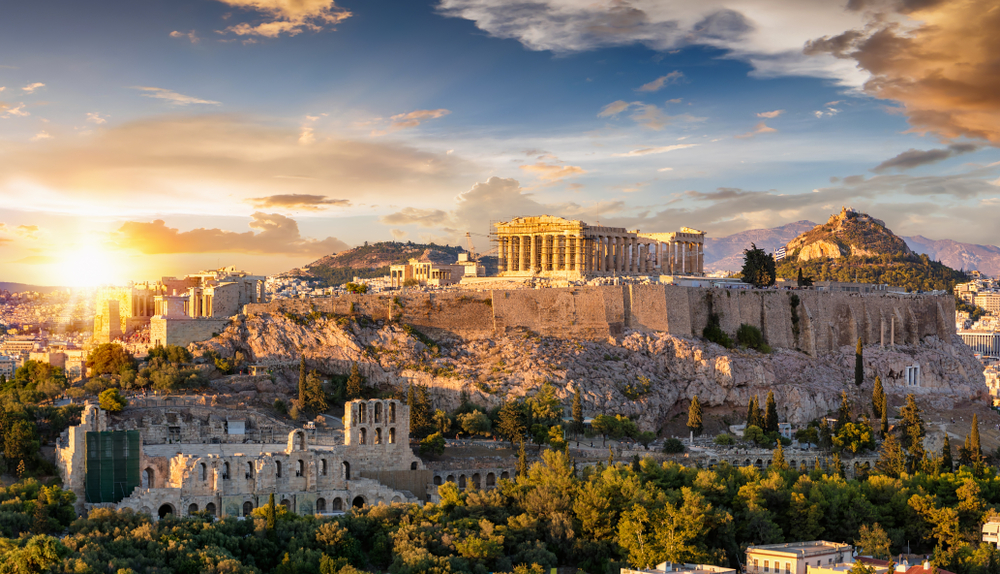
Sven Hansche/Shutterstock.com
This issue of the Newsletter offers reflections on the crisis facing modern liberal democracies.
From an overview of the foundations of democratic approaches to governance in classical times, articles explore the nature of the challenges the current crisis presents on the path towards a ‘true democracy’; the critical role played by education, in all its dimensions, in moving forward on that path; and, finally, the essentially spiritual nature of the crisis that nations across the world are facing.
Wisdom teachings suggest that higher energies pouring into human consciousness are one of the causes of the current crisis in democracy. The mental atmosphere is disturbed by the stimulation of lower appetites, desires and illusions of separation together with a deepening of ideas of relationship, oneness, and freedom. This disturbance is awakening a quest for dialogue and reflection across the ideological spectrum. Democratic processes are quietly developing to balance analysis of different approaches with intuitive understandings of oneness, goodness and truth.
Among people of goodwill the quality of the judicial mind is steadily maturing. This will surely lead to more substantive, deliberative approaches to democracy.
“When the world has in it more truly awakened people and more thinking men and women,
we shall see a purification of the political field taking place, and a cleansing of our processes
of representation instituted, as well as a more exacting accounting required from the people
of those whom they have chosen to put in authority. There must eventually be a closer tie-up
between the educational system, the legal system and the government, but it will all be directed
to an effort to work out the best ideals of the thinkers of the day. This period does not lie so
far ahead as you might imagine, particularly if the first move in this direction is made by the
New Group of World Servers.” Alice Bailey, Externalisation of the Hierarchy 52 - 53
Challenges on the Path towards True Democracy
Few would doubt that we are experiencing a moment of existential crisis in the world. While organized networks of wise and intelligent goodwill thrive and have become a solid presence in the modern multi-cultural and multi-polar world, powerful forces of separation and disruption resist efforts to plan for the good of the whole.
As a result, significant sections of national populations have become disillusioned, losing the sense of agency in the governing of their affairs. And actions to meet visionary goals for human development alongside diplomatic processes at the United Nations have consistently been thwarted, regardless of pressure from civil society and affected stakeholders – all producing a crisis of alienation and an absence of hope in the general populace, leading, to an easily exploited spirit of angry populism and a desire to disrupt ‘things as they are’. Behind this is a disturbance in the beliefs, practices and delicate system of checks and balances underpinning the nation state, amounting to a crisis of faith in democracy’s ability to provide a viable path towards increasingly free, just and lawful societies where the lives and the very being of all citizens are equally valued and respected.
True democracy has always been a visionary goal in nations practicing different forms of representative government. The vision holds when there is a basic trust in the integrity of the relationship between an elected legislature, an independent judiciary (centered in the Law), and an Executive that seeks to implement policies outlined in free and fair elections and supported in legislatures. Yet, such a system of governance only works for the common good if citizens motivated by a thoughtful concern for the wellbeing of the whole are organized, educated and actively engaged in the community. As these people of goodwill, of different ideological persuasions, drive research, thought, dialogue, and experimentation, pathways towards more just, free and responsible forms of governance, economics, law and so on are constantly refined and refreshed. Belief in the possibility of reflective deliberation between differing interest groups determines the health of the heart of any democracy.
In part the crisis of faith in democracy is a product of the role that money and those who control the financial and material assets now play in modern liberal democracies, and in the globalized system of relationship between nations and economies. Wealth and power are concentrated in the hands of the few, amplifying the divides between classes, ethnic groups, and religious communities. While the spirit of relationship, and the sense of being part of one nation, let alone one world, persists among a significant section of usually more educated and younger groups within nations, this sense of universality is not widespread enough, or sufficiently organized to offset the alienation felt by the many.
The challenge facing responsible servers is to consider spiritual, cultural, social and economic causes of the loss of trust in representative democracy and to associate with others in becoming seeds of renewal that can revive realistic national visions of paths towards true democracy.
Wisdom teachings suggest that the crisis in modern democracy is part of a wider cycle in the transition of consciousness as humanity responds to incoming energies of the Aquarian Age with themes of relationship, mutuality and service to the whole, and resistance to these energies from outgoing, established qualities of the Piscean Age emphasizing separation, devotion and a paternalistic respect for authority. The sense of alienation experienced by those who are not part of the economically successful wealthy elites produces a resistance to the emerging sense of wholeness and relationship that Aquarian energies bring. Mary Kaldor, Emeritus Professor of Global Governance at London School of Economics speaks of a “howl of frustration” from those who feel they have lost any ability to influence the decisions that affect their lives, particularly those who have been hardest hit by the “decline of traditional industries.”
The impacts of the energetic changes that are part of the transition from the Piscean to the Aquarian Age are reflected in social changes outlined by political scientist Pippa Norris. Traditional patterns of party competition in Western democracies, she notes, have been disrupted during the post-War era partly due to “changes in the mass electorate at the base, notably the erosion in the foundational post-war social cleavages in Western Europe based primarily on social identities of occupational class and religious faith, anchoring grassroots supporters to party leadership elites, and the rise of cultural cleavages around climate change, women’s rights, and moral issues associated with post-material values. Long-term processes of partisan dealignment have also been observed with the erosion of lifetime party loyalties, but also the rise of negative partisanship, where citizens cast ballots out of intense dislike of ‘Them’ rather than love of ‘Us’.” [Pippa Norris, Things Fall Apart’, European Political Science, V. 23, 2024]
Into this volatile mix of alienation and emerging Aquarian values emphasizing environmental issues, gender equality and an overall concern for right relationship between the part and the whole, the rise of social media with its bias towards stimulating extreme views and partisanship, and the resulting decline of trust in widely respected sources of information has had a devastating effect on grass-roots community associations (including churches, voluntary bodies, trade unions, social organizations) that have traditionally brought citizens with different views together to discuss, listen and reflect on critical decisions. The chaotic media environment creates a ‘political theatre’ in which ‘authorized opinions’ are broadcast through ‘manipulative publicity’: “Even arguments are translated into symbols to which one cannot respond by arguing, but only by identifying with them.” [Jürgen Habermas, The Structural Transformation of the Public Sphere, p. 178]
Yet a democracy in crisis contains within itself the seeds of a truer and more substantive democracy where citizens engage in building a better world. The loss of faith in democracy stimulates a will to find new and more realistic spaces where good people can associate with others to reach beyond the manipulators and deliberate on what might be a right local or national or global response to issues. There is evidence that more people want to believe in the possibility of civilized deliberation, and to find meaning in working for it. This is to be found in countless movements around the world sponsoring conversation across political divides. And it is reflected in moves to establish new ways of ensuring that all viewpoints are included in representative assemblies. One prime example is to be found in Democracy R&D, a global network of 95 organizations “dedicated to deliberative democracy and democratic innovation”. Using a form of random selection, groups of everyday people representing a wide diversity of views are assembled by Network members to deliberate issues of concern and negotiate with decision makers.
Spiritual teachings suggest that crisis plays a potent role in the evolution of consciousness and society. May the current spirit of disruption and angry frustration evoke fresh understandings of the responsibility that people of goodwill hold to become the seeds a new, truer and more substantive democracy.
Download Newsletter in PDF
Go to Newsletter Home
Ancient, Modern and Future Democracy
Classical Greece is often seen as a pinnacle of human civilization, and it was during this era that the foundations of democracy were established. While we frequently speak of a “golden age” of ancient Greek culture, it’s worth remembering that Greece as a unified nation only came into being with its independence from the Ottoman Empire in 1830. In ancient times, the land was a mosaic of rival city-states competing for dominance. What loosely bound them was a shared language, common myths, and a literary tradition. This “Pan-Hellenic” identity was most vividly expressed every four years at the Olympic Games, when warfare paused and crowds flocked to Olympia. The idea of democracy arose in only one—albeit the most influential—of these city-states: Athens. It was never a universally “Greek” concept shared by the entire Greek-speaking community.
The idea arose in response to deep social and political inequalities under aristocratic rule and, later, tyrants. In 594 BCE, the Athenian Statesman Solon introduced economic and political reforms to ease class tensions. His measures curtailed aristocratic power and granted more rights to ordinary citizens, laying the groundwork for participatory governance. The true beginning of Athenian democracy came with Cleisthenes’ reforms in 508 BCE. By reorganizing Athens’ political structure and establishing institutions like the ἐκκλησία (Assembly), Cleisthenes enabled male free citizens to engage directly in civic decision-making. Democracy was further developed in the 5th century BCE under Pericles, who promoted broader access to public office. This system, known as Athenian democracy (c. 507–322 BCE), remains the best-known example of a direct democracy, where citizens voted on laws themselves rather than through representatives.
For the modern thinker, it is difficult to reconcile the ideals of ancient democracy with the fact that it coexisted with—and depended upon—state-sanctioned slavery. In Athens, slavery was a foundational pillar of both the economy and daily life, enabling a minority of “free citizens” to participate in political affairs. This democratic privilege excluded women, non-citizens, and slaves, and was thus reserved for only a small fraction of the population.
Today, democracy is widely regarded as a positive concept—often even as a panacea for modern challenges. However, in ancient Greek culture, δημοκρατία was a hotly debated and frequently criticized form of government, particularly among philosophers. Plato was especially critical, viewing democracy as a flawed system in which unqualified masses made crucial decisions, often choosing leaders based on persuasion rather than wisdom. He feared the social chaos resulting from individuals prioritizing personal desires over the common good. For Plato, democracy led to instability, emerging when charismatic demagogues exploited public emotions to gain power. As an alternative, he advocated rule by philosopher-kings—wise leaders trained in justice and governance. One can see the resemblance of this idea with the “oligarchy of illumined minds” mentioned in Alice Bailey’s The Externalisation of the Hierarchy [p. 52]: truly enlightened individuals recognized by advanced thinkers for their natural wisdom.
It is also interesting to note that Plato was very sensitive about political corruption: In the Myth of Er, which appears at the end of The Republic (Book X), a soldier who dies in battle recounts his journey to the afterlife. He beholds the just ascending to a high place, and the unjust descending to the underworld, where corrupt politicians receive the harshest punishments due to their abuse of power. Were this scenery true, one may wonder how overpopulated this area of Hades might be today.
This ancient suspicion toward democracy echoed through later centuries. Some modern thinkers and statesmen, including George Washington, feared the potential for mob rule, believing democracy could easily lead to chaos and tyranny. Other Founding Fathers of the United States also held a critical view of democracy. Their thinking was mostly shaped by Enlightenment ideals. Figures like James Madison warned that democracy might empower majorities to infringe upon the rights of individuals, leading to instability and emotionally driven decision-making. This skepticism was shared by philosophers such as Friedrich Nietzsche and José Ortega y Gasset. It is important to note that such criticisms were aimed primarily at direct democracy, not liberal democracy—a system that combines democratic processes for selecting leaders with constitutional liberalism, which protects individual autonomy from coercion by the state, religious authorities, or society at large.
However, and despite all external differences, democracy has always been intrinsically linked to ideals of liberty and equality, as Thucydides reminds us. [Histories 2.37] The fundamental democratic ideal was freedom (ἐλευθερία), which encompassed both political liberty, allowing citizens to participate in democratic institutions, and private liberty, granting individuals the right to live as they choose [Aristotle, Politics 1317a] . The most essential aspect of liberty was freedom of speech (παρρησία)—both in the public sphere and in private life. As for equality (ἰσότης), it was not based on the belief that all individuals are inherently equal, but on the principle that all citizens should have equal opportunity to engage in political life.
Even before the emergence of this idea in Athens, political systems resembling democracy had already begun to take shape in other ancient civilizations, such as in India. These systems existed from around the 6th century BCE and were mentioned in both Indian and Greek sources. The most notable records of such systems come from ancient texts like the Mahābhārata (the Bhagavad Gita being a chapter within this, the largest epic poem ever written) the Buddhist Pali Canon, and the Arthashastra, as well as accounts by foreign observers like Megasthenes, a Greek ambassador to the Mauryan court in the 4th century BCE. While these systems were not democracies in the modern sense, they had elements of collective decision-making, rule by consensus, and power-sharing among aristocratic or warrior elites. These early “republics” eventually declined due to internal conflicts and the rise of centralized monarchies like the Maurya Empire in the 4th century BCE.
The discovery of Mohenjo-Daro and Harappa, major cities of the Indus Valley Civilization (2600–1900 BCE), revealed an advanced urban society in present-day Pakistan and northwest India. Some non-mainstream archaeologists date them as far back as 10,000 BCE. Excavations uncovered grid-planned cities, advanced drainage, multi-story brick houses, and complex public structures. The undeciphered Indus script leaves its political system unknown, but the absence of palaces or large temples suggests a relatively egalitarian society rather than a centralized monarchy. Ancient China also produced ideas which defied absolutism. Confucius emphasized moral leadership and the role of virtue and education; and the “Mandate of Heaven”, developed during the Zhou dynasty, implied that rulers could lose their right to govern if they failed to serve the people.
What we know of democracy today is perhaps only a foreshadowing of the spiritual democracy humanity is yet to achieve. We can expect that its more material and selfish aspects will fade as more individuals shift from being driven by desires and emotions to cultivating reason and intuition, thus emerging an enlightened public opinion which will contribute meaningfully to politics. Only then will true democracy be possible—achieved primarily “through the right use of the systems of education, and by the steady training of the people to recognize the finer values, the higher idealism, and the spirit of synthesis…”. [Bailey, Externalisation of the Hierarchy, p. 52] The democratic experiment of ancient Athens remains a remarkable phenomenon and, despite its limitations, became a foundational model for later democratic systems. However, a glance at history reveals that true democracy is still unknown: “it awaits the time when an educated and enlightened public opinion will bring it to power” [Bailey, Rays and Initiations, p. 748]. There is a truly spiritual side of democracy yet to emerge as humanity’s response to the pure energy of love.
Download Newsletter in PDF
Go to Newsletter Home
Kerry Arcane School CV
Kerry Woodward is an international orchestra and opera conductor and composer. He has occupied the position of conductor of the BBC Singers, BBC Symphony Chorus, the Nederlands Chamber Choir, the Akron Symphony and Ohio Chamber Orchestra (U.S.A). He has conducted all the BBC orchestras, the English Chamber Orchestra, the Royal Ballet, the London Sinfonietta and the chamber orchestras of the Royal Concertgebouw and the Rotterdam Philharmonic Orchestras.
He discovered, edited and conducted the first performance of an opera composed in the Theresienstadt concentration camp, which has now entered the standard opera repertoire and is the subject of an award-winning film, “The Kaiser of Atlantis.”
As a composer, he has written music for orchestra, band, ballet, chorus, chamber ensembles and videos. His music is published by Donemus.
As a teacher, he has been a faculty member at the University of Akron (Ohio, USA), at the Conservatories of Utrecht and Enschede (Netherlands) where he taught orchestra conducting, choral conducting and composition. He was also a guest professor at the conservatories of St.Petersburg (Russia), Riga (Latvia), Lodz and Wroclav (Poland).
He has been an Arcane School student for the past 25 years.
April-June 2025
Subscription > 1 year > 2 years > 3 years | Single issue > Sample issue >
CONTENTS:
Editorial – A Space for Enlightened Contemplation.
We seem to have entered an interim period of experimentation with new ideas and paradigms, new forms of energy which fire up the world in new ways. A world in crisis provides a most powerful impetus that sparks many positive ideas.
Visualisation as a Science -
The science of visualisation is the process whereby the creative imagination is rendered active, becoming responsive to and attracted by a point of tension established on the mental plane. It leads to the realisation that everything outer and tangible is a symbol of inner, creative forces…
Science, Light and Esotericism: An Interpretation of Quantum Physics – Chris Noakes
Science, exoteric or esoteric, is a collective mental and imaginative project to represent the nature of the cosmos consistently at all levels. As such, it’s a definite strand in the building of the collective antahkarana, serving to clarify the shared structures of consciousness and form in which circulating energies are differentiated, materialised and re-synthesised.
The Purifying Fires – Nazanin Zohdi
The distinction between purificatory and initiatory fires lies in their intent and function. The former prepares, cleanses, and purifies.... The latter transforms and elevates, activating the divine potential within and bringing the aspirant into alignment with the universal order. Purification is the prerequisite; initiation is the fulfillment.
Life is a Paradox – Barbara Allen
We are living at a time in human history where, to employ a phrase from the late Terrence McKenna, we are approaching the transcendental object at the end of time. In other words, we are approaching a momentous time – in the history of the whole planet – when the human race is transcending itself.
Reframing Responsibility – Eduardo Gramaglia
What we call “esoteric knowledge” is by definition always transformative, and leads to the experience of inner transmutation, otherwise it is just information and data. One of the natural driving forces behind such transformation is always the sense of responsibility and implies active and conscious participation.
Transmutation – Kevin Patten
Can we through training and correct motivation, place ourselves in a position to contribute to The Plan of The Christ through Hierarchic intention and change the vibration of the planes of earth that will bring a new form of trans-muting energy into the minds of our brothers and sisters? When considering this, in view of the world situation we must work to-wards that process.
David Bohm, A Forerunner – Swaan Barrett
A major thread that weaves itself through his life is the relationship between the in-dividual and the collective as well as his profound awareness of social and global issues. In fact, Bohm’s philosophical thought and readings influenced the way he studied physics until the end of his life.
Subscription > 1 year > 2 years > 3 years | Single issue > Sample issue >
World Invocation Day 2026
An Invitation to People of Goodwill
World Invocation Day is a day of prayer, of focused spiritual contact, when people of all faiths and spiritual paths join together to make an invocative appeal to Divinity. This united appeal, focalized through the sounding of the Great Invocation, calls for light and love to flow into human consciousness so that the soul of humanity can be born on earth.
To many today, the world situation seems dire, and indeed a variety of interlocking political, economic, social, and ideological crises have come to the fore. Underlying these crises, however, are crises of consciousness and of values that are propelling humanity towards a higher expression of its spiritual potential. What appears to be a strengthening of darkness is really an intensification of ancient conflicts: between the past and the future; between selfishness and group welfare; between collective karma and spiritual destiny.
The mass desire for a world based on the values of goodwill, sharing, cooperation and unity has created a state of spiritual tension. When this desire does not just become part of humanity’s collective wish life, but is concentrated and propelled upwards into an invocative call to the spiritual realms, it can bring about great changes in consciousness, enabling humanity to act on its highest values.
Ultimately, the world’s problems are of humanity’s making and they are for humanity to solve. But the essence of the spiritual life lies in knowing that we are not alone. The energies of Divinity are abundantly available and, when the Enlightened beings who occupy the realm of soul are invoked, this higher love flows through us into the world. Through widespread use of the Great Invocation on World Invocation Day, humanity becomes the bridge between spirit and matter, transmitting spiritual energies and distributing them to the entire planetary life.
World Invocation Day is an opportunity to make the spiritual world a dominant reality in human consciousness. We invite you to join the many thousands around the world in observing this day through the use of the Great Invocation. Together, we can release energies which will enable humanity to give birth to a new civilization, bringing illumination to the darkness, and unification to that which has been divided.
The Power of Invocation
Invocation flows out of the natural evolutionary urge to reach upwards towards the light. It is the cause of all progress upon the path of expanding consciousness. This is true of a plant pushing its way out of the darkness of earth into the light of the sun, of a child extricating itself under the life impulse from the womb of its mother, of the human being pushing into realms of greater knowledge, of the aspirant and disciple driving forward on the way of liberation, and of still greater beings penetrating into realms of divine life beyond the human being’s comprehension. All comes about through invocation and evocation, appeal and response.
Invocation gives form to the power which is latent in life itself. This is the power to evolve, to transform, to redeem, and to resurrect those forms through which the One Life cannot yet adequately express. The act of invocation elevates all life forms, relating them to their spiritual essence, their soul.
The kingdom of the soul forms a great planetary center known by some as the Spiritual Hierarchy. The Hierarchy, which is the heart of the planetary Being, the Earth, maintains the divine circulatory flow of life throughout all grades of matter. This great heart draws spirit downward and raises matter upwards, merging through itself all aspects of the One.
The Hierarchy is composed of those members of humanity who have triumphed over matter and who have achieved the goal of self-mastery by the same path that individuals tread today. These enlightened beings are no longer centered in the individualized consciousness but have entered into the realization of the planetary whole. This includes all stages of consciousness on our planet, from that sense of social responsibility of the man or woman taking their first steps upon the path of spiritual maturity, to the supreme compassion of the Christ Himself.
The universal Christ, embodying the Principle of Love, is the head of Hierarchy, and oversees all aspects of its work. As the ‘Coming One’, the World Teacher, He works for all humanity – people of all religions and those of no religious persuasion at all. He represents the fullest expression of divinity to which human beings can aspire. When the Great Invocation invokes the Coming One, it invokes this potentiality.
The Great Invocation
The Great Invocation is a world prayer, and when sounded with heartfelt intent, it draws humanity closer to the center of divine love from which the great agents of divinity have, down the ages, come forth. It expresses humanity’s need and pierces through all difficulties, doubts, and despairs straight to the Mind and Heart of the One in Whom we live and move and have our being.
The Great Invocation expresses a number of central truths: the truth of the existence of a basic Intelligence to Whom we vaguely give the name of God; the truth that behind all outer seeming, the motivating power of the universe is Love; the truth that a great Individuality came to earth, called by Christians, the Christ, and embodied that love so that we could understand; and the truth that both love and intelligence are effects of what is called the Will of God.
The true power of this mantram lies in its potential to transform not just the individual consciousness but the consciousness of all humanity, and therefore the planet itself. Humanity’s role in the Divine Plan is to mediate those higher spiritual potencies into expression on earth, thus aiding the evolution of the animal, plant and mineral kingdoms.
The Great Invocation belongs to all humanity and not to any one religion or group. It has been translated into around 80 languages and dialects. On World Invocation Day, we invite you to use the Great Invocation and to aid in the evolution of human consciousness and the elevation of the Planet.
Reflections on: The Effect of Sound
These Elder Brothers of humanity are characterised by a love which endures… by a knowledge which has been gained through millennia of lives… by a courage which is the result of that experience… by a purpose which is enlightened and intelligent… and finally, they are distinguished by a knowledge of the power of sound. This final fact is the basis of that aphorism which states that all true occultists are distinguished by the characteristics of knowledge, dynamic will, courage, and silence. “To know, to will, to dare, and to be silent.” Knowing the plan so well, and having clear, illuminated vision, They can bend Their will unflinchingly and unswervingly to the great work of creation by the power of sound. This leads to Their silence where the average man would speak, and Their speaking where the average man is silent.
Initiation, Human and Solar, p.25
The Sound which was the first indication of the activity of the planetary Logos is not a word, but a full reverberating sound, holding within itself all other sounds, all chords and certain musical tones (which have been given the name of the ‘music of the spheres’) and dissonances, unknown as yet to the modern ear. It is this Sound which the ‘Rising One’ must learn to recognise, and to which he must respond not only by means of the sense of hearing and its higher correspondences, but through a response from every part and aspect of the form nature in the three worlds…
Esoteric Healing, pp.688–89
… sound permeates all forms; the planet itself has its own note or sound; each minute atom also has its sound; each form can be evoked into music and each human being has his peculiar chord and all chords contribute to the great symphony which the Hierarchy and Humanity are playing, and playing now. Every spiritual group has its own tune… and the groups which are in process of collaborating with the Hierarchy make music ceaselessly. This rhythm of sound and this myriad of chords and notes blend with the music of the Hierarchy itself and this is a steadily enriching symphony; as the centuries slip away, all these sounds slowly unite and are resolved into each other until some day the planetary symphony which Sanat Kumara is composing will be completed and our Earth will then make a notable contribution to the great chords of the solar system – and this is a part, intrinsic and real, of the music of the spheres.
Glamour, A World Problem, p.260
… by his knowledge of ritual (which is the ancient codified means whereby the attractive and expressive nature of the energies to be employed are organised and related), by his understanding of the ‘Words of Power’ (which he discovers by experiment) and by using the potency of sound, the disciple of the future will work and build the new world with its culture and civilisation.
A curious indication of the effect of the seventh ray magical work upon the mass consciousness is the growing use of slogans and of ‘catch phrases’… which are employed to bring about results and to sweep human beings into certain forms of mass action. This is the embryonic use of the Words of Power, and from a study of their tonal values, their numerological indications and their inherent potency, men will eventually arrive at vast magical achievements and creations, producing group activity and the appearance of certain forms of expression upon the outer plane.
The Destiny of the Nations, pp.130–131
One of the major linking and blending processes is the creative work of music. I would suggest to you that you bring music into your life far more than you have hitherto done, particularly orchestral music … the effect of blended instruments and broad sound productions upon your personality will be to break down the opposition which it presents to soul contact and impose a different note and key upon your life. Let love and light and music enter more definitely into your daily life.
The divine principle with which the seventh ray humanity will be mainly concerned is that of life as it expresses itself through the medium of the etheric body. It is for this reason that we find a growing interest in the nature of vitality; the function of the glands is being studied and before long their major function as vitality generators will be noted. Esoterically, they are regarded as externalisations upon the physical plane of force centres in the etheric body and their aliveness or their lack of activity are indicative of the condition of those centres. The shift of the world interest is also into the realm of economics which is definitely the realm of life sustenance. Much is, therefore, bound to happen in all these spheres of interest, and once the etheric body becomes an established scientific fact and the centres—major and minor—are recognised as the foci of all energy as it expresses itself through the human body upon the physical plane, we shall see a great revolution take place in medicine, in diet and in the handling of daily life activity. This will produce great changes in the mode of work and labour and above everything else in the leisure activities of the race.
Discipleship in the New Age II, pp.699–700
The Singing Fire
|
Three Spiritual Festivals 2025 |
Dear co-worker,
From the esoteric perspective, biological life is a musical fire – sound,along with fire, being the underlying features of the substance from which every living creature is made. The origin of this substance is a realm of soniferous fire, and the Earth, along with its inhabitants, are comprised of materials that can be attuned to the fiery sounds that issue forth from these celestial heights. Man, in essence, is a singing fire.
The ongoing descent of ‘celestial fire and sound’ to Earth has an expansive effect on human thought. It is a process that incrementally liberates human consciousness from its imprisonment on the lower planes of the Earth but one that requires ‘right timing’ due to the attendant risks. The Great Invocation, for instance, is a superlative instrument for evoking the descent of fiery sound into human consciousness, but the Spiritual Hierarchy of our planet had to carry out much planning and preparatory work before releasing it to the general public; without this, the premature use of such a great Word of Power may have caused a crisis that distorted rather than enhanced humanity’s perception of reality. Even with the necessary precautions taken, certain risks attended its distribution:
“The primary result of the correct use of the Great Invocation (as far as humanity is concerned) is acceleration. As I have also earlier pointed out, such an acceleration carries with it its own risks, and consequently we have the appearance of the truly terrific problems and the dire happenings which have for many years overtaken the aspirants and the disciples in the world.” 1
In today’s world, the descent of celestial fire and sound into human consciousness is causing a dramatic increase in the speed of events. There is a sense of time flying by and things spinning out of control. Crises are piling up relentlessly on a national and international level; world karma is intensifying and both the higher and the lower aspects of human nature are being stimulated as never before. Accompanying all this, and arguably causing much of it, is the terrific problem of noise pollution. The acoustic environment that modern societies inhabit is known to have a damaging effect on people’s well-being. A pioneering researcher in this field was the composer and music educator, Ray Murray Schafer, who instigated studies in acoustic ecology and the World Soundscape Project. In a book entitled The Soundscape: Our Sonic Environment and the Tuning of the World, he wrote:
“The Industrial Revolution introduced a multitude of new sounds with unhappy consequences for many of the natural and human sounds which they tended to obscure; and this development was extended into a second phase when the Electric Revolution added new effects of its own and introduced devices for packaging sounds and transmitting them schizophonically across time and space to live amplified or multiplied existences. Today the world suffers from an overpopulation of sounds; there is so much acoustic information that little of it can emerge with clarity… If we have a hope of improving the acoustic design of the world, it will be realizable only after the recovery of silence as a positive state in our lives. Still the noise in the mind: that is the first task – then everything else will follow in time…
…all research into sound must conclude with silence – not the silence of negative vacuum, but the positive silence of perfection and fulfillment. Thus, just as man strives for perfection, all sound aspires to the condition of silence, to the eternal life of the Music of the Spheres. Can silence be heard? Yes, if we could extend our consciousness outward to the universe and to eternity, we could hear silence.
Through the practice of contemplation, little by little, the muscles and the mind relax and the whole body opens out to become an ear. When the Indian yogi attains a state of liberation from the senses, he hears the anahata, the ‘unstruck’ sound. Then perfection is achieved. The secret hieroglyph of the Universe is revealed. Number becomes audible and flows down filling the receiver with tones and light.” 2
As Ray Murray Schafer understood:
“when there is no sound, hearing is most alert – Silence is indeed news for those possessing clairaudience.”
As the ‘unstruck’ sounds of the Divine Plan ring throughout the higher planes of being, can we open up towards them as one, united, listening ear? And can we then resonate to the acoustic quality of the Divine Plan in a way that amplifies and relays its ‘sonorous tones of meaning’ deep into the consciousness of the human race? Equally, we can try to generate those fiery sounds within ourselves that can rise up to the ears of the listening Hierarchy and serve the kingdom that they inhabit.
“… sound and fire are closely allied… disciples are gathered by the Masters [of the Wisdom] into Their Ashrams when their sound has gone forth and when the fire that is in them has successfully burned away the intervening barriers between the soul and the personality. Then their sound can safely be added to the sound of the Ashram, enriching its volume, adding quality to its tone, and conveying the needed creative qualities.” 3
The science of sound and fire are an integral part of esoteric study – the Alice Bailey writings indicate that there are twenty-seven occult laws of fire that sum up the basic laws of color and of music and rhythm. While these laws of fire are only revealed after initiation at this stage of evolution, we are told that they will gradually be permitted exoteric publication in the times ahead. Perhaps Rudolf Steiner understood something of these laws, for he taught that the human body is a great musical instrument, with the consonants representing the instrument and the vowels representing the soul playing upon it:
“When we utter the vowel sounds, we press what is living in our soul down into the body; and the body, by adding the consonantal element, does but provide the musical instrument for our soul to use. You will certainly have the feeling that in every vowel there is something of the soul, immediate and living. The vowel can be taken by itself. The consonant on the other hand is perpetually longing for the vowel, tending towards it. The plastic instrument of the body is in fact a dead thing until the vowel nature – the soul – strikes its chords.” 4
The outstanding example of this symbolic relationship between vowel and consonant – soul and personality – lies in the Sacred Word:
AUM. is the Word of Glory; it signifies the Word made flesh and the manifestation upon the plane of matter of the second aspect of divinity. 5
The Alice Bailey writings consider A.U.M. as the expression of something from which advanced humanity is seeking release, and for them the Sacred Word is better represented as O.M. This can be portrayed as the left-hand symbol below, the letter M representing matter in which the soul, represented by the encircling O, is enmeshed. For the aspirants and disciples of the world, the smaller, decapitalized m indicates the changing dynamic that matter is becoming subordinated to the will of the soul. 6
When the Sacred Word is apprehended in this way, we are told that it greatly assists “the second, or Christ aspect of divinity to shine forth resplendently”:
“… By its use the ‘spark’ becomes a radiant light, the light becomes a flame, and the flame eventually becomes a sun… The Word is to be sounded by the soul… on its own plane, and the vibration will subsequently affect the various bodies or vehicles which house that soul… [the aspirant]… in meditation… hears the sound (called sometimes the ‘still small Voice’, or the ‘Voice of the Silence’)… and in deep reflection… assimilates the results of…[the]… soul’s activity.” 7
Just as the first sense to evolve in the incarnating soul is hearing (babies having the ability to hear long before they are born), the strike of the soul’s chords, symbolized by the Sacred Word, may be detected through intense listening in the contemplative stage of meditation and the whole of one’s being brought into a state of resonance with the sound that it emits and the meaning that it conveys. The human organism is then transformed into a musical instrument that is constantly, rhythmically, broadcasting the music of the soul and its kingdom into the sphere of human endeavour. The soul’s fiery music is an organizing power forging harmonic lines of relationship wherever it is played, and in our own small way, by each of us becoming instruments of the One Soul, we are slowly but surely furthering the transfiguration of humanity into an organism of fiery sound in the vital body of the Logos.
For spiritual organizations the world over, this transformation is more important than ever as we move towards the higher interlude of 2025 which sees the ending of one stage of endeavour by the Spiritual Hierarchy of our planet and the beginning of another. The closing cycle, technically referred to as ‘The Stage of the Forerunner’, aimed at establishing a path of resonant interplay between the soul kingdom and the human kingdom to prepare for the first stage of the Hierarchy’s externalisation on Earth. While any new dynamic will undoubtedly take many years to establish itself, a fresh impetus may be detectable at a relatively early stage if we can form ourselves into a collective instrument of occult hearing. Sensitivity to the acoustic rhythms of this next stage of activity by the Spiritual Hierarchy and our participation in it through the expression of spiritual fire and sound is surely a goal worthy of our most ardent efforts. As we approach the Three Spiritual Festivals of 2025, may we all play our part in orchestrating the grand symphony of the Divine Plan on Earth – by transforming ourselves into one great chorus of singing fires.
In the companionship of the One Work,
Lucis Trust
- A.A. Bailey, The Externalisation of the Hierarchy, p.152.
- The Soundscape: Our Sonic Environment and the Tuning of the World, pp.109, 389–90 and 393–394, Kindle Edition.
- A.A. Bailey, Discipleship in the New Age, Vol II, p.553.
- Rudolf Steiner, Speech and Song, The Rudolf Steiner Archive
- A.A. Bailey, The Light of the Soul, p.7.
- A.A. Bailey, The Rays and the Initiations, pp.53–55.
- Ibid, p.56, 58 and 60.
 View UK version |
View US version |
The Great Invocation - March 2025
| THE GREAT INVOCATION | THE GREAT INVOCATION (Adapted) |
|
From the point of Light within the Mind of God From the point of Love within the Heart of God From the centre where the Will of God is known From the centre which we call the race of men Let Light and Love and Power restore the Plan on Earth. |
From the point of Light within the Mind of God From the point of Love within the Heart of God From the centre where the Will of God is known From the centre which we call the human race Let Light and Love and Power restore the Plan on Earth. |
*Many religions believe in a World Teacher, a “Coming One”, knowing him under such names as the Lord Maitreya, the Imam Mahdi, the Kalki Avatar and the Bodhisattva. These terms are sometimes used in versions of the Great Invocation for people of specific faiths.
Triangles is a world service activity in which people link in thought in groups of three to create a planetary network of Triangles of light and goodwill. Using a world prayer, the Great Invocation, they invoke light and love as a service to humanity. Further information is available on request from Triangles.
The Triangles Bulletin is for people of goodwill and is published four times a year in Dutch, English, French, German, Greek, Italian, Polish, Portuguese, Russian and Spanish. Triangles is an activity of the Lucis Trust, a non-profit educational charity which exists to promote right human relations.
For further information and literature write to:
| Suite 54 3 Whitehall Court London SW1A 2EF UK |
Rue du Stand 40 Geneva CH-1204 SWITZERLAND |
866 United Nations Plaza Suite 482 New York NY 10017 USA |
THE THREE SPIRITUAL FESTIVALS
The sun’s symbolic passage through the zodiac brings into focus the subtle energies it represents and marks the year’s spiritual progress. The higher interlude of this annual cycle begins in Aries with the spring equinox in the northern hemisphere and continues through Taurus and up to the solstice at the close of Gemini. The three festivals of Easter, Wesak and Goodwill celebrate the fresh divine energies that set the tone for the service initiatives to come.
The Easter Festival brings the restoration of life force from the mind of God, stimulating creative mental activity; the Wesak Festival follows with enlightenment emanating from the heart of God related to divine understanding and love-wisdom; and, from the will of God, the Festival of Goodwill vitalises constructive forces, synthesising energies, that help transform theoretical unity into a practical, spiritual unity – the divinity within humanity. These festivals focus on the divine vibration received and offer the opportunity to consciously engage with the renewed spiritual influences, facilitating their fuller expression in personal and group life.
Further information about the Three Spiritual Festivals, their meaning and influences is available via the links below.
For information in printed form, please use the contact details at the bottom of this page.
www.lucistrust.org/3sf/how_can_we_help www.lucistrust.org/3sf www.lucistrust.org/3sf/resources
Festival of Easter (Aries) . . . . . . . . . . . . . . . . . . . . . . . . . . . . . . . . . . 12 April 2025
Festival of Wesak (Taurus) . . . . . . . . . . . . . . . . . . . . . . . . . . . . . . . . . . 12 May 2025
The Festival of Goodwill,
Christ’s Festival and World Invocation Day (Gemini) . .. . . . . . . . . . . . . . 11 June 2025
See https://www.lucistrust.org/events for the actual days of the Festival Meetings
held by Geneva, London & New York headquarters
Triangles is a world service activity in which people link in thought in groups of three to create a planetary network of Triangles of light and goodwill. Using a world prayer, the Great Invocation, they invoke light and love as a service to humanity. Further information is available on request from Triangles.
The Triangles Bulletin is for people of goodwill and is published four times a year in Dutch, English, French, German, Greek, Italian, Polish, Portuguese, Russian and Spanish. Triangles is an activity of the Lucis Trust, a non-profit educational charity which exists to promote right human relations.
For further information and literature write to Triangles:
Suite 54 Rue du Stand 40 866 United Nations Plaza
3 Whitehall Court Geneva Suite 482
London SW1A 2EF CH-1204 New York NY 10017
UK SWITZERLAND USA
www.lucistrust.org/triangles
THE WORLD OF MEANING
The search for meaning is a defining characteristic of the human experience and key to our social, psychological, and spiritual development. But rather than an idealized quest for the ‘Holy Grail’, this search today is undertaken right where we are, mined from the quarry of the daily life. This hidden glory, once discovered, uplifts, redeems, and makes all things new.
Meaning can be examined from a variety of angles. Its common definition—as the something which a word or phrase is intended to communicate—affirms its role as the subjective or inner counterpart to the objective word-form. It is the metaphysical substance of every object or form. The ability to express this substance through the medium of words or speech (i.e. form), creates a veritable bridge between inner perception and outer expression.
Esoterically one could say that meaning is the noumenon (inner thought) made fully tangible through the medium of speech. As such, it fulfills the same role as the Soul in man, for the Soul or spiritual self likewise is noumenon—a product of Divine Thought—made flesh through cyclic incarnation. In a broader sense, the world of Soul is one and the same with the world of meaning; whereas the Soul is a linking agency, meaning is the substance within which the divine agent lives and moves and works.
The search for the world of meaning (which is the world of Soul) is a search for the hidden knowledge which relates to the essence of things, the key to which (occultism teaches) lies in knowledge of self. But to attain to Atma Vidya or true Self-Knowledge, one must go beyond individuality altogether, identifying with the great principle of Soul which resides innate in all things, which is one also with the Universal Mind. The Soul therefore relates macrocosm to microcosm, individual to group, and group to the whole. The world of meaning thus reveals the multifaceted nature of an interrelated whole.
Today, the world of meaning is emerging so rapidly that it is producing a deep and profound dissonance within the collective psyche. Without the consciousness of Soul as a mediating factor, the fire which fuels the light of meaning meets the waters of appearance and a mist or fog is produced creating distortion and moral confusion. Triangles workers play a significant role in dispelling this fog by clarifying the mental atmosphere through which we all think and see the world. The ability of Triangle members to stand daily in the light of the Soul supports an alignment within the collective human psyche. Rightly aligned, the fire and light of the higher world finds fit receptacle, and rather than distortion and delusion, the precipitation of meaning produces clarity, moral alignment, and spiritual contentment. On the plains of Earth, Heaven emerges from within the struggle and conflict.
Even on our conflicted planet, evidence abounds of this world of meaning emerging in very concrete ways: in science, religion, literature, art, music, even politics, business, and industry. Yet, its most striking emergence is perhaps in the very ordinary world of the everyday. This includes family and communal relationships, but it also involves the ideas with which the now educated and mature peoples of every country interact on a daily basis. Today, many are discovering the perennial truth: “That which is to be revealed lies all around us, and within us.”1 — a spiritual firmament within the world, not apart from it.
1Esoteric Psychology, Vol. II, p.246 A. A. Bailey
Triangles Webinar: Broadcast on the second Monday of every month
www.lucistrust.org/triangles/webinar
LETTING IN THE LIGHT
Many decades ago, in the difficulties of the World War years, an eminent spiritual teacher urged all those who love humanity to act with steadfastness, service and sacrifice. And, although the world is not at war today, at least not physically in the same way, these words seem equally appropriate in our tumultuous times. Most would agree that it requires sacrifice to stand steady in a spirit of love and not become indifferent to the injustices and deepening crises in the world. In response to the pressing needs and challenges confronting humanity, many thinking people of goodwill are learning to serve rhythmically with the ebb and flow of spiritual energy.
Many Triangles members will be familiar with the pattern of the yearly spiritual cycle. Each month, at the full moon, divine energies are available for planetary and human transformation. During these periods, there is an unimpeded alignment between the sun and our planet. And, in particular, at the time of the full moons at the Festival of Easter (Aries), the Festival of Wesak (Taurus), and the Festival of Goodwill (Gemini), there exists a special opportunity to co-operate. Collectively, these three spiritual Festivals constitute a “unified spiritual approach of humanity” to work at a deeper level so that the light can shine in a dark place.
The inflow of light into the human kingdom is not only revealing the good, the beautiful and the true, but also exposing the inadequacies in human society. It seems that all the conventional pillars of the world order are in a perilous state, whether it is in religion, economics and finance, law and order, science, or governance. The old structures have become inadequate to reflect the higher vision, and the new incoming energies require new forms through which they can work to create a better world for all people and the earth itself. There is no doubt that visionary and intuitive minds need to clearly formulate and hold before the gaze of humanity the archetypal pattern through which the new world order can emerge. And the time for this is now.
In the face of unprecedented global challenges, one of the needed services we can offer is to stand with steadfastness in the radiance of the group work and so allow the clear light of the Triangles Network to irradiate spiritual values and human choices. The Network, created and vitalised by selfless human thought over many decades, acts as a planetary interface. And it is through this portal of enlightened goodwill that the higher impressions embodying spiritual ideas can inspire the thinking needed to rebuild the shrine of human living. The brilliance of this piercing light is disturbing age-old traditions, and nothing ultimately can arrest this progress.
* * *
“Long patience will be needed. Mistakes will be made. There will be periods of indecision, of ineffective action and of negative yet deep discouragement. Workers will be prone to attitudes of despair, and at times the task will appear to them to demand too much, to be too difficult and the forces opposing what they seek to do too strong. But behind all the reconstruction with which humanity is faced is the potency of inevitable resurrection, the constant flow of enlightened thinking into and directing the mass consciousness, plus a growing realisation that humanity is not alone, that the spiritual values are the only real values, and that the Hierarchy stands, immovable in its spiritual strength, steadily oriented towards world salvation, and acting ever under the direction of that great divine yet human Leader, the Christ.”
The Externalisation of the Hierarchy, p. 487, A. A. Bailey
MORE LIGHT
“Light, more light” – these are said to be Goethe’s last words on his deathbed. Was this because of something mundane like him wanting the curtains drawn back? Or was it more likely because he was responding to the now well-known and well-studied phenomenon of the near death experience when a dying person travels through a tunnel towards a being of the purest light? Whichever it was, it shows the central importance and hold that light has to us.
Our human life is characterised by an overpowering desire for light and simultaneously a gradual growth of the quality and intensity of the light that animates our being. In the dense physical world, we can see this instinctual reaching for the light beautifully symbolised in the plant kingdom. Seeds in the pure darkness of the earth germinate, react to the force of gravity, and send roots down into the soil; simultaneously they force their young shoots upwards through the resisting soil out into the open air where the sun’s light bestows the essential energy for the plant’s growth. The simile comes to mind of gravity representing a taut bow string releasing the upward arrow of the plant towards its source.
In the world of emotion, we can see the light of this realm dulled with the dark colours of base desire and selfishness. But as our desires are redeemed, so the light of this dimension becomes pure and radiant, reflecting evermore the splendour of the lighted buddhic nature of love-wisdom. In the world of the intellect, light is intimately connected with knowledge. When we grasp a new concept or begin to understand something, we say, ‘Oh I see!’ This is not just a commonplace figure of speech; it is a statement of a factual experience, and a signpost to the truth that all is light.
The world of the Soul is one in which light rules supreme. In the Bhagavad Gita, when Arjuna asks Krishna, the embodiment of the Soul, to reveal himself as he really is, the revelation that comes evokes these wondrous words: “Ah, Brighter than a Thousand Suns!” The same reaction came from Oppenheimer at the sight of the first atomic explosion in 1945, when the released Soul of the atom momentarily eclipsed all other light and gave humanity the power of death or redemption over the physical world. It is hardly necessary to observe that this is a crisis that humanity has not yet resolved finally and irrevocably on the side of the Hierarchy of Light, whose work is so focussed on the will-to-good. Its physical plane expression, a dynamic and practical goodwill, will one day care equally for all people everywhere in the world.
In our daily triangles work, we visualise the world-wide network becoming increasingly alive with the light of the Soul, underlying and supporting all the outer service work of humanity as it struggles against enormous odds to take those firm and sure steps into a future of lighted and right human relationships.
March 2025
World Invocation Day 2025o
An Invitation to People of Goodwill
World Invocation Day is a day of prayer, of focused spiritual contact, when people of all faiths and spiritual paths join together to make an invocative appeal to Divinity. This united appeal, focalized through the sounding of the Great Invocation, calls for light and love to flow into human consciousness so that the soul of humanity can be born on earth.
To many today, the world situation seems dire, and indeed a variety of interlocking political, economic, social, and ideological crises have come to the fore. Underlying these crises, however, are crises of consciousness and of values that are propelling humanity towards a higher expression of its spiritual potential. What appears to be a strengthening of darkness is really an intensification of ancient conflicts: between the past and the future; between selfishness and group welfare; between collective karma and spiritual destiny.
The mass desire for a world based on the values of goodwill, sharing, cooperation and unity has created a state of spiritual tension. When this desire does not just become part of humanity’s collective wish life, but is concentrated and propelled upwards into an invocative call to the spiritual realms, it can bring about great changes in consciousness, enabling humanity to act on its highest values.
Ultimately, the world’s problems are of humanity’s making and they are for humanity to solve. But the essence of the spiritual life lies in knowing that we are not alone. The energies of Divinity are abundantly available and, when the Enlightened beings who occupy the realm of soul are invoked, this higher love flows through us into the world. Through widespread use of the Great Invocation on World Invocation Day, humanity becomes the bridge between spirit and matter, transmitting spiritual energies and distributing them to the entire planetary life.
World Invocation Day is an opportunity to make the spiritual world a dominant reality in human consciousness. We invite you to join the many thousands around the world in observing this day through the use of the Great Invocation. Together, we can release energies which will enable humanity to give birth to a new civilization, bringing illumination to the darkness, and unification to that which has been divided.
The Power of Invocation
Invocation flows out of the natural evolutionary urge to reach upwards towards the light. It is the cause of all progress upon the path of expanding consciousness. This is true of a plant pushing its way out of the darkness of earth into the light of the sun, of a child extricating itself under the life impulse from the womb of its mother, of the human being pushing into realms of greater knowledge, of the aspirant and disciple driving forward on the way of liberation, and of still greater beings penetrating into realms of divine life beyond the human being’s comprehension. All comes about through invocation and evocation, appeal and response.
Invocation gives form to the power which is latent in life itself. This is the power to evolve, to transform, to redeem, and to resurrect those forms through which the One Life cannot yet adequately express. The act of invocation elevates all life forms, relating them to their spiritual essence, their soul.
The kingdom of the soul forms a great planetary center known by some as the Spiritual Hierarchy. The Hierarchy, which is the heart of the planetary Being, the Earth, maintains the divine circulatory flow of life throughout all grades of matter. This great heart draws spirit downward and raises matter upwards, merging through itself all aspects of the One.
The Hierarchy is composed of those members of humanity who have triumphed over matter and who have achieved the goal of self-mastery by the same path that individuals tread today. These enlightened beings are no longer centered in the individualized consciousness but have entered into the realization of the planetary whole. This includes all stages of consciousness on our planet, from that sense of social responsibility of the man or woman taking their first steps upon the path of spiritual maturity, to the supreme compassion of the Christ Himself.
The universal Christ, embodying the Principle of Love, is the head of Hierarchy, and oversees all aspects of its work. As the ‘Coming One’, the World Teacher, He works for all humanity – people of all religions and those of no religious persuasion at all. He represents the fullest expression of divinity to which human beings can aspire. When the Great Invocation invokes the Coming One, it invokes this potentiality.
The Great Invocation
The Great Invocation is a world prayer, and when sounded with heartfelt intent, it draws humanity closer to the center of divine love from which the great agents of divinity have, down the ages, come forth. It expresses humanity’s need and pierces through all difficulties, doubts, and despairs straight to the Mind and Heart of the One in Whom we live and move and have our being.
The Great Invocation expresses a number of central truths: the truth of the existence of a basic Intelligence to Whom we vaguely give the name of God; the truth that behind all outer seeming, the motivating power of the universe is Love; the truth that a great Individuality came to earth, called by Christians, the Christ, and embodied that love so that we could understand; and the truth that both love and intelligence are effects of what is called the Will of God.
The true power of this mantram lies in its potential to transform not just the individual consciousness but the consciousness of all humanity, and therefore the planet itself. Humanity’s role in the Divine Plan is to mediate those higher spiritual potencies into expression on earth, thus aiding the evolution of the animal, plant and mineral kingdoms.
The Great Invocation belongs to all humanity and not to any one religion or group. It has been translated into around 80 languages and dialects. On World Invocation Day, we invite you to use the Great Invocation and to aid in the evolution of human consciousness and the elevation of the Planet.

Registration: 2025 Arcane School Conference (London)
Fill in the form below to register for the 2025 Arcane School Conference in London which takes place June 7-8.
For more information visit the conference page.
{embed="forms/registration_as_london" form_title="Registration to Attend 2025 Arcane School Conference in London"}
Registration: 2025 Arcane School Conference (Geneva)
Fill in the form below to register for the 2025 Arcane School Conference in Geneva which takes place May 31-June 1.
For more information visit the conference page.
{embed="forms/registration_as_geneva" form_title="Registration to Attend 2025 Arcane School Conference in Geneva"}
Registration: 2025 Arcane School Conference (New York)
Fill in the form below to register for the 2025 Arcane School Conference in New York which takes place May 10-11.
For more information visit the conference page.
{embed="forms/registration_as_newyork" form_title="Registration to Attend 2025 Arcane School Conference in New York"}
The Seven Ray Causes of Inharmony and Disease
The Seven Ray Causes of Inharmony and Disease
In Theosophy, the seven rays denote seven basic qualities of energy. Theosophical writers have applied this notion to many areas of human life. The present book is concerned with the application of the seven rays to psychology and healing.
Alice Bailey, author of many books, founded a spiritual movement growing out of the theosophical tradition. Her book Esoteric Healing concerns “the laws of healing, those laws which guide the initiates and must gradually supersede the more physical methods of the present art of healing.”1 In its chapter on karmic liabilities, Bailey’s book presents seven symbolic stanzas that portray “The Seven Ray Causes of Inharmony and Disease,” but with little explanation.2 Bailey says that these seven stanzas are “from one of the most ancient volumes in the world” and are “abstruse and difficult,” but that their comprehension leads to “the isolation of the seven psychological causes of disease, inherent in the substance of all forms in this world cycle.”3 The purpose of the present book is to elucidate the practical significance of these seven stanzas.
Free Download: https://www.icloud.com/iclouddrive/0dfLymyGyidOWKCpmo3VzA_vQ#SRCID_Book
Alice Bailey’s Formulas for Initiation
Alice Bailey’s Formulas for Initiation
Alice Bailey (1880 – 1949), author of many books, founded a spiritual movement growing out of the theosophical tradition. Her book Discipleship in the New Age presents “six ancient formulas or symbolic forms which are to be found in the archives for disciples,” and says that “they concern the six fundamental prerequisites for initiation.”1 Bailey does not explain the meaning of these formulas but instead acknowledges their “mysterious presentations”2 and “their extreme difficulty of interpretation.”3 The purpose of the present book is to elucidate these six symbolic formulas.
Free Download: https://www.icloud.com/iclouddrive/09da6sI1GcmTPDkZ31DZ28pjA#ABFFI_Book