

Christine Morgan, in her opening address, emphasized that the will is a beneficent and dynamic power in governance, politics, and law:
Today, the growth of global governance provides a counterbalance to the human atrocities and infringements on civil liberties still occurring around the world. World Goodwill seeks to play a vital role in the evocation of the will-to-good expressed through the medium of human thinking and relationships. We have “to invoke, to evoke”—to be receptive to ideas from higher realms of wisdom. These are vital to rethinking international relationships and progressing inwardly to a new, shared Reality.
We are approaching a time when we can perceive the divinity “inherent in the whole” and the unity within diversity. Humanity is more important than nations, just as its inner splendour is more than its outer form.
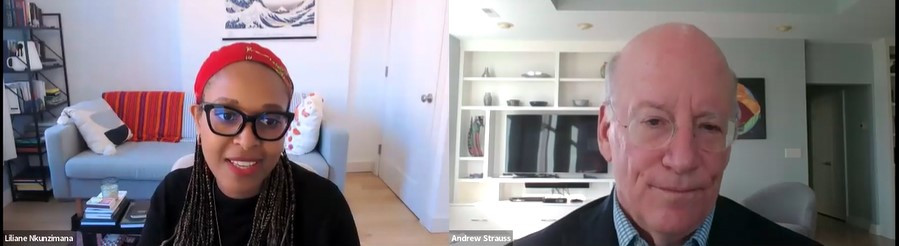
Andrew Strauss, expert and professor of International Law, spoke on the intersection of spirituality and international law:
Spiritual growth is a kind of decentering from our own views, perspectives, and egocentric thoughts. Meditation lends itself to seeing the world through the lens of that which is bigger than the separated self. The effort to try to create a more harmonious global system through international law is part of that same effort.
There is a tremendous need and desire among people for a positive vision that comes out of our sense of shared humanity. Ultimately, we may achieve some things in the near term, and others in the longer term. There may be real setbacks, but we don't have the luxury of just saying there could be a reaction, so we're not going to do it. We do the best we can.
Liliane Nkunzimana, Representative of the Baha'i International Community’s UN Office in New York, spoke on the transformative potential of global governance:
The role of religion and humanity’s relationship with the divine can be seen in the growing consciousness of the whole of life. At the UN, there are endless conferences and deep conversations about how to relate the separateness enshrined in national sovereignty with the fact that we, our environment, and everything about our lives is interdependent. It's not just about hope, it's about seeing things really as they are. This is the first time the human community has ever been pushed to this degree of realization of our fundamental interdependence. It's closer than our heart—it's within us.
The Summit of the Future is not explicitly spiritual, but it aimed to integrate spiritual principles into a number of issues. It was a way to rethink what it means to be a successful nation. Part of this is reconceptualizing power and what this means in the face of unprecedented interconnectivity and the rapid advancement of technology.
The Panel which followed discussed the transformation of global relationships, and how it facilitates a greater expression of the will-to-good. The way that we think about international relationships has changed significantly over the last 10-20 years, and likewise so has the way we think about power. Power is no longer just the type that comes from the barrel of a gun; a power which is based in goodwill is also growing in the world, but our systems are still catching up. To really transform international relationships will require us to change not only our behavior, but also how we perceive the other.
Complicating this transformation, but part of it, is a simultaneous epistemological crisis—science and philosophy alone have not brought us clear moral direction. The role that religion or spirituality should play, and how the political question factors into this is an important one. The future of how we're going to be governing the world has to come from sources of knowledge that are both scientific and religious—something that is evidence based, but also taps into the nature of who we are.
The New York seminar ended with a panel which discussed the study of the problems of humanity as a spiritual practice. Such practice supports expanding focus on the self and one’s inner being to an understanding of that same being in others and the world around us. Meditation hones the mind; you learn to focus your enquiry into the cause of the problems in national and international relations, deepening your knowledge about the world; and you learn to think your own thoughts rather than echo the thoughts of others.
Spiritual students have a special role to play in the worldwide effort to think through the world’s major problems to solution. Experts have knowledge, but they don’t necessarily have wisdom or goodwill. People of goodwill act as the moral conscience of humanity to a degree. The more that moral conscience is informed, the stronger and more consequential it becomes.
