

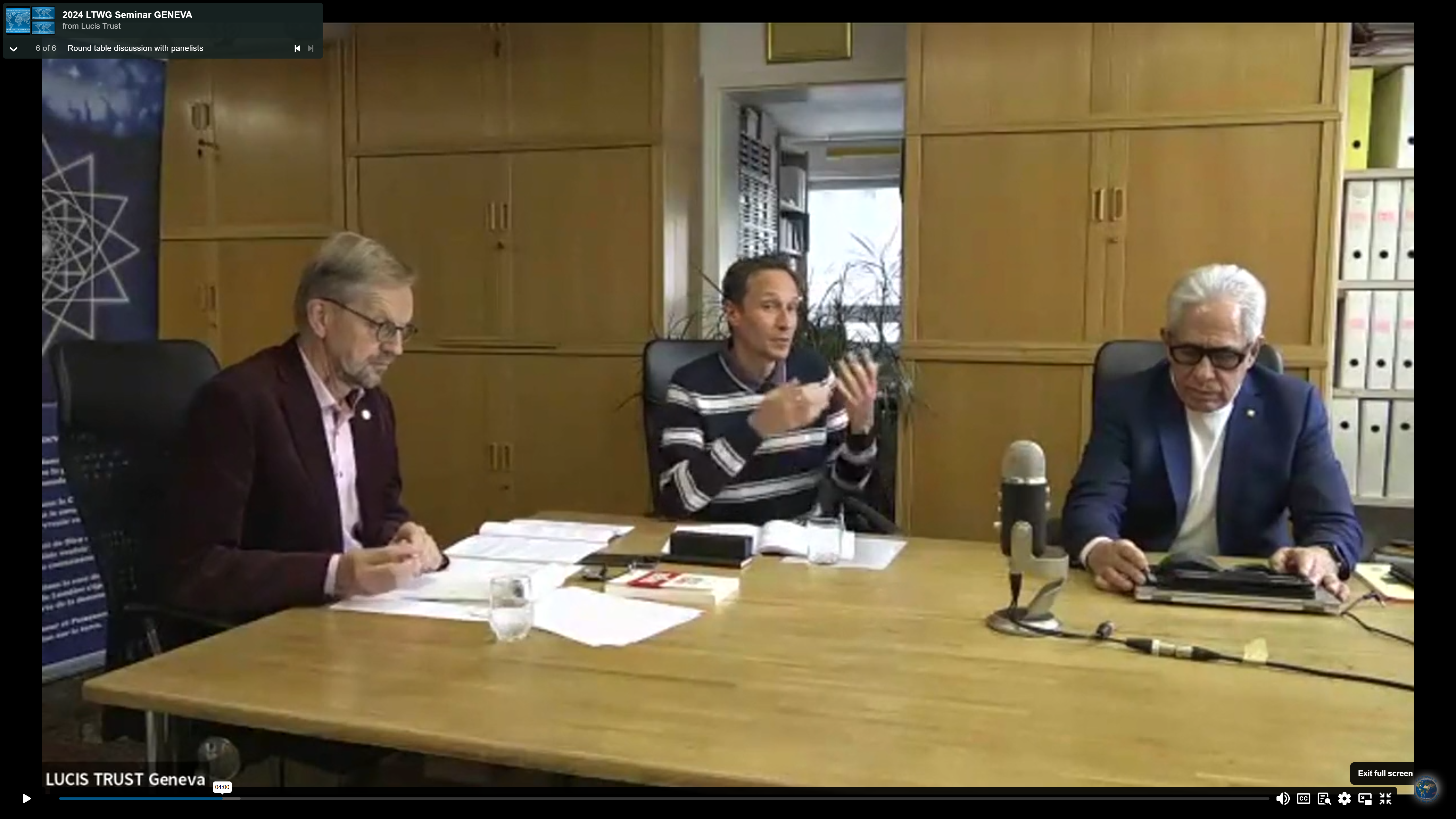
The Geneva Seminar focused on how to make an effective change in the world of today. Goodwill is obviously necessary, but is it enough?
From Bipolar Conflict to Multipolar Harmony – Vincent Claessens highlighted the fact that not only human beings but also nations are faced with their shadow, those unconscious aspects of oneself which one doesn’t recognise but projects on the adversary. From conflict to harmony, there is a long road full of nuances that requires the awakening of consciousness and the growth of understanding. The Charter of the UN states it to be a “centre for harmonising the actions of nations in the attainment of common ends.”
Moving from conflict to harmony implies replacing competition with collaboration, the desire for power with goodwill, domination with mutual aid and sharing. We need all our common resources to tackle the global challenges standing before us.
Converging Voices: From Dialogue to Action in Global Cooperation – Dr. Alejandro Bonilla Garcia – a former co-worker of the International Labour Organisation (ILO) and now representing the NGO Committee on Ageing – shared practical points from his long career as an international servant of diplomacy. He shared his experiences of many conferences this year, including the Summit of the Future and the NGO conference in Nairobi.
A striking dilemma emerged at a conference on how to assure ethical values in Artificial Intelligence models. As a former ILO worker, he knows that the values of workers, employers and governments are each different. Even if the goal of negotiations is the same, the starting points are different. This is also the case for many international negotiations at the UN. Alejandro concluded on an optimistic note from Nelson Mandela: “it always seems impossible until it’s done.”
Surya-World, a Citizen Initiative to Connect Spiritual Traditions and Scientific Modernity in the Service of Global Goodwill – Stéphane Chollet – the Surya-World Association, founded by Stephane, focuses on building bridges between spiritual traditions and modernity to respond to growing malaise in society. Surya-World combines traditional arts (Ayurveda, Yoga, Meditation) with modern concepts of todays society.
Once a balance is brought about in the physical, emotional and mental bodies, there is a focus on expansion of consciousness, including through elements of psychosynthesis. The concept of service is central to the Surya-World approach – on group, international and global levels.
Through active participation in the dialogue between science and consciousness development a better understanding of the human being and its relationship to the universe emerges. (https://www.surya-world.org/)
Fostering Change in International Relations in order to Leave No One Behind – Jean Fabre, a former coworker of the UN Development Programme shared inspiring insights in how to bring about practical change. Nelson Mandela and Mahatma Gandhi were both excellent strategists, going way beyond an emotional wave of goodwill.
Instead of the obvious criticism of the UN, Jean highlighted many of the less known activities: preventing numerous armed conflicts, helping millions of people with food, shelter, protection and education. It helps countries in the transition from conflict to democracy. The UN is the only place where the entire world is represented, even countries in conflict with each other.
The panel discussion started with the question: Where is there hope? (drawn from a book by Jean Ziegler, Où est l’espoire?). Stéphane noted that hope starts basically within ourselves. We have to clean house, individually, as a community, nationally.
Alejandro mentioned that gender equality needs to be included in education. Even in countries considered to be ‘macho’, mothers often raise their children in such a tradition. Awareness and education of gender equality is key to solving this problem.
Jean mentioned a yearly march for peace in Italy, drawing often over 100,000 people. For over 60 years the march between Perugia and Assisi has become a symbol of humanity’s active commitment to peace, dignity, and equality, solidarity, human rights, freedom, justice, democracy, fraternity (www.perugiassisi.org). Where do we hear about this initiative? And there are thousands of other goodwill projects that we hear almost nothing about.
Reflecting on his work in India, Stéphane noted he became very humble when he got there as a Westerner, because he realised how much wealth, inner richness Indian people have because of their ability to face difficulties and challenges. Roberto Assagioli said that the mud is actually nourishing the Lotus. And we see people developing compassion because they are surrounded by a lot of suffering.
Jean concluded that although social media often draw us away from the essentials of living a decent life, people of goodwill can also use these tools to promote the message (i.e. the energy) of goodwill to a very broad audience. He urged us to become active and engage with representatives of the local community as well as national governments, thus making our voice heard.
Download Newsletter in PDF
Go to Newsletter Home
Videos
Seminar Transcripts
