

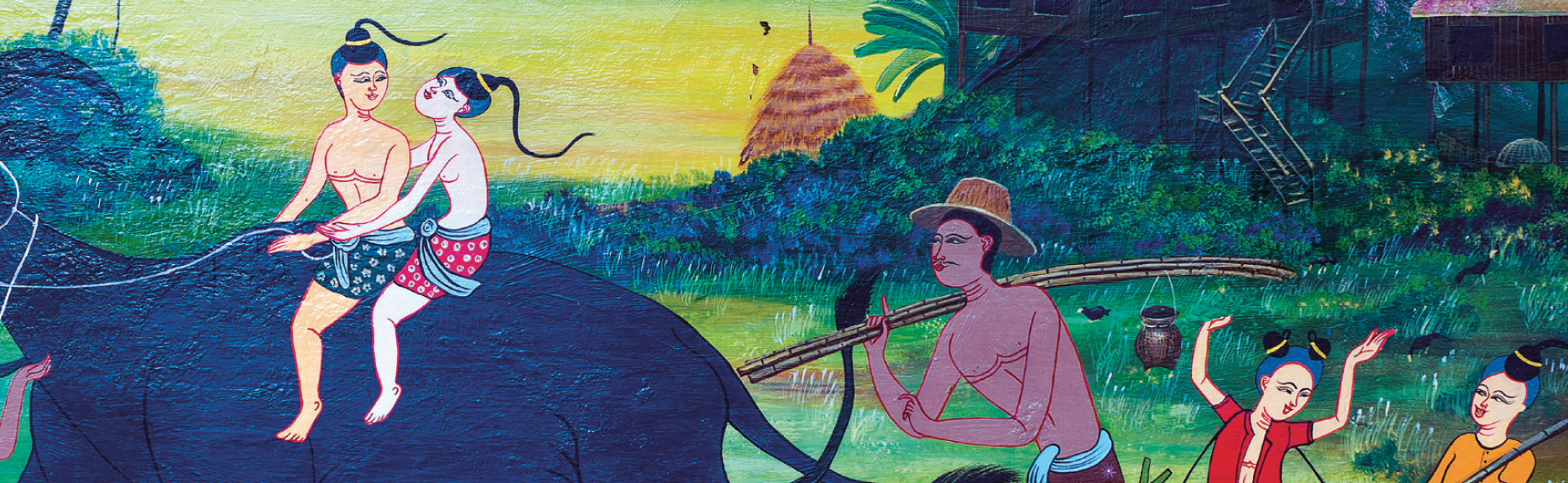
In its early stages, the pandemic revitalised a sense of community spirit and support, with local initiatives to help the more vulnerable springing up, and the celebration of the everyday courage and sacrifice of essential workers. However, as it has progressed, there are signs of a waning of this impulse, with people and nations retreating into a desire for ‘normality’ to be restored. ‘Business as usual’ contends with ‘Build back better’. So now is a good time to re-focus on some of the many groups and initiatives that are actively seeking to regenerate society, so that all groups of people, and all the kingdoms of nature, are in harmonious co-existence.
A central foundation of community is the sense of a collective responsibility to work together. There are many initiatives around the world which aim to foster such a sense, and in this issue we feature a small sampling.
In keeping with the idea, emphasised by many of these groups, that it is important to ground global ideas in local realities, the projects featured include a mix of global alliances, national projects and local initiatives.
All articles are adapted from the websites of the groups featured.
Involve || P2P Foundation || Doughnut Economics Action Lab || Common Earth || Wellbeing Economy Alliance || Ceinture Aliment-Terre Liégeoise || ImaginationLancaster || Ouishare || Empty Shop || Open Source Ecology || Regeneration International || Essential Partners

Involve (www.involve.org.uk) is a UK organisation that wants to build a more vibrant democracy, with people at the heart of decision-making.
Involve believes that we need to make important choices as a society. But politics often doesn’t work as it should. Decision-makers struggle to get things done. People are frustrated the system isn’t working for them. And everyone is left feeling divided, distrustful and powerless.
On the other hand, Involve’s vision is of a vibrant democracy, with people at the heart of decision-making, so that decision-making in the UK is more:
- Open – so that people can understand, influence and hold decision-makers to account for the actions and inactions of their governments;
- Participatory – so that people have the freedom, support and opportunity to shape their communities and influence the decisions that affect their lives; and,
- Deliberative – so that people can exchange and acknowledge different perspectives, understand conflict and find common ground, and build a shared vision for society.
There are a huge number of democratic innovations – from citizens’ assemblies to crowdlaw (“the practice of using technology to tap the intelligence and expertise of the public in order to improve the quality of lawmaking”), citizens’ initiatives to co-production – that put people at the heart of decision-making by modelling these values. Embedding these values at the heart of British democracy would mean that people can shape the decisions that affect their lives.
A democracy with openness, participation and deliberation at its heart would ensure that public services are responsive to people’s needs and make the most of what they can offer. It would ensure that political power is more evenly distributed throughout society, with everyone able to affect change regardless of their circumstances.
Dialogue is essential for bridging divides between communities and building a strong, cohesive and prosperous society. When people come face-to-face and are given the opportunity to work together on a shared task, they build understanding and trust and often find they agree on many more things than they disagree. A democracy with openness, participation and deliberation at its heart would enable us to understand different perspectives, negotiate our differences and build a shared vision for society.
The vision is to create opportunities for people to find common ground with people not like them. §

The P2P Foundation (https://p2pfoundation.net) has since 2005 been researching, cataloging and advocating for the potential of peer-to-peer (P2P) and Commons-based approaches to societal and consciousness change. The P2P Foundation is a non-profit organization and global network dedicated to advocacy and research of commons-oriented P2P dynamics in society.
P2P is an abbreviation of “peer to peer”, sometimes also described as “person to person” or “people to people”. The essence of P2P is this direct relationship, and its core characteristics include:
- Creation of common goods through open, participatory production and governance processes;
- Universal access guaranteed through licenses such as Creative Commons, GPL, Peer Production Licence.
P2P is a process or dynamic that can be found in many communities and movements self-organising around the co-creation of culture and knowledge. Well known general examples include the free/open source software movement; free culture; open hardware; and open access in education and science.
The Commons is a concept and practice that has been steadily gathering increased attention and advocates. Deeply rooted in human history, it’s difficult to settle on a single definition that covers its broad potential for social, economic, cultural and political change. The Commons is now demonstrating its power as a “key ingredient” for change in diverse locations and contexts around the world.
P2P/commons-oriented communities, values and practices are now also increasingly present in the world of physical production through open design, the sharing economy and co-working in hacker/makerspaces and Fab-labs. These movements represent a cultural shift towards new kinds of democratic and economic participation that we believe are sowing the seeds for a more sustainable, egalitarian future.
The P2P Foundation, with its particular focus on the relationship of the Commons and peer-to-peer practices, is supporting this Commons transition by helping to share knowledge and develop tools to create common value and facilitate open, participatory input across society.
The P2P Foundation exists as an ‘organized network’ which can facilitate the creation of networks, yet without directing them. “Our primary aim is to be an incubator and catalyst for the emerging ecosystem, focusing on the ‘missing pieces’, and the interconnectedness that can lead to a wider movement.” §

DEAL, the Doughnut Economics Action Lab (https://doughnuteconomics.org) seeks to turn Doughnut Economics from a radical idea into transformative action.
The Doughnut offers a vision of what it means for humanity to thrive in the 21st century - and Doughnut Economics explores the mindset and ways of thinking needed to get us there.
First published in 2012 in an Oxfam report by Kate Raworth, the Doughnut concept consists of two concentric rings: a social foundation, to ensure that no one is left falling short on life’s essentials, and an ecological ceiling, to ensure that humanity does not collectively overshoot the planetary boundaries that protect Earth’s life-supporting systems. Between these two sets of boundaries lies a doughnut-shaped space that is both ecologically safe and socially just: a space in which humanity can thrive.
The concept has influenced international thought, from the UN General Assembly to the Occupy movement.
Kate’s 2017 book, Doughnut Economics: seven ways to think like a 21st century economist, further explored the economic thinking needed to bring humanity into the Doughnut, drawing together insights from diverse economic perspectives in a way that everyone can understand. The book soon became an international bestseller and has now been translated into over 20 languages.
The Doughnut is a compass for human prosperity in the 21st century, with the aim of meeting the needs of all people within the means of the living planet.
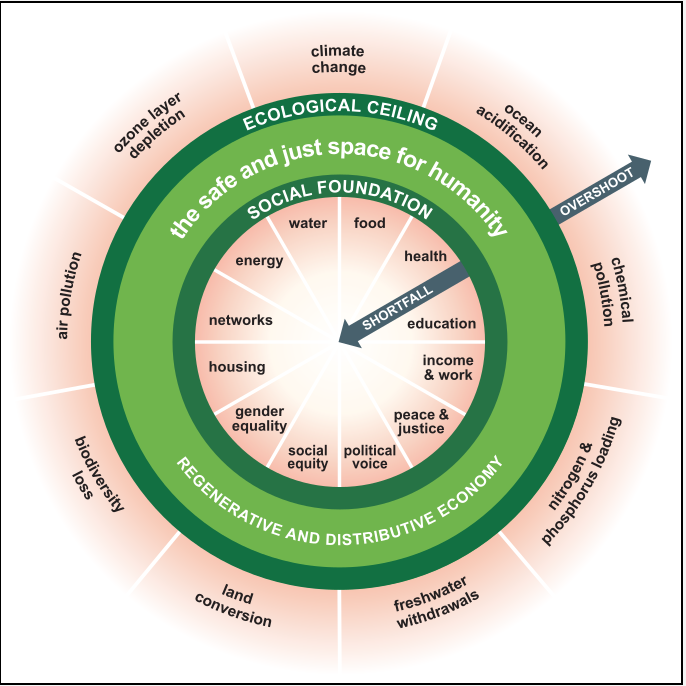
If the 21st century goal is to meet the needs of all people within the means of the living planet - in other words, get into the Doughnut - then how can humanity get there? Not with last century’s economic thinking.
Doughnut Economics proposes an economic mindset that’s fit for the 21st century context and challenges. It’s not a set of policies and institutions, but rather a way of thinking that brings about the regenerative and distributive dynamics that this century calls for. Drawing on insights from diverse schools of economic thought - including ecological, feminist, institutional, behavioural and complexity economics - it sets out seven ways to think like a 21st century economist in order to bring the world’s economies into the safe and just space for humanity.
The starting point of Doughnut Economics is to change the goal from endless GDP growth to thriving in the Doughnut. At the same time, begin economic analysis by seeing the big picture and recognising that the economy is embedded within, and dependent upon, society and the living world. Doughnut Economics recognises that human behaviour can be nurtured to be cooperative and caring, just as it can be competitive and individualistic. It also recognises that economies, societies, and the rest of the living world, are complex, interdependent systems that are best understood through the lens of systems thinking. And it calls for turning today’s degenerative economies into regenerative ones, and divisive economies into far more distributive ones. Lastly, Doughnut Economics recognises that growth is a healthy phase of life but nothing grows forever and things that succeed do so by growing until it is time to grow up and thrive instead.
What would make it possible for an organisation to become regenerative and distributive so that it helps bring humanity into the Doughnut? DEAL has run workshops for businesses, city departments, foundations and other kinds of organisations that want to explore this question, and the implications are transformational. §
Common Earth (https://common.earth) is a charity mandated by the Commonwealth Secretariat to assist communities throughout the Commonwealth approach environmental and social problems from the perspective of regenerative development.
The Commonwealth is a unique international community of nations embracing 1/5th of the world’s land mass, 1/3rd of the human population, and including some of the richest and poorest nations as well as some of the largest and smallest. So, it is highly significant that the Commonwealth took the initiative to convene Common Earth following a Regenerative Development Summit in 2019: an unprecedented meeting between scientists, regenerative and drawdown practitioners, and diverse communities including many youth and indigenous peoples who came to discuss the importance of integrated climate action to restore ecosystems and communities.
The group’s task is to support regenerative development within all 54 countries of the commonwealth, drawing on the wisdom and local knowledge of the people of a particular area to help identify fertile ground for regenerative solutions to social and environmental problems. Regenerative development works from the principle that development initiatives must be interwoven with the people and places, not imposed upon them. Its focus is not growth of financial wealth, but instead growth of understanding in how to work with living, dynamic systems.
True wealth derives from humans in harmony with a healthy biosphere. Common Earth works to improve humanity’s relationship with the planet through collaboration and understanding.
Projects include a Regenerative Learning Laboratory which, in collaboration with the Commonwealth Secretariat’s Innovation Hub works with initiatives in the 54 members states: “Common Earth provides a learning laboratory for these projects: showcasing and analyzing how innovations, technologies, and ancient wisdom can all work together to restore and regenerate ecological and social health.”
Common Earth Alliance is an association of diverse independent working groups tackling topics such as regenerative finance in work on climate change, good governance, national-scale regeneration, and more. “These working groups build connective tissue between areas of practice, theory and science, and policy.” Alliance members sign up to a Charter defining a set of first principles of Regenerative Development, including the affirmation:
“We affirm that what we do is one aspect of regeneration as a constant evolution and transformation of our doing and our being states hence we must also regularly ask ourselves who are we and who do we want to become and what will we serve as these questions will greatly inform the course of our actions and the outcomes…” §
The Wellbeing Economy Alliance (WEAll) (https://weall.org) is a global collaboration of organisations, movements, governments, academics, communities and businesses from around the world working together to transform the economic system to deliver “human and ecological wellbeing”.
All members share in the vision of transforming the purpose of the economic system so that it meets 5 core needs for ecological and human wellbeing: “dignity, connection, nature, fairness and participation.” A wellbeing Economy has been defined as “an economic system that prioritizes wellbeing for all beings – including people, wildlife, and planet – over short-term financial growth.”
The Alliance seeks to provide the “connective tissue between different elements of the movement for a Wellbeing Economy”, bringing together participants who are already working in their own areas. There is a shared recognition that it is vital that “collaboration and togetherness define our destination and also how we get there. The transformation required calls for an entirely different way of being within human society: a shift from ‘us vs them’ to ‘WE All’”.
Targeting collaboration between different members, the Alliance works through five sectors:
- WEALL Citizens is an online collaborative and action-oriented community of individuals and citizens groups sharing experiences in their work to build an economic system that is fair for all.
- WEALL Hubs are local place-based groups (at city, state, regional or country level) that share experiences and are working together to build a global movement for wellbeing economies. Hub groups include California, Canada, Cymru-Wales, Denmark, Aotearoa-New Zealand, Scotland and more.
- WEALL Youth is a “growing global youth network, which aims at inspiring young people to act towards a new economy in which people and planet are at the heart of the system instead of profits.”
- WEGo, the Wellbeing Economy Governments partnership, is a collaboration of national and regional governments promoting “sharing of expertise and transferable policy practices”. The group currently consists of Scotland, New Zealand, Iceland and Wales.
- Business in a Wellbeing Economy is a collaborative network of businesses. Business “is a vehicle for creativity and innovation. And it has the potential to be one of the most effective advocates for change.”
All five sectors are working together through the Alliance on a ten-year project that has the goal of catalyzing system change and creating a critical mass of people and organisations actively creating wellbeing economies. Within a decade the goal is that the project will no longer be needed as multiple countries will be undergoing economic system change on a path towards wellbeing economies. §
The Ceinture Aliment-Terre Liégeoise [CATL] (www.catl.be site in French) is a project to mobilize the living forces of the Liège region in favour of the development of a short, ecological food chain that generates quality jobs. Launched in November 2013 by a coalition of citizen, economic and cultural actors from the Liège region, the CATL laid the foundations for a reflection and an action plan for a significant increase in the local production of food items consumed in the Province of Liège.
In recent years, against the trend of the disappearance of a large number of farms and a loss of regional food sovereignty, many alternative production and marketing initiatives have been launched in the Liège region: production, training, processing and installation support projects have emerged, often favoring the cooperative form, and many consumers have organized themselves to support local agriculture. A number of new projects are in the pipeline, including supplying collective kitchens through shorter food delivery channels. These developments constitute a fundamental movement that it seems desirable to support and structure. These initiatives, in their diversity, together contribute to increasing the market share of local, “good, clean and fair” products.
Since the launch of the Ceinture Aliment-Terre Liégeoise, around fifteen new cooperatives have been created across the entire spectrum of the food sector, with a very significant increase (more than a doubling) of the number of market gardeners in the province of Liège. There has also been an increased commitment of local public authorities to the food transition, notably via the territorial development plan of the 24 municipalities of the Arrondissement of Liège, and the support provided by the 20 French-speaking municipalities of the Arrondissement of Verviers in the development of the Réseau Aliment-Terre Vervietois. §
ImaginationLancaster (http://imagination.lancaster.ac.uk) is an open and exploratory globally recognised design-led research lab at Lancaster University, one of the top 10 universities in the UK.
ImaginationLancaster conducts interdisciplinary design and architecture research into current and future challenges facing cities, communities, factories, workplaces and homes.
With partnerships across multiple sectors and industries, a critical mass of diverse, internationally acclaimed researchers work together in an open, ‘anti-disciplinary’ culture, delivering new knowledge and concepts for places, products, services and policy. This approach facilitates innovation and provides fresh perspectives on real world issues.
Work is conducted at local, regional, national and international scales to deliver new solutions to complex global challenges, contributing to a healthier, more prosperous and sustainable world. And Undergraduate, Masters, and PhD study opportunities are also available.
Current projects include investigating how micro-gardening can activate social wellbeing; inquiring into the main challenges young Londoners face, what their own long-term visions are, and how this can be mapped onto the concept of ‘sustainability’; and researching levels of social interaction in coliving spaces. §

Ouishare (www.ouishare.net) started in France in 2012 around a utopian vision: the idea of a ‘Collaborative Society’, made up of communities of peers that work and live together.
Ouishare is an international network of researchers, activists, innoivators and decision-makers. The network is defined by its commitment to five values: collaboration, openness, care, “do-cracy” and “permanent beta”. Network participants come from Europe, Latin and North America, and the Middle-East. Over the last 8 years, Ouishare:
- built an international network of committed members;
- discussed and revealed divergent opinions about the collaborative economy and its potential to transform society
- gathered researchers, activists, innovators and decision-makers from around the world at one-of-a-kind events such as Ouishare Fest in Europe and Colaboramerica in South America;
- explored social challenges beyond myths and clichés by doing research on the ground, about the impact of the collaborative economy in rural areas, and how people living in underprivileged areas use digital technology, and;
- ran speculative design processes with citizens to explore scenarios for the future of the work world.
Ouishare questions the status quo, instigates encounters between actors from different corners of society and is a leader in creating forms of collaboration. The work is defined by long term thinking, listening, and dialogue, and functions at the intersections to create bridges between knowledge, skills and experiences, to shift societal power dynamics. §
Empty Shop CIC (https://emptyshop.org) is a non profit arts organisation and practice-based consultancy in the North East of England.
Founded in 2008, Empty Shop has produced projects in over 50 different spaces in its first decade, “providing much needed accesible platforms.”
Working as consultants or producers – and often bringing both together – the group helps “build scenes & communities, create bespoke pop-up events, cultural programmes and sector development schemes to deliver strategic impacts.”
“While taking up work with a range of clients, commissioners and partners we still maintain our commitment to grassroots cultural development, serving the communities who have supported us from day one.”
Collaboration is at the core of all of Empty Shop’s work in the community, which has led to cooperation with an amazing range of individuals, groups and organisations. §
Open Source Ecology (www.opensourceecology.org) is developing open source industrial machines such as tractors, bread ovens, wind turbines, welders and trucks, that can be made for a fraction of commercial costs, and are sharing the designs online for free. Open source promotes universal access via an open-source or free license to a product’s design or blueprint, and universal redistribution of that design or blueprint. Thus, it is the belief of Open Source Ecology (OSE) that an open source economy will be an efficient economy which increases innovation by open collaboration, and it is their goal to contribute to its creation.
To move towards an open source economy, OSE is currently developing a set of open source blueprints for the Global Village Construction Set (GVCS) – a set of the 50 most important machines that it takes for modern life to exist. In the process of creating the GVCS, OSE intends to develop a modular, scalable platform for documenting and developing open source, libre hardware – including blueprints for both physical artifacts and for related open enterprises.
The current practical implementation of the GVCS is a life size LEGO set of powerful, self-replicating production tools for distributed production. The Set includes fabrication and automated machines that make other machines. Through the GVCS, OSE intends to build not individual machines – but machine construction systems that can be used to build any machine whatsoever. Because new machines can be built from existing machines, the GVCS is intended to be a kernel for building the infrastructures of modern civilization.
“We – the countless collaborators upon whose shoulders this Vision stands – imagine a world of innovation accelerated by open, collaborative development – to solve wicked problems – before they are created. We see a world of prosperity that doesn’t leave anyone behind. We see a world of interdisciplinary, synergistic systems thinking – not the isolated silos of today’s world.” §
Regeneration International (https://regenerationinternational.org) is promoting, facilitating and accelerating the global transition to regenerative food, farming and land management for the purpose of restoring climate stability, ending world hunger and rebuilding deteriorated social, ecological and economic systems.
The vision is of a healthy global ecosystem in which practitioners of regenerative agriculture and land use, in concert with consumers, educators, business leaders and policymakers, cool the planet, feed the world and restore public health, prosperity and peace on a global scale.
Regeneration International works with multiple stakeholders in key regions of the world who are committed to building alternative food and farming systems on a regional or national level. A number of Regeneration Alliances are being built, including those in South Africa, India, Mexico, Guatemala, Belize, Canada, and in the Midwest region of the USA.
Regeneration International engages in activities, either directly or by providing support to partners and stakeholders, that have the potential to advance the mission. Activities are organised to cover three major program areas: education, network-building and policy work:
Education: “We educate consumers, farmers, policymakers, media and the general public on the benefits of regenerative agriculture and land management.”
Network-Building: “We invite groups to join our Partner Network and we assist groups or individuals at the local, regional or national level who are committed to building Regeneration Alliances.”
Policy Work: “We identify, promote and galvanize support for local, regional, national and international policy initiatives that have the potential to advance the transition to regenerative food, farming and land management.” §
“In this world of polarizing conflicts, we have glimpsed a new possibility: a way in which people can disagree frankly and passionately, become clearer in heart and mind about their activism, and, at the same time, contribute to a more civil and compassionate society.”
Pro-Choice and Pro-Life leaders from Boston, MA, USA
Essential Partners (https://whatisessential.org). In 1989, family therapist Laura Chasin was concerned about the increasingly polarized and uncivil nature of public discourses in the US. She brought together a group of colleagues to explore the dynamics of polarization and to consider ways in which people could speak to each other truthfully and compassionately about issues where they held strong views. Out of this a Public Conversations Project was launched with a series of experimental dialogues on the issue of abortion. Reflective Structured Dialogue, a new approach to conversations on divisive issues, was developed. It contained elements of family therapy, neuroscience, mediation and careful research into ‘what works’.
Over the years, conversations were organized in a variety of fields, “from a regional environmental preservation conflict to a United Nations conference on women’s health”. After three generations of practitioners, the group became known as Essential Partners, offering its services as partners to “civic groups, faith communities, colleges, and organizations” across the globe, “equipping them to hold constructive conversations about the values, views and identities that are most essential to them”.
Essential Partners is inspired by the vision of building “a world of thriving communities strengthened by difference, connected by trust”.
“Our evolving approach is driven by ongoing research into interventions that effectively address the underlying forces of polarization and social divisiveness. In recent years we have embarked on multi-year research into the application of Reflective Structured Dialogue in higher education, social media platforms, and secondary school contexts.” §
The New Group of World Servers
The text of this booklet contains quotations (with slight adaptations in some cases) from books by Alice A. Bailey. Countless students around the world have been studying and meditating upon Alice Bailey’s writings on the New Group of World Servers since that time
The description of the New Group of World Servers as a subjective group in humanity with specific tasks and challenges seems more relevant today even than it was at the time these books were written in the 1930s and 40s. All around us in our increasingly interdependent world, we see evidence of the Group’s pioneering efforts to transform human relationships in every sphere of life. The challenge facing intelligent, thoughtful people of goodwill today is how to enhance their own participation in the life of the Group and how to most usefully support the members of the Group. Ideas presented here invite us to deepen our understanding of the New Group of World Servers through study of the great forerunners of modern esoteric thought, alongside the writings of the inspired servers of our time. When this study is combined with meditation and intuitive reflection, the livingness of the group is touched. Meditation that is aligned with this subjective group who form the mediating bridge between the outer and inner worlds becomes a highly creative and useful field of service.
The booklet can be downloaded as a PDF from worldgoodwill.org/newgroup, or a printed copy can be ordered from this page.
Image Credits:
Banner photo copyright Artpienpiset/Shutterstock; all other images are from the respective organisations mentioned.
