
Judith Hegedus addressed the World Goodwill Seminar, The Ethical Responsibility of the Sustainable Development Goals, at UN Headquarters in Geneva, October 28, 2016. Judith Hegedus is Executive Director of the College Board International Office. College Board is a mission-driven not-for-profit organization that connects students around the world to college success and opportunity.
Any process to implement an idea is a complex one. How do we get from thought to action? There isn’t actually that much time left before 2030. How do we ensure effective implementation of the 2030 Agenda or the Sustainable Development Goals? It is commendable that these Goals have been formulated, and this is an example of the recognition of our global interconnectedness as one humanity. It is not an easy task to implement something like this, but we can do it by creating a vertical alignment between the thoughts, the words, and the actions of individuals as well as governments. We also need a horizontal and focused alignment between individual citizens’ efforts, national governments, and the United Nations. This is a task for every member of the human family, and for all responsible national governments. The United Nations is uniquely qualified as the organization leading the way for the SDG implementation and inspiring humanity. We have the thoughts and the words already in the form of the published 2030 Agenda – we just need to make sure that the proper actions follow, aligned with the thoughts and words. What roles do individual citizens, governments and the UN itself have in an effective implementation?
The United Nations: Reflecting the World, Reflecting Ourselves
Crisis of Growth, Crisis of Consciousness
Patrice Brasseur addressed the World Goodwill Seminar, The Ethical Responsibility of the Sustainable Development Goals, at UN Headquarters in Geneva, October 28, 2016. Patrice Brasseur is founder of Psychopsophie, a movement which is at the cross roads of philosophy, spirituality and psychology. This text is a translation of the original French.
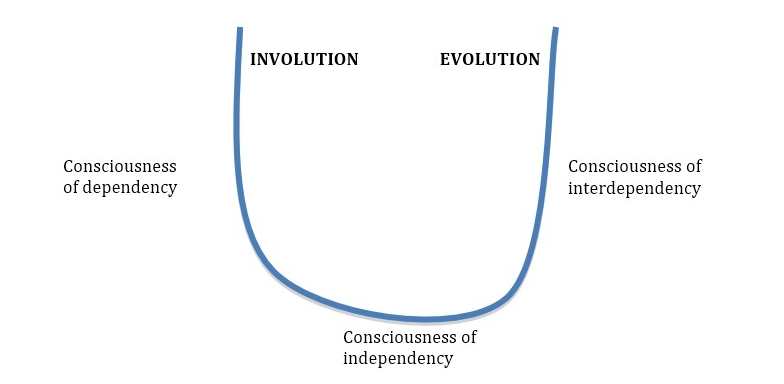
The involution and evolution of consciousness can be traced in a 'U shaped' curve. The first, descending limb of the curve, represents involution. While gradually losing the consciousness of instinctive interdependency [mass-type of unitary consciousness], humanity builds itself successive bodies. Towards the bottom of the curve --the remotest point from the collective-- individualism is powerful. Thereafter on the ascending evolutionary limb global awareness is growing.
Today an ever growing fraction of our society is coming into the state of awareness of inter-independence. Every day we behold the growing prevalence of this state of consciousness manifesting in the international, social, and ecological spheres. Every day we can observe in books or movies the first signs of a new world consciousness.
On the other hand, an overdose of egoism, with its dogmas about consumption and promotion of a non-egalitarian culture, is also manifesting everywhere. This explains how for half a century a double development has been taking place. While more and more persons are reaching the bottom of the curve, and developing individual consciousness - with all the implied consequences about consumption - another parallel portion of society is breaking out of such a state of consciousness and moving into a growing awareness of interdependence.
περισσότερα...
Dag Hammarskjöld– Ethics in International Cooperation
Marco Toscano-Rivalta addressed the World Goodwill Seminar at UN Headquarters in Geneva, October 28, 2016. A UN staff member, he was speaking in his personal capacity and not as a representative of the organization.
The United Nations was conceived to be an agent of change, endowed with the necessary agency. Not the cause of the change, which indeed rests with the growing consciousness of humanity. Rather the United Nations is “a focal point for efforts so to guide the difficult and delicate development that this progress may be achieved in peace and become a means to reinforce peace”.
Being an agent of change implies to be a model of change, and this needs to be reflected in an ongoing adjustment of how the Organization is used, including its working methods. This is a fundamental point, which far from being purely academic, has very practical implications.
Hammarskjöld invested a lot of time in articulating, explaining, and practicing the potential of the precepts contained in the UN Charter on the role of the United Nations and the Secretariat, and how the existing rules offered a strong basis and could be interpreted to address the ever emerging new issues and serve the peoples’ needs.
A legitimate question is whether he and his colleagues at that time unveiled everything under the Charter or there is something else to pursue. Even today, Hammarskjöld is of help.
περισσότερα...Καλή Θέληση, Ηθική Υπευθυνότητα & Στόχοι Βιώσιμης Ανάπτυξης: Η Πρόκληση του Αιώνα μας
Ο Διευθυντής του Λούσις Τραστ και της παγκόσμιας Καλής Θέλησης στην Γενεύη, Mintze van der Velde, ανοίγει το Σεμινάριο Παγκόσμιας Καλής Θέλησης στην Έδρα των ΗΕ στη Γενεύη, στις 28 Οκτωβρίου 2016
Η καλή θέληση είναι μια από τις βασικές πνευματικές ποιότητες του ανθρώπου και το μεγάλο αψηλάφητο απόθεμα στην καρδιά κάθε ανθρώπινης κοινότητας. Αυτή η ενέργεια είναι δυνητικά μια πανίσχυρη δύναμη για κοινωνική αλλαγή, που όμως παραμένει σε μεγάλο βαθμό μη αναγνωρίσιμη και αναξιοποίητη. Η Παγκόσμια Καλή Θέληση προωθεί την κατανόηση αυτής της ενέργειας και του ρόλου που μπορεί να διαδραματίσει στην εξέλιξη μιας νέας ανθρωπότητας.
Η συνετή και οργανωμένη δράση των δικτύων καλής θέλησης είναι εκείνη που επιφέρει ανταπόκριση σε όλα τα προβλήματα της εποχής μας: από την φτώχια, τις δηλητηριασμένες φυλετικές σχέσεις, τη μετανάστευση και το προσφυγικό, αλλά και την περιβαλλοντική καταστροφή, μέχρι την συναισθηματική πνευματικότητα, την απόγνωση για το μέλλον, την απελπισία που συνοδεύει σκέψεις για το μέλλον, και όλες τις κρίσεις του υλισμού και της ιδιοτέλειας. Άνθρωποι καλής θέλησης, από κάθε πολιτιστική παράδοση, πίστη και επάγγελμα, δημιουργούν μέσα από τα λόγια και τις πράξεις τους έναν νέο κόσμο, όπου ο μερισμός, η συνεργασία και οι ορθές σχέσεις ριζώνουν και απλώνονται. Ποτέ πριν στην ιστορία του πλανήτη μας δεν ήταν τόσο ενεργή η καλή θέληση.
Για να ξημερώσει αυτή η νέα μέρα και να έρθει η ανθρώπινη ευημερία, η οποία είναι κληρονομικό μας δικαίωμα, χρειάζεται μια βαθύτερη αίσθηση της πραγματικότητας βασισμένη σε πνευματικές αξίες, αλλά και μια νέα αντίληψη για την ανθρωπότητα ως μονάδα θείας ζωής μέσα σε ένα σύμπαν που διέπεται από τάξη και σκοπό. Είναι δύσκολο για τον σύγχρονο άνθρωπο να συλλάβει μια εποχή όπου δεν θα υπάρχει φυλετική, εθνική ή χωριστική θρησκευτική συνείδηση στην ανθρώπινη σκέψη. Όπως ήταν εξίσου δύσκολο για τον προϊστορικό άνθρωπο να συλλάβει μια εποχή όπου θα υπήρχε εθνική επίγνωση, κι αυτό καλό είναι να το έχουμε στο νου μας. Η εποχή όπου η ανθρωπότητα θα είναι ικανή να σκέπτεται με συμπαντικούς όρους βρίσκεται ακόμη μακριά στο μέλλον, αλλά το γεγονός ότι μπορούμε να αναφερόμαστε σε αυτήν, να την επιθυμούμε και να την σχεδιάζουμε, αποτελεί ασφαλώς την εγγύηση ότι δεν είναι κάτι ανέφικτο. Η ανθρωπότητα προόδευε πάντα από τη μια βαθμίδα φώτισης στην επόμενη και από δόξα σε δόξα. Σήμερα βρισκόμαστε καθοδόν προς έναν πολιτισμό πολύ καλύτερο απ’ όσους γνώρισε ποτέ ο κόσμος και προς εκείνες τις συνθήκες που θα εξασφαλίσουν μια πολύ πιο ευτυχισμένη ανθρωπότητα και οι οποίες θα δουν το τέλος των εθνικών διαφορών, ταξικών διακρίσεων (είτε αυτές βασίζονται στο κληρονομικό είτε στο οικονομικό στάτους) και θα διασφαλίσουν μια πληρέστερη και πλουσιότερη ζωή για όλους.
περισσότερα...Εν Μέσω Χάους, Σπέρματα Ελπίδας: Τα Η.Ε., οι Στόχοι Βιώσιμης Ανάπτυξης και η Παγκόσμια Καλή Θέληση
Huffington Post Blogger,Alex Ratcliffe, reviews World Goodwill's Seminar at the United Nations in Geneva.
Λίγες μέρες πριν τις εκλογές (στις ΗΠΑ), στις 28 Οκτωβρίου 2016, παρακολούθησα ένα σεμινάριο μέσα στο υγιές περιβάλλον του Palais des Nations (Η.Ε.), στη Γενεύη, «την πρωτεύουσα της ειρήνης και της ελευθερίας».Το θέμα του σεμιναρίου, το οποίο προσέλκυσε 150 άτομα από ένα ευρύ φάσμα, σε ό,τι αφορά το υπόβαθρο, τα επαγγέλματα και τις εθνικότητες, ήταν: «Παγκόσμια Καλή Θέληση, Ηθική Ευθύνη και οι Στόχοι για την Βιώσιμη Ανάπτυξη (ΣΒΑ) των Ηνωμένων Εθνών»
Ο βασικός τόνος του σεμιναρίου της Γενεύης, ήταν για την δυνατότητα που έχουμε να κάνουμε βιώσιμη την ανάπτυξη, αλλά αυτό προϋποθέτει παγκόσμια συνεργασία και παγκόσμια ανάληψη ευθύνης, καθώς και συνεργασία μεταξύ κυβερνήσεων και ιδιωτικού τομέα. Προϋποθέτει, ακόμα, η κοινωνία των πολιτών, εξίσου και οι πολίτες, να αναγνωρίσουν το επείγον και να καταστρώσουν σχέδια έχοντας κατά νου τις μελλοντικές γενιές. Υπογραμμίστηκε, ωστόσο, ότι για αυτήν την ενέργεια προϋπόθεση είναι η κοινωνική και πολιτική θέληση, πίσω από την οποία βρίσκεται, και πρέπει να βρίσκεται, η πρόθεση για το ευρύτερο καλό σε αντιδιαστολή με προσωπικές επιδιώξεις...
περισσότερα...